 Optical Wonderful
Bridget Riley
The British painter whose precisely engineered black-and-white and color compositions helped define Op Art in the 1960s, using repeating geometric pattern alone to produce sensations of vibration, flicker, and movement on a static canvas.
Bridget Riley (born 1931) is a British painter closely associated with - and, by most historical accounts, one of the founders of - the Op Art movement that emerged in the early 1960s. She studied at Goldsmiths College and the Royal College of Art in London, and her mature style, which she arrived at by the early 1960s, abandoned representational subject matter almost entirely in favor of precise, repeating geometric structures: lines, curves, and later grids of dots and color, arranged so that the static pattern itself seems to shimmer, ripple, or advance and recede as the viewer looks at it.
Black, white, and motion without movement
Riley's early breakthrough works, such as Movement in Squares (1961) and Fall (1963), are executed purely in black and white, using rows of shapes whose width, spacing, or curvature changes gradually across the canvas. There is no actual motion, animation, or three-dimensional depth in these paintings - only flat paint on a flat surface - yet viewers reliably report a strong sensation of flickering, pulsing, or wave-like movement, particularly in peripheral vision or when the eyes scan across the pattern. This places her work in direct conversation with the same category of effect studied under names like peripheral drift and simultaneous contrast: the visual system, faced with dense, regularly repeating high-contrast pattern, generates a motion or vibration signal that has no corresponding change in the physical stimulus.
Riley's 1965 inclusion in the influential The Responsive Eye exhibition at New York's Museum of Modern Art helped cement Op Art as an international movement and brought her work to broad public attention - attention that came with complications, as her striking black-and-white patterns were quickly appropriated by the fashion and design industries of the period, often without credit or compensation, a source of considerable frustration to her at the time. From the mid-1960s onward she introduced color into her work, developing compositions of stripes and later curved bands whose interacting hues produce their own perceptual effects - colors that appear to shift or interact with their neighbors, related to the same simultaneous-contrast principles that make identical colors look different depending on what surrounds them.
Craft over accident
A defining feature of Riley's practice, distinguishing her from artists who arrive at illusion-like effects incidentally, is the sheer deliberateness of the engineering involved. Her compositions are developed through extensive preparatory studies - testing exact spacing, curvature, and tonal relationships - before being executed, often with studio assistants, at a scale and precision that makes the perceptual effect as strong and consistent as possible. Riley has spoken about her interest in perception itself as a subject, rather than treating the visual disturbance as a side effect of abstract pattern-making; the optical instability is the content of the work, not an incidental byproduct of it.
Why it matters to illusion research
Riley's paintings sit at an interesting intersection between fine art and vision science: they were made without reference to formal psychological research on grid, contrast, or pattern-induced illusions, yet they exploit exactly the same underlying sensitivities - to spatial frequency, edge contrast, and repeating structure - that later researchers formalized in illusions such as the Hermann grid and café wall effects. Her body of work is frequently cited as evidence that an artist working purely by eye and intuition can independently discover, and put to expressive use, perceptual phenomena that psychologists were studying in parallel, and it remains one of the clearest demonstrations that "illusion" and "fine art" are not separate categories but frequently the same phenomenon viewed through different disciplinary lenses.
Illusions connected to Bridget Riley
Café Wall Illusion
Perfectly straight, perfectly parallel rows of offset light and dark tiles appear to tilt and taper, purely because of a mid-gray mortar line running between them.
Color & ContrastHermann Grid Illusion
A plain grid of black squares on a white background produces faint gray smudges at every intersection - visible only when you're not looking directly at them.
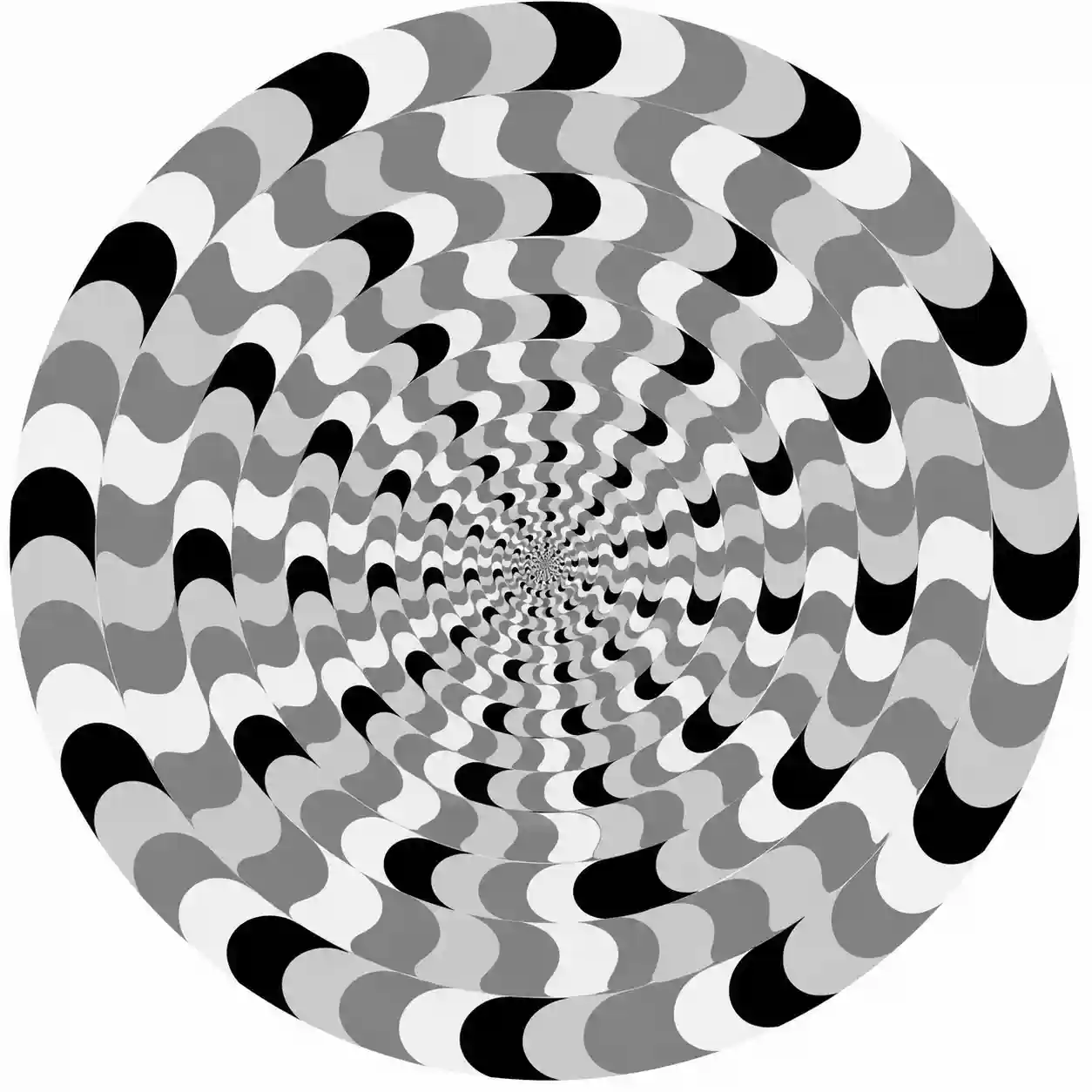 Motion
Peripheral Drift Illusion
A broad category of static repeating patterns that appear to drift or shimmer whenever they sit outside the direct focus of your gaze, thanks to asymmetric brightness gradients.