 Optical Wonderful
Peripheral Drift Illusion
A broad category of static repeating patterns that appear to drift or shimmer whenever they sit outside the direct focus of your gaze, thanks to asymmetric brightness gradients.
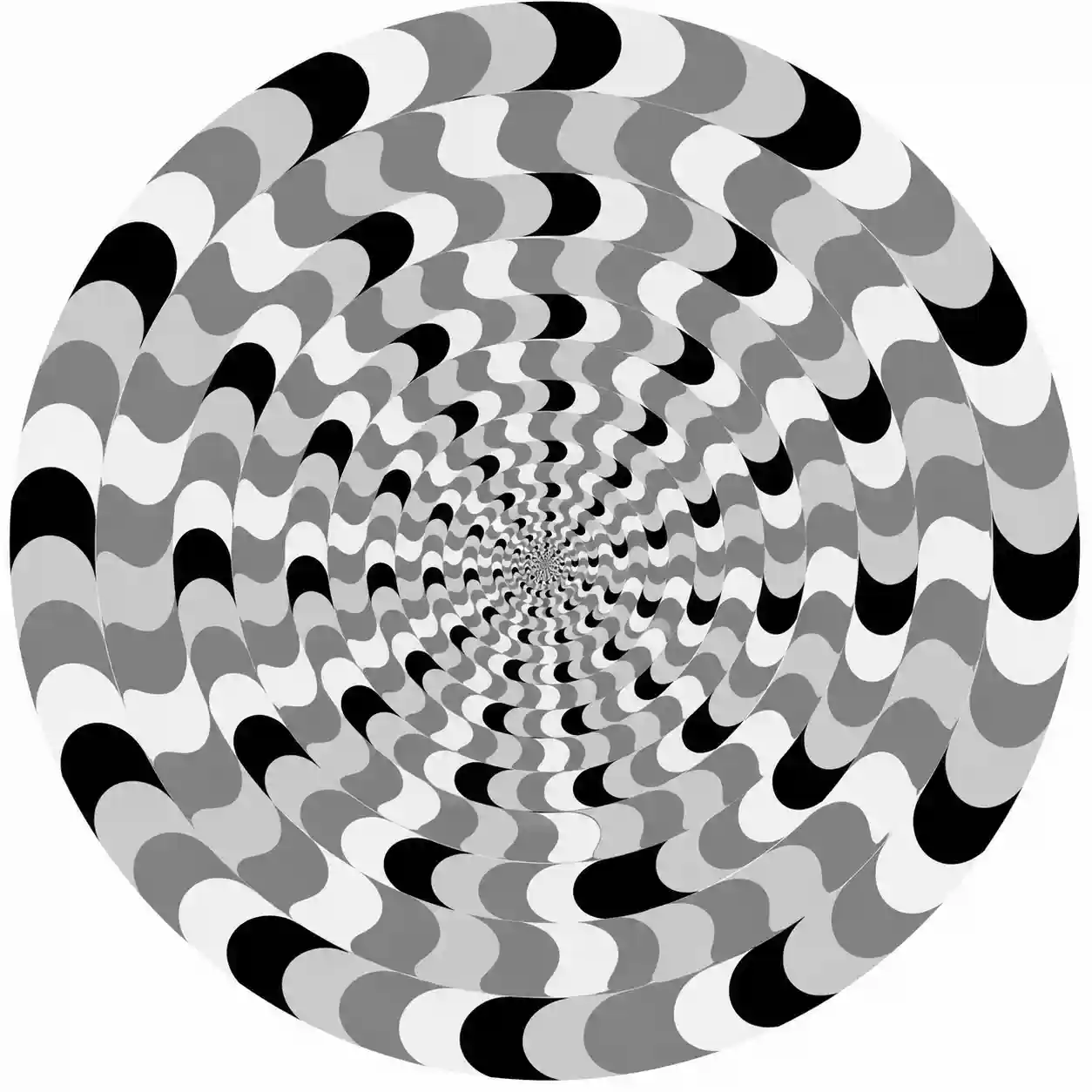
What you're seeing
Peripheral drift illusion is the general name for a whole category of static images - tiled patterns, repeating bands, grids of small shapes - that appear to shimmer, ripple, or drift, but only when they occupy your side vision rather than the exact spot you're looking at. Look directly at any one part of the pattern and it settles down; let your eyes wander, glance around the page, or simply hold the pattern off to the side, and it starts creeping again. The rotating snakes illusion is the single most famous member of this category, but the underlying effect shows up in dozens of simpler patterns: rows of asymmetric teardrop shapes, sawtooth-striped bands, and repeating gradient tiles all produce some version of the same drift.
The building block: an asymmetric brightness ramp
Every peripheral drift pattern is built from a repeating unit that cycles through brightness levels unevenly across its width - for instance a sharp, sudden jump from black to white on one edge, followed by a slow, gradual fade back down to black across the rest of the shape. That asymmetry is the entire trick. A symmetric brightness cycle (evenly spaced light and dark bands, say) produces no illusory motion at all, no matter how it's arranged. It's specifically the lopsided ramp - fast rise, slow fall, or vice versa - that generates a directional signal your visual system mistakes for real movement.
Why your peripheral vision is the trigger, not your central vision
The effect depends on where the pattern falls on your retina because different regions of your visual field are wired very differently. Your fovea, the small central patch responsible for sharp detail, is dominated by slower-responding visual pathways well suited to resolving fine static structure. Areas outside the fovea rely more heavily on faster, more motion-sensitive pathways - useful for catching movement at the edge of your vision so you can turn and look at it, but also exactly the machinery that misreads an asymmetric brightness ramp as genuine directional motion. Tiny involuntary eye movements called microsaccades, which happen many times per second even during "steady" fixation, repeatedly refresh this false signal across the parts of the pattern you aren't directly looking at, which is why patterns kept in your peripheral view never fully settle the way a directly fixated one does.
Related but distinct research threads
Kitaoka's rotating snakes made the peripheral drift illusion famous, but the underlying phenomenon of illusory motion from static asymmetric gratings had been explored from related angles by other vision researchers around the same period, including work by Jocelyn Faubert and Andrew Herbert on similar drifting-grating effects in the late 1990s. The field converged on a shared explanation centered on differential neural response timing to brightness rather than any single, uncontested account, and Kitaoka's name remains most closely tied to the effect mainly because his rotating-snakes composition is the version nearly everyone has actually seen.
Design factors that strengthen or weaken it
Not every asymmetric-gradient pattern produces an equally strong illusion. Contrast matters a great deal - patterns using true black and white with mid-tone grays in between tend to drift more convincingly than low-contrast or muted-color versions. Repetition count matters too: a pattern with many small repeating units tends to look more fluid than one with just a few large ones, because the eye's constant micro-jitter has more repeating edges to trigger false signals from. Color choice also plays a role; the classic blue-and-yellow-and-black-and-white rotating snakes palette isn't accidental, since high luminance contrast between adjacent segments amplifies the timing mismatch that drives the whole effect.
A little history
The academic groundwork for peripheral drift effects developed through the 1990s, but the illusion reached mainstream fame specifically through Akiyoshi Kitaoka's work at Ritsumeikan University in the early 2000s. Kitaoka has produced an extensive catalog of peripheral drift variations beyond the rotating snakes, several with genuinely different visual textures, all sharing the identical asymmetric-ramp mechanism underneath.
Related reading
See the rotating snakes illusion for the most famous single example of a peripheral drift pattern, and the motion aftereffect for a related but mechanistically distinct case where genuine prior motion - not a static gradient trick - is what fools the visual system afterward.
Read the science behind why this happens →
Related illusions
 Motion
Rotating Snakes Illusion
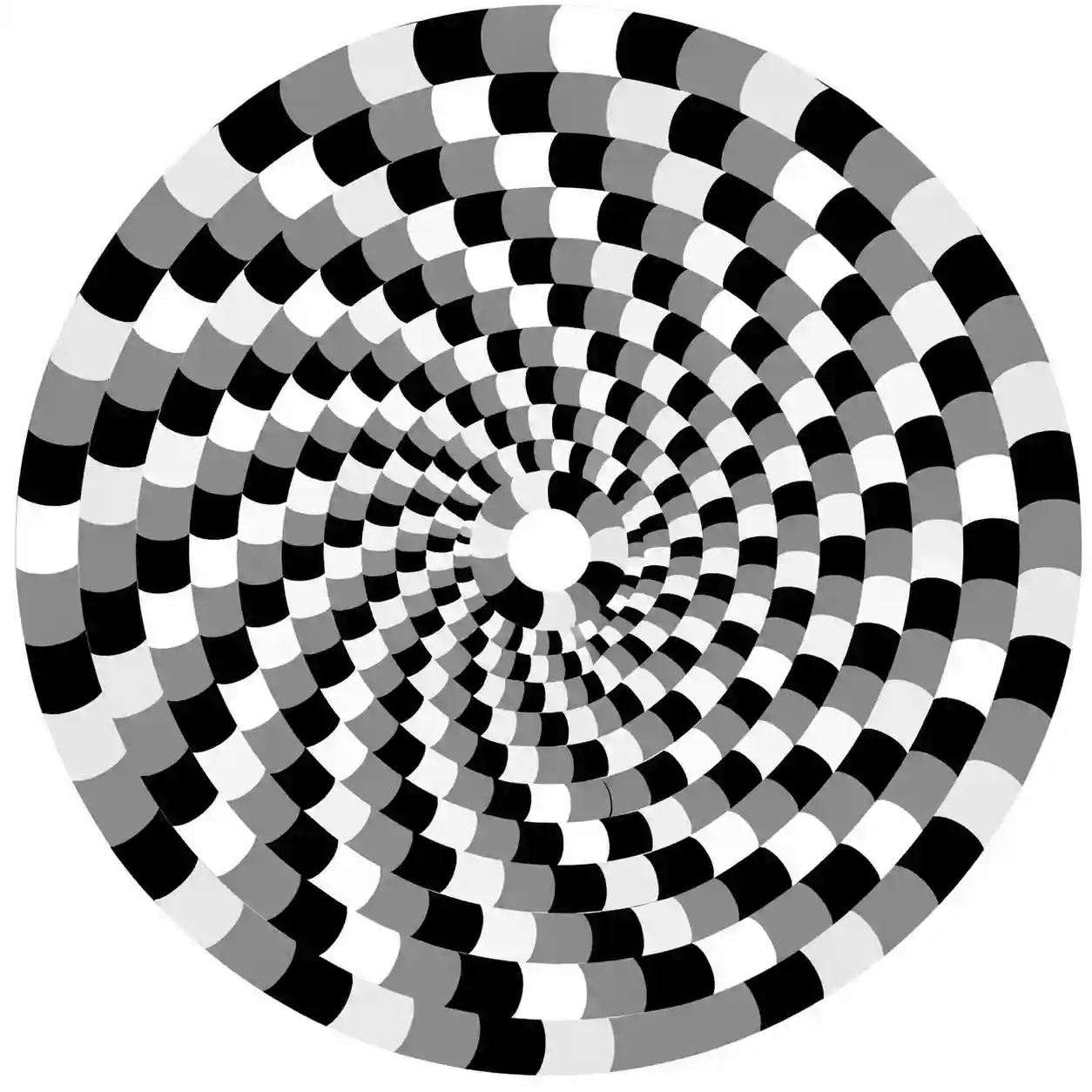
A completely still image built from repeating rings of asymmetric color gradients that appears to writhe and rotate on its own - one of the strongest static-image motion illusions known.
 Motion
Motion Aftereffect (Waterfall Illusion)
Stare at flowing water or a spinning pattern for half a minute, then look at something still - and the stationary scene will appear to drift in the opposite direction for a few seconds.
MotionBarber Pole Illusion
The diagonal stripes on a barber's pole appear to travel upward forever, even though they're only ever rotating sideways around a cylinder - a classic case of the visual system solving an ambiguous motion problem badly.