 Optical Wonderful
Oscar Reutersvärd
The Swedish artist who drew the first known version of the impossible triangle in 1934, decades before it was independently rediscovered and formalized by the Penroses.
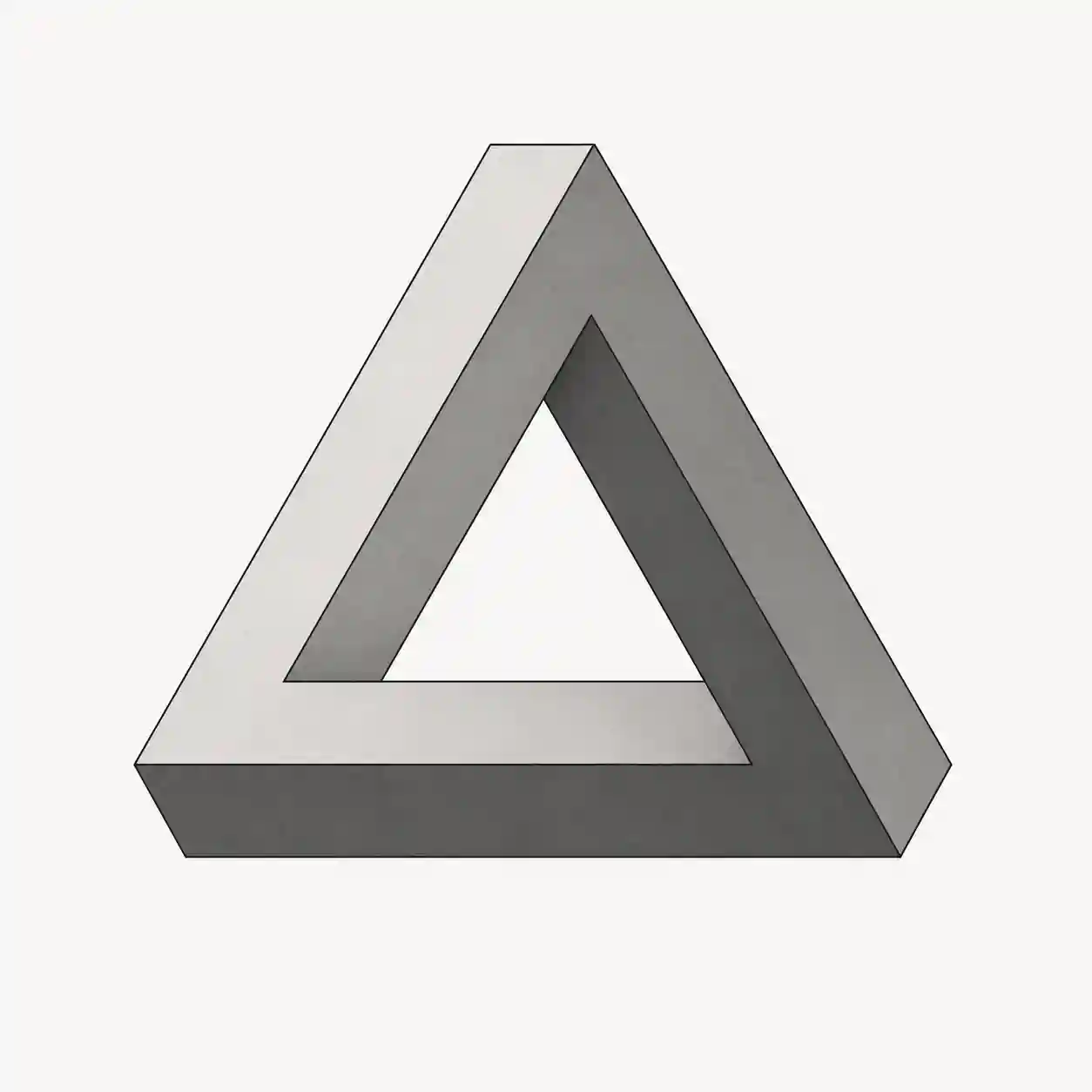
Oscar Reutersvärd (1915–2002) is one of those figures in the history of visual illusion whose priority is well documented but whose fame never quite caught up to it. A Swedish artist who spent most of his career as an art historian and professor rather than a working illustrator, Reutersvärd is widely credited with producing the earliest known drawing of what is now called the impossible triangle - the three-beam figure where each corner is a locally valid right angle, yet the whole shape can never close up in three-dimensional space.
The 1934 drawing
According to Reutersvärd's own account, and as accepted by most historians of the subject, he sketched the figure in 1934 while a student, arranging a set of cubes into a triangular ring purely as a compositional exercise, without initially realizing he had stumbled onto a genuine geometric paradox. He continued to explore the idea across his career, eventually producing hundreds of variations on impossible figures built from cubes, rings, and staircases, often rendered in a distinctive isometric style using flat, evenly shaded blocks with no vanishing-point perspective - a technique that makes the impossibility read more like a puzzle in graphic design than an optical trick.
This predates the far more famous version of the same figure - the "Penrose triangle," published by psychiatrist Lionel Penrose and his son, mathematician Roger Penrose, in a 1958 paper in the British Journal of Psychology - by roughly two decades. The Penroses appear to have arrived at the figure independently, unaware of Reutersvärd's earlier work, which had been published mostly in Swedish contexts and had not circulated widely internationally. This kind of parallel, independent discovery is not unusual in the history of visual science, but it does mean credit for the "impossible triangle" concept is genuinely split: Reutersvärd for priority of the drawing itself, and the Penroses for the mathematical formalization and the analysis that connected it to broader questions about depth perception, which is what brought the figure into psychological literature and gave it its lasting name.
Recognition and legacy
Reutersvärd's contribution went largely uncredited outside specialist circles for much of the twentieth century. That changed somewhat in his home country: in 1982, Sweden issued a set of postage stamps featuring his impossible figures, and by the end of his life he was recognized in Sweden as a pioneering figure in the study of impossible objects, sometimes described there as the "father of the impossible figure." Internationally, his name still tends to appear as a footnote in discussions dominated by the Penrose name and by M.C. Escher's far more visually elaborate prints, even though Escher's own famous impossible-triangle-based work, Waterfall, was built on the Penroses' 1958 paper rather than on Reutersvärd's earlier drawings.
Why it matters to illusion research
Reutersvärd's work matters less for any single influential publication and more as a case study in how a purely geometric curiosity - a shape that is locally consistent but globally impossible - can be discovered independently by an artist working from compositional intuition, decades before psychologists formalize the same idea as a tool for studying how the visual system reconciles local depth cues into a global three-dimensional interpretation. His body of work also demonstrates that impossible figures are not a single fixed image but a whole family of related constructions - rings of cubes, staircases, forks, and lattices - many of which he was the first to render on paper.