 Optical Wonderful
Penrose Triangle
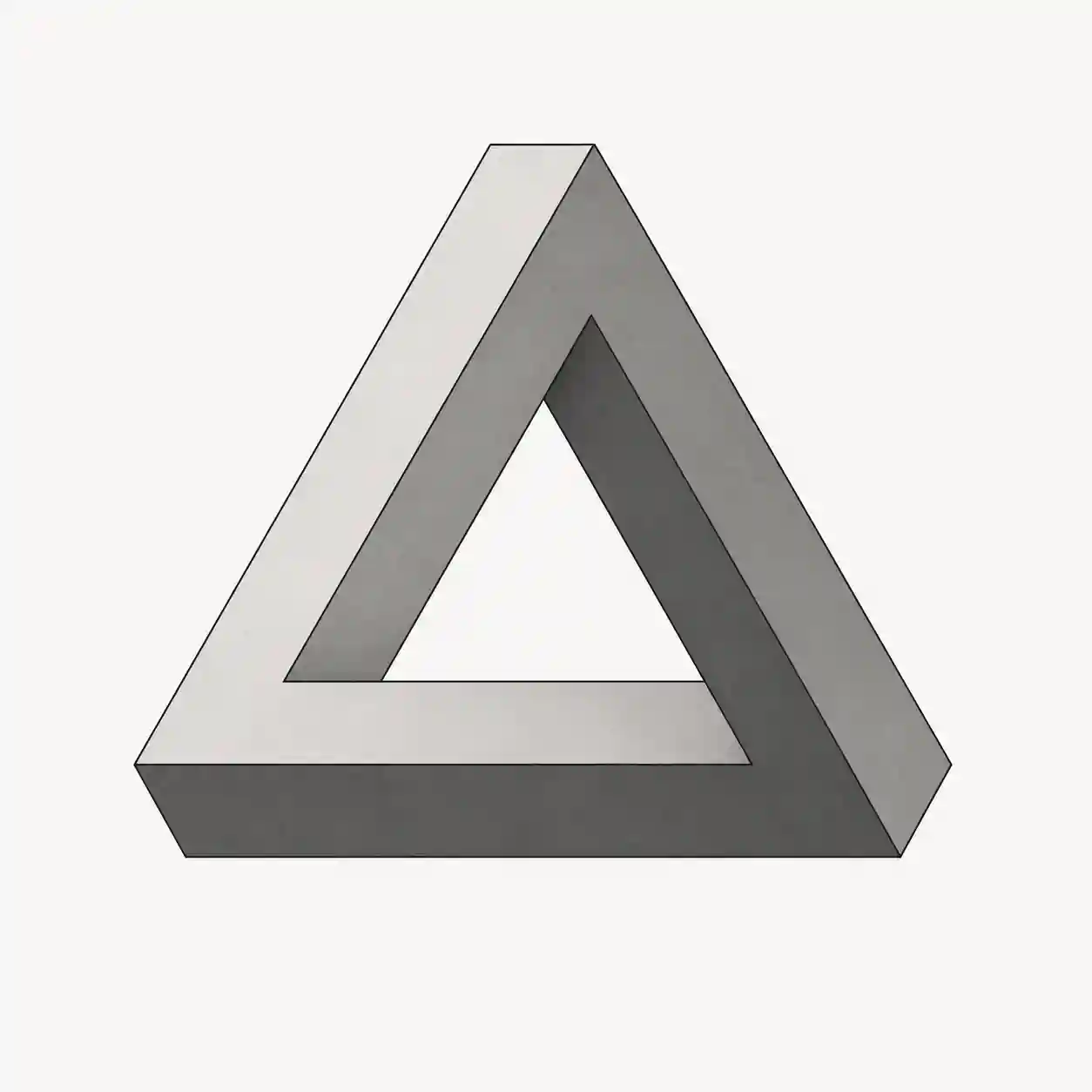
A closed loop of three beams that each look like an ordinary 3D bar in isolation, yet together describe an object that cannot exist in three dimensions.
What you're seeing
Three straight beams, each rendered with the shading, thickness, and converging edges of an ordinary length of timber or steel, are joined end to end into a closed triangular loop. Cover up two of the corners and look only at the third: it reads as a completely unremarkable right-angle joint, the kind you'd see on a real bookshelf frame. Do that for each corner in turn and every single one checks out. And yet trace the whole loop with your eye, corner to corner to corner, and the beams cannot possibly connect the way the drawing insists they do - the far end of one beam would simultaneously have to be nearer to you and farther from you than the beam it joins.
There's no trick of shading or perspective distortion hiding in the image. The drawing is a flawless, internally consistent set of three 2D joints. It's only when your visual system tries to assemble those three locally valid joints into a single coherent 3D object that the contradiction appears - and by then, you've already committed to seeing "a solid triangular object," so the contradiction reads as impossible rather than as "not a real object."
Why it happens
Your visual system doesn't verify a whole scene's geometry in one global pass. It builds a 3D interpretation piecewise, joint by joint and edge by edge, extending local depth cues outward and assuming they'll stay consistent across the rest of the figure - which, in the real world, they almost always do, because real objects don't casually violate Euclidean geometry between one corner and the next. The Penrose triangle is constructed specifically to exploit that assumption: each individual corner supplies a fully legitimate, unambiguous depth cue, but the three cues are quietly inconsistent with one another once you follow them all the way around the loop.
This is closely related to how Gestalt grouping principles push your brain toward the simplest, most "good" interpretation of a figure - closure and continuity make you complete the triangle as a single solid shape rather than as three disconnected fragments floating near each other, even though "three unconnected fragments" is the only interpretation that's actually geometrically possible. The impossible reading isn't a failure of perception; it's what happens when a normally reliable shortcut (local edges predict global structure) is deliberately fed self-contradictory input.
Two inventions, decades apart
The tribar, as researchers sometimes call it, has two legitimate points of origin, and it's worth naming both rather than crediting just the more famous one. Swedish artist Oscar Reutersvärd drew what is very likely the first version of the impossible triangle in 1934, built from a set of stacked cubes rendered in isometric projection - years before anyone in the psychology literature had described the effect. Independently, British psychiatrist Lionel Penrose and his son, the mathematician (and later Nobel laureate in physics) Roger Penrose, arrived at the same figure on their own and published it in a 1958 paper in the British Journal of Psychology titled "Impossible Objects: A Special Type of Visual Illusion" - the paper that gave the whole category of impossible figures its name and brought the shape to wide scientific attention. The Penroses' paper is also what introduced the figure to M. C. Escher, who was sent a copy and used the same underlying logic to build Waterfall, one of his best-known lithographs.
Building the impossible, sort of
Because the contradiction only exists as a 2D projection, it's possible to construct a real three-dimensional object that looks exactly like a Penrose triangle from one specific vantage point, even though it's actually a bent, disconnected, or gapped structure in real space. Several public sculptures around the world - including a well-known aluminum installation in East Perth, Australia - do exactly this: walk around the sculpture and it visibly falls apart into disjointed beams, but stand in the one marked spot and the gaps align perfectly with your line of sight, and the impossible triangle snaps into place. It's the same principle behind Escher's Waterfall and forced-perspective photography generally: exploit the fact that a single 2D projection throws away depth information, and you can make wildly different 3D objects produce an identical image.
Related reading
For the loop's close cousin, see the Penrose stairs, which apply the same local-versus-global trick to a staircase instead of a triangle, and Escher's Waterfall, which builds directly on the Penroses' published work. The Kanizsa triangle shows a very different way a triangle can be perceptually "constructed" that isn't actually drawn on the page at all.
Read the science behind why this happens →
Related illusions
 Geometric
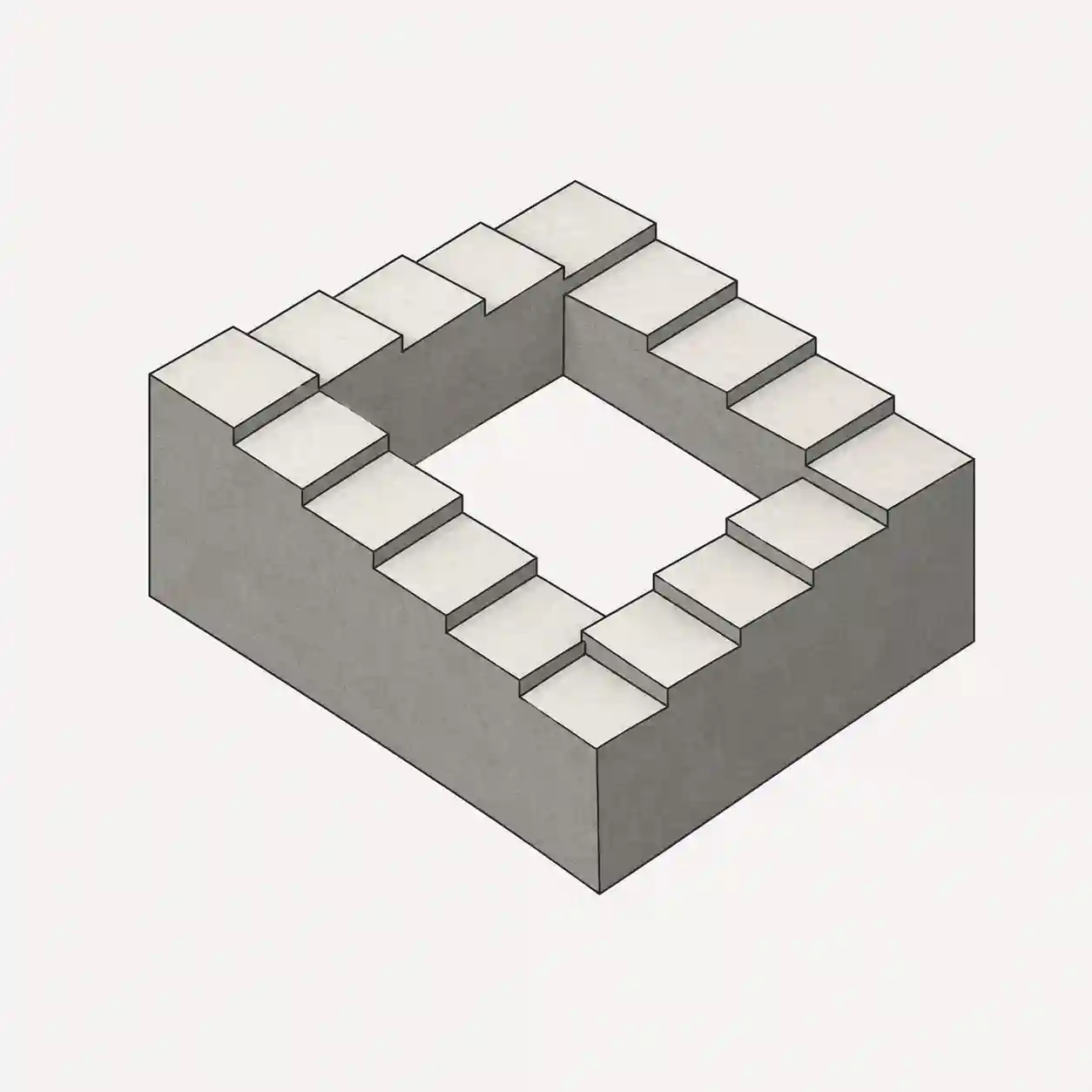
Penrose Stairs (The Impossible Staircase)
A staircase drawn so that each flight climbs upward into the next, all the way around a closed loop, with no floor that is ever the lowest or the highest.
 Geometric
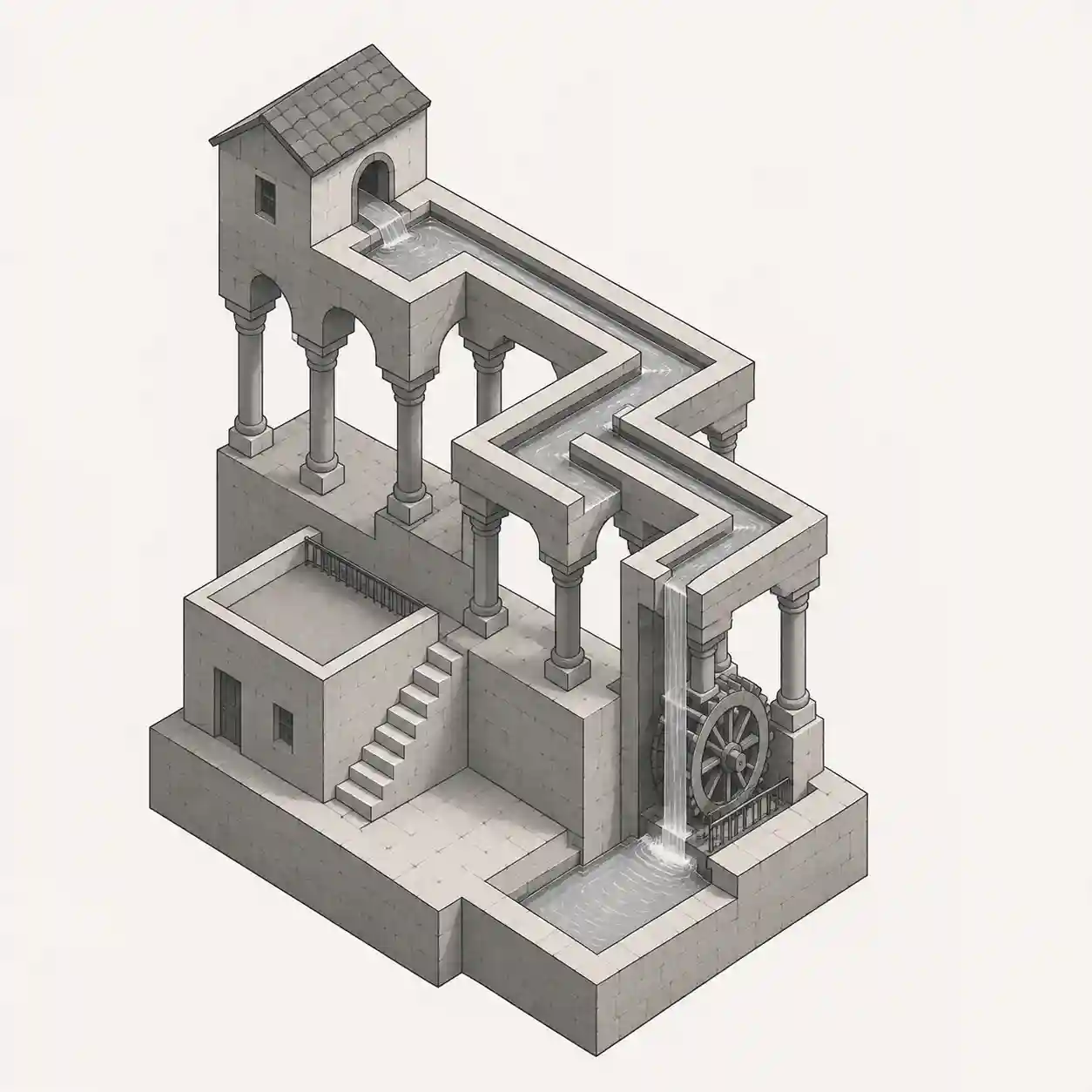
Escher's Waterfall (The Impossible Waterfall)
A lithograph in which water flows downhill through a zigzagging aqueduct, turns a mill wheel, and somehow ends up back at the top of the very same waterfall.
GeometricKanizsa Triangle
Three notched circles, arranged just so, produce a bright white triangle with crisp edges - even though no triangle is actually drawn anywhere in the image.