 Optical Wonderful
Checker Shadow Illusion
Two squares on a checkerboard, one inside a cast shadow and one outside it, are rendered in the exact same shade of gray - yet almost nobody can see that without proof.
What you're seeing
A checkerboard sits partly in shadow. Square A is a dark tile sitting outside the shadow; square B is a light tile sitting inside it. To your eyes, A looks distinctly darker than B. In reality, the two squares are painted in the identical shade of gray - you can prove it to yourself with the "bridge" button above, which draws an unbroken bar of solid color connecting the two squares. Once the bridge is visible, the difference vanishes instantly; your brain can no longer maintain two different readings of a color it can see is continuous.
Why it happens
Your visual system was never built to report absolute light values, the way a light meter does. It's built to answer a much more useful question: what is this surface's true reflectance - its actual color and lightness - regardless of how much light happens to be falling on it right now? A white shirt in shadow reflects far less light back to your eye than a gray shirt in full sun, yet you correctly perceive the first as "white" and the second as "gray," because your brain factors out the illumination and estimates the underlying material.
The checker shadow illusion works by presenting a scene where that illumination-discounting process runs exactly as designed, but with a display that isn't actually a real shadow - just a region of the image rendered darker. The brain treats the darkened region as if a real shadow were falling across it, and "corrects" its estimate of the tiles inside that region upward, making a genuinely darker pixel value read out as a lighter tile. The tile outside the shadow gets no such correction. The result: two physically identical patches of gray, perceived as different, because the brain is doing exactly what it should do with a photograph of a genuinely shadowed checkerboard - it just so happens this one isn't real.
The local checkerboard context reinforces the effect. Square A is surrounded by light tiles, which makes it look relatively dark by contrast; square B is surrounded by dark tiles (partly darkened further by the shadow), which makes it look relatively light by contrast. This is the same simultaneous contrast principle at work in the simultaneous contrast illusion - perceived lightness and color are always judged relative to their surroundings, never in isolation.
Why the bridge proof works
The connecting bar breaks the illusion because it removes the very thing the brain was using to build separate categories: the visual boundary between "inside the shadow" and "outside the shadow." Once a single continuous strip of identical pixels visibly spans both squares, your visual system can't simultaneously claim that strip is two different colors - continuity forces a single reading, and the shadow-correction logic that made A and B look different no longer has separate regions to apply itself to.
A little history
Vision scientist Edward H. Adelson, a professor at MIT, created the illusion in 1995 as a teaching demonstration of lightness constancy, and it quickly became one of the most widely reproduced illusions on the internet - a testament to how convincingly it holds up even when viewers are told, in advance, that the squares are the same. It's frequently cited alongside "the dress" as one of the clearest public demonstrations that color perception is a computed inference, not a direct readout of the light hitting your retina.
Related reading
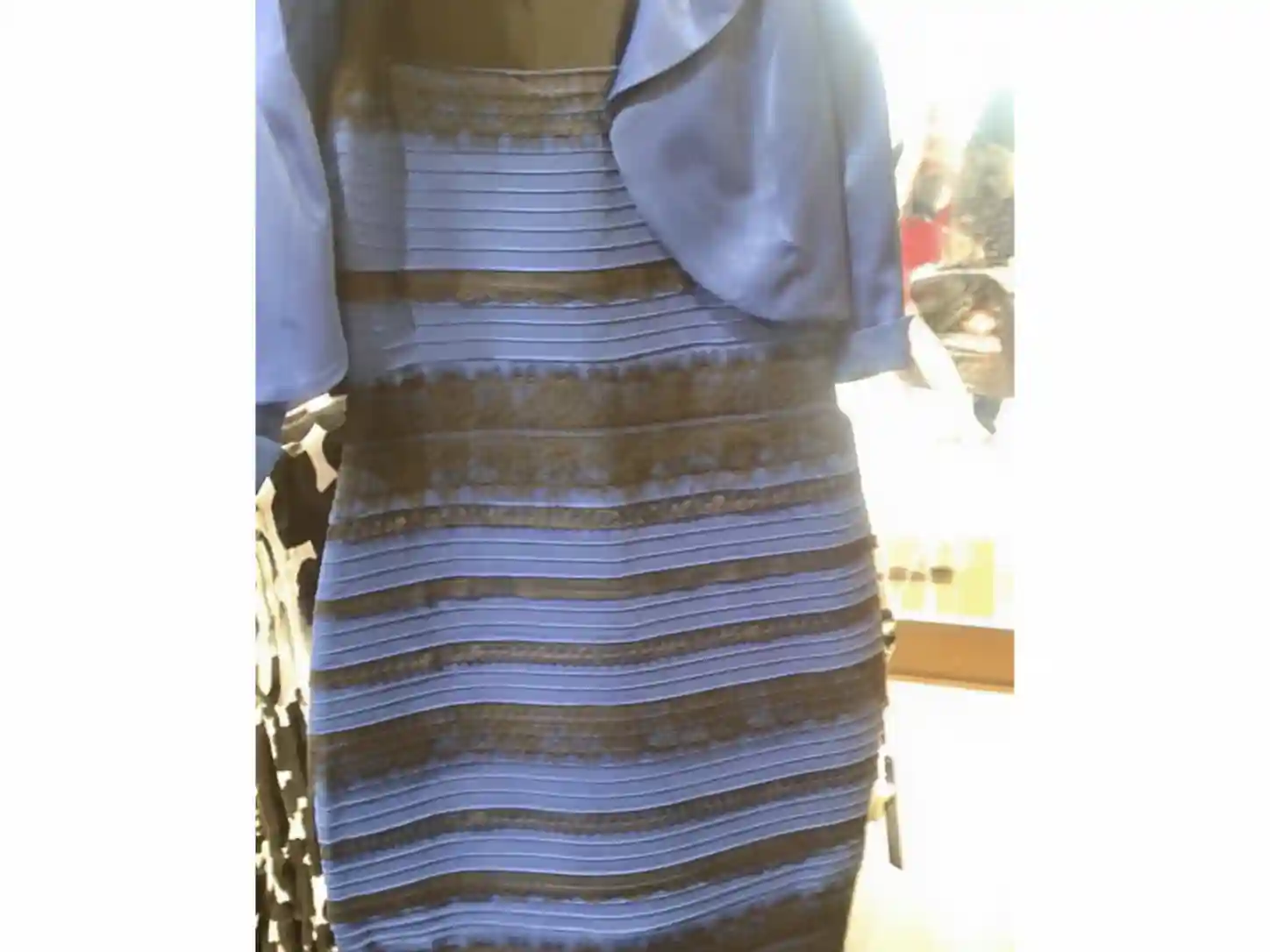
See simultaneous contrast for the underlying local-contrast effect in isolation, and "the dress" for a case where illumination-guessing famously split the internet in two.
Read the science behind why this happens →
Related illusions
Simultaneous Contrast Illusion
Two identical gray squares look like different shades the instant you place one on a dark background and the other on a light one - proof that the brain never judges color in isolation.
 Color & Contrast
"The Dress" (Blue/Black vs White/Gold)
A single photograph of a striped dress split the internet in 2015 between people who saw it as white and gold and people who saw it as blue and black, both looking at the identical pixels.