 Optical Wonderful
Ames Room Illusion
A distorted, trapezoidal room that looks perfectly rectangular from one exact viewing point, making people standing in opposite corners appear to shrink or grow to impossible sizes.
What you're seeing
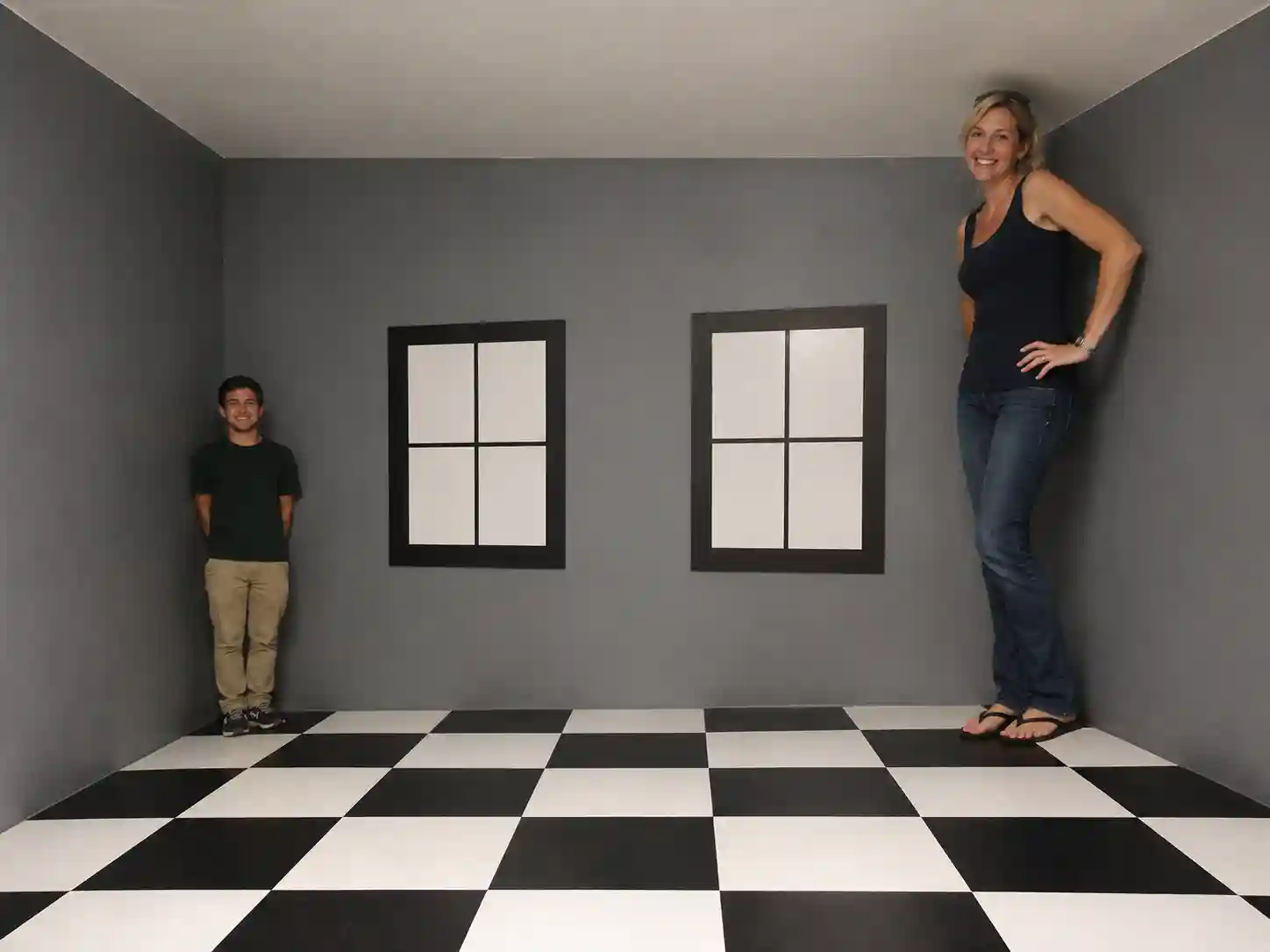
Two people stand in the same room, one in the left corner and one in the right. From the room's single viewing peephole, one of them looks like a giant and the other looks like they'd fit in a dollhouse - and if they swap corners, their apparent sizes swap too, as though one person shrank and the other grew simply by walking a few steps. The room itself, viewed from that one specific peephole, looks like an entirely ordinary rectangular room with a flat back wall and a level floor and ceiling.
The actual shape of the room
None of that is true. An Ames room is built as a distorted trapezoid, not a rectangle: the back wall runs at a sharp diagonal rather than straight across, one back corner is much farther from the viewing point than the other, and the floor, ceiling, and windows are all constructed with matching non-rectangular, sloped, or tapered shapes specifically calculated to cancel out the visual cues that would normally reveal the distortion. From any other angle, or from directly above, the room's true trapezoidal shape is completely obvious - the illusion depends entirely on viewing it through one fixed peephole that puts your eye at the exact single point the geometry was designed around.
Why the distortion becomes invisible
Your visual system judges a room's shape using converging lines, the apparent size of features like windows or floor tiles, and assumptions about how walls and ceilings usually meet - assumptions built on a lifetime of standing in ordinary rectangular rooms. The Ames room's construction is calculated so that, from the single correct viewing position, every one of those cues produces exactly the same pattern on your retina that an ordinary rectangular room would produce. The far corner is genuinely much farther away than the near corner, but its size, angle, and lighting are engineered so it still projects the retinal image of an equally distant, ordinary corner. With every depth cue lying in perfect agreement that the room is a normal rectangle, your visual system has no basis at all for suspecting otherwise - it isn't being sloppy, it's using entirely sound reasoning on deliberately falsified evidence.
Why the people, not the room, seem to change size
Once your visual system has locked onto "this is an ordinary rectangular room," it applies its usual size-constancy reasoning to anything standing inside it: a person's apparent height gets interpreted relative to how far away the room's geometry says they are. But the two back corners of an Ames room are actually at very different real distances from the peephole, even though the room's disguised geometry says they're equally distant. A person standing in the genuinely farther corner produces a smaller image on your retina than a person of the same height standing in the genuinely nearer corner. Normally your brain would read that size difference as "distance," but because it's already committed to treating both corners as equally distant, it reads the size difference as "height" instead. The room's false geometry effectively hijacks the same size-constancy machinery that lets you correctly judge two real distant and near people as equal height in an ordinary space.
Built to be experienced in person
Unlike many illusions that work equally well on a printed page or a screen, the Ames room was originally built as a walk-through physical installation, and it remains most convincing as a real three-dimensional space viewed with one eye through a fixed peephole. Viewing with both eyes, or moving your head, supplies binocular and motion-parallax cues that can partly break the illusion, since your two eyes see the room from very slightly different positions and can pick up on the true depth mismatch. Photographs and videos of Ames rooms work by simulating that single fixed monocular viewpoint the camera lens provides.
A little history
American scientist Adelbert Ames Jr. built the room in 1946, developing it from earlier theoretical work on the geometry of visual perception rather than as a novelty. Ames was broadly interested in demonstrating how much of ordinary perception depends on assumptions rather than direct measurement, and the room became one of the most vivid public demonstrations of that idea, later reproduced in science museums, psychology courses, and - memorably - the Lord of the Rings films, which used a Hobbiton-set Ames-style room in some shots alongside their forced-perspective camera work.
Related reading
The Ames room and forced perspective photography exploit the same underlying size-constancy machinery from two different directions - one builds a false room, the other stages a false camera angle - and both share their conceptual root with the Ponzo illusion.
Read the science behind why this happens →
Related illusions
 Size & Perspective
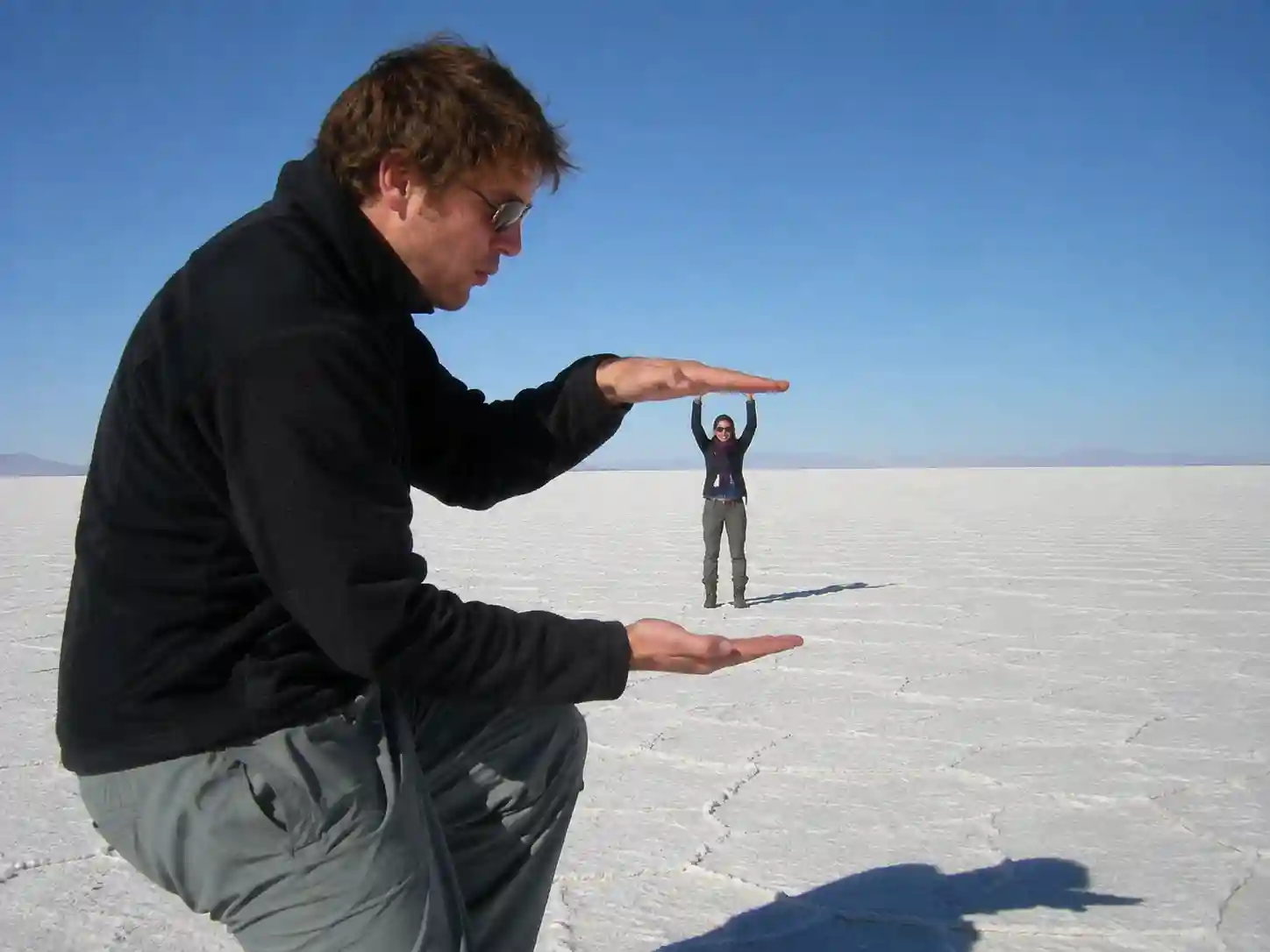
Forced Perspective (Photography Technique)
A deliberate camera trick that makes objects at different distances look like they're the same size, or vice versa, by carefully aligning them along a single line of sight.
Size & PerspectivePonzo Illusion
Two identical bars look like different lengths when placed across a pair of converging lines, because the brain reads the converging lines as a hint about distance.
Size & PerspectiveMüller-Lyer Illusion
Two identical lines look like different lengths depending only on which way their arrow-like fins point - one of the most reliable size illusions ever tested.