 Optical Wonderful
Ebbinghaus Illusion
Two identical center circles look like completely different sizes depending only on whether they're surrounded by a ring of large circles or a ring of small ones.
What you're seeing
Two orange circles, exactly the same diameter, sit at the center of the demo above. One is surrounded by a ring of large circles; the other is surrounded by a ring of small circles. The one ringed by large neighbors looks distinctly smaller than the one ringed by small neighbors - measure them against each other directly, or trace their outlines, and the size difference vanishes completely.
Why the same circle reads as two different sizes
Your visual system almost never judges size as an isolated, absolute measurement. Instead, it evaluates a shape's size relative to nearby objects it can use for comparison - a strategy that works well in the real world, where relative-size cues (a person standing next to a building, a coin next to a hand) are often more reliable and more immediately available than an internal ruler would be. The Ebbinghaus illusion isolates that relative-judgment process and shows how easily it can be steered. Surround a circle with much larger neighbors and your visual system implicitly recalibrates its sense of "typical size" upward to match those neighbors, which makes the central circle look small by comparison. Surround the identical circle with much smaller neighbors and the calibration runs the other way, making the same circle look comparatively large.
Distance from the surrounding ring also matters
The strength of the illusion isn't just about how big or small the surrounding circles are - the spacing between the central circle and its ring matters too. A tightly packed ring of large circles, sitting close to the central circle, tends to produce a stronger size-contrast effect than the same large circles spaced farther away. This has made the Ebbinghaus illusion a useful tool for researchers studying exactly which spatial relationships drive relative-size judgments, since the size of the surrounding shapes and their distance from the target can be manipulated independently.
A close cousin: the Delboeuf illusion
A related illusion, named for Belgian philosopher and psychologist Joseph Delboeuf, uses concentric circles instead of a ring of separate small circles - a target circle surrounded by a single larger outline circle looks smaller when that outline sits close around it, and larger when the outline is spaced farther out. The Delboeuf illusion is often mentioned alongside the Ebbinghaus effect because both hinge on the same core principle - perceived size shifting based on surrounding context - even though the specific geometry differs. Some researchers group the two together, or treat the Delboeuf as a special-case variant, when discussing size-contrast illusions generally.
Where it shows up outside the lab
The Ebbinghaus illusion isn't purely academic - it's been used in real-world studies of things like portion perception, where identical amounts of food on a large plate versus a small plate are judged as different quantities, a finding with genuine implications for how plate size can subtly affect how much people serve themselves. It has also been used in perception-and-action research examining whether the grip your hand forms when reaching to pick up an object is fooled by the same size-contrast illusion that fools your conscious size judgment - a genuinely contested question in vision science, with some studies finding the reaching hand is less deceived than conscious perception and others finding no such split.
A little history
The illusion is named for German psychologist Hermann Ebbinghaus, better known for his pioneering 19th-century research on memory and the forgetting curve, though in the historical record the effect itself is more closely associated with the broader circle of German experimental psychologists working on geometric-optical illusions in that era. American psychologist Edward Titchener helped popularize the specific circles-of-circles version in English-language textbooks in the early 20th century, which is why it's sometimes called the Titchener circles illusion instead.
Related reading
The Ebbinghaus illusion belongs to the same family of context-driven size illusions as the Müller-Lyer illusion and the Ponzo illusion, and shares its "size judged relative to context" core principle with forced perspective photography, just built from flat circles instead of a photographed scene.
Read the science behind why this happens →
Related illusions
Müller-Lyer Illusion
Two identical lines look like different lengths depending only on which way their arrow-like fins point - one of the most reliable size illusions ever tested.
Size & PerspectivePonzo Illusion
Two identical bars look like different lengths when placed across a pair of converging lines, because the brain reads the converging lines as a hint about distance.
 Size & Perspective
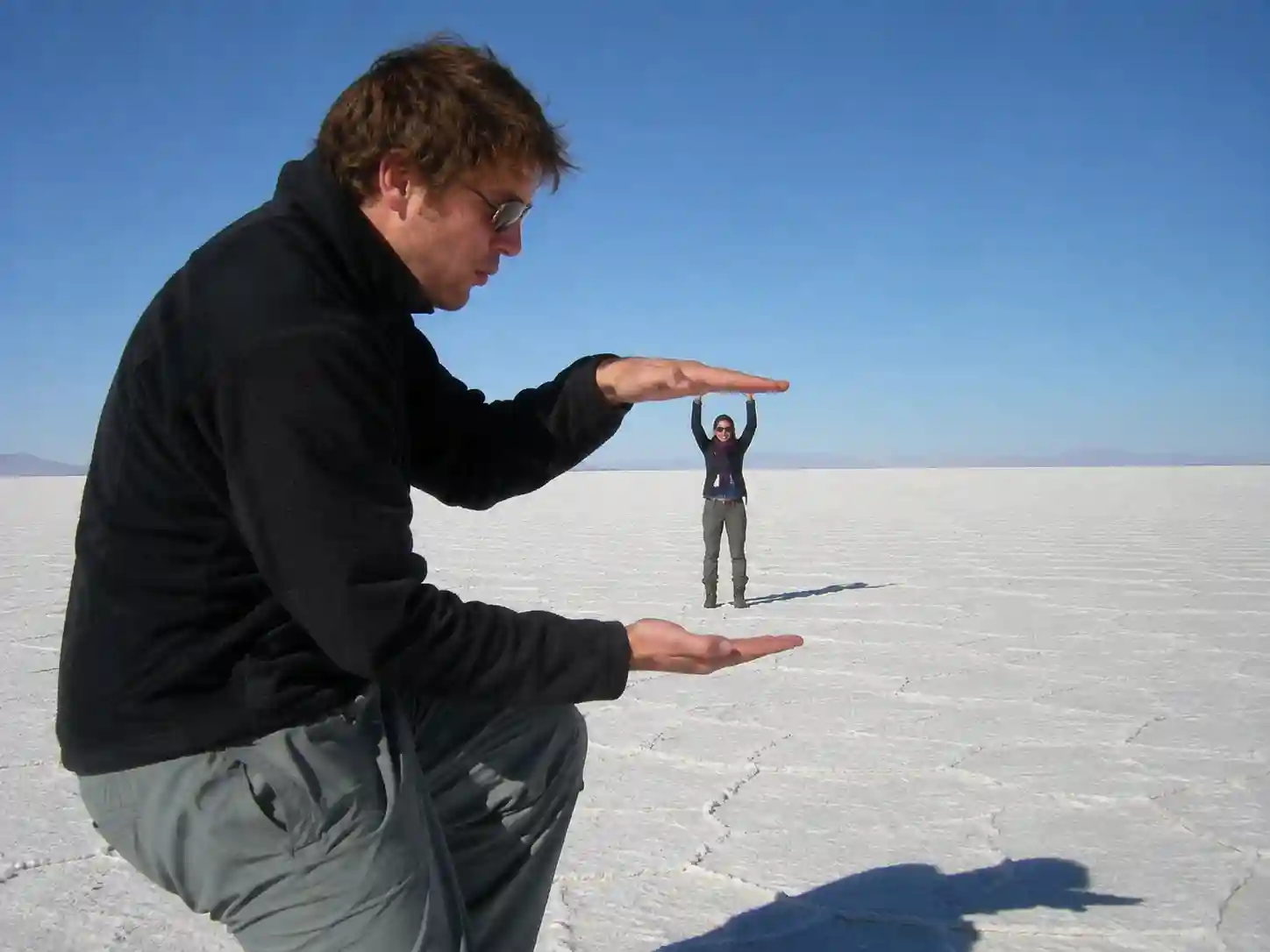
Forced Perspective (Photography Technique)
A deliberate camera trick that makes objects at different distances look like they're the same size, or vice versa, by carefully aligning them along a single line of sight.