 Optical Wonderful
Felice Varini
The Swiss-born, Paris-based artist known for painting geometric shapes across entire buildings, streets, and landscapes that only resolve into a coherent form from one precise viewing point.
A single vantage point, painted across a whole space
Felice Varini, born in Locarno, Switzerland in 1952 and based in Paris for most of his career, works in a form of large-scale anamorphic painting that has become his signature: bold, flat-colored geometric shapes - circles, ellipses, grids of lines, concentric rings - painted directly onto the walls, floors, ceilings, staircases, and surrounding architecture of real physical spaces, in fragments that look scattered and disconnected from almost every angle. Walk to one specific, carefully calculated point in the space, however, and the fragments snap into alignment, resolving into a single clean, complete geometric shape that appears to float in front of the architecture.
Away from that one vantage point, the same installation reads as a set of disjointed painted stripes and arcs crossing walls, corners, windows, and stairwells at odd angles, obeying the physical geometry of the building rather than the illusion. This is the core anamorphic principle taken to architectural scale: a form encoded not on a flat surface but distributed across a complex three-dimensional environment, decodable only from the single point in space where the artist calculated the projection to align with human vision.
Working method and scale
Varini's process typically begins with a projector: he sets up his light source at the exact point he wants to serve as the eventual viewing position, projects the geometric design outward across the real walls and surfaces of the space, and then traces and paints the design directly onto whatever surfaces the projected light lands on - regardless of whether that surface is flat, angled, near, or far. The paint itself is usually a single saturated color, chosen to read as a strong flat shape once aligned, in deliberate contrast to the varied materials and depths of the architecture underneath it.
His installations have been mounted in an unusually wide range of settings: historic buildings, public squares, museum interiors, industrial sites, and outdoor landscapes across Europe, Asia, and the Americas, often as large-scale public art commissions. Because the work depends entirely on physical space and light rather than on canvas, each installation is site-specific and generally temporary, existing afterward mainly through photographs taken from the single correct vantage point - the same vantage point the projector occupied during its creation.
Why it matters to illusion research
Varini's work is a large-scale, real-world demonstration of the core anamorphic principle: that the visual system reconstructs a scene by assuming a single, consistent viewpoint, and that a shape distributed across multiple surfaces at different distances and angles can be made to look coherent if - and only if - it is viewed from the exact point the geometry was calculated for. Anamorphic art of this kind exploits the same perspective assumptions that underlie forced-perspective photography and architectural trompe l'oeil, but Varini's contribution is distinctive for the sheer physical scale at which he applies the principle, treating entire buildings and public spaces as the "canvas" and turning the viewer's own position in physical space into an active part of the artwork rather than a passive vantage point in front of it. His installations are frequently cited in discussions of anamorphosis precisely because they make the underlying geometry so visible: viewers can walk around the space, watch the fragments drift out of alignment as they move away from the sweet spot, and directly experience the mechanism that makes the illusion work.
Illusions connected to Felice Varini
 Depth
Depth
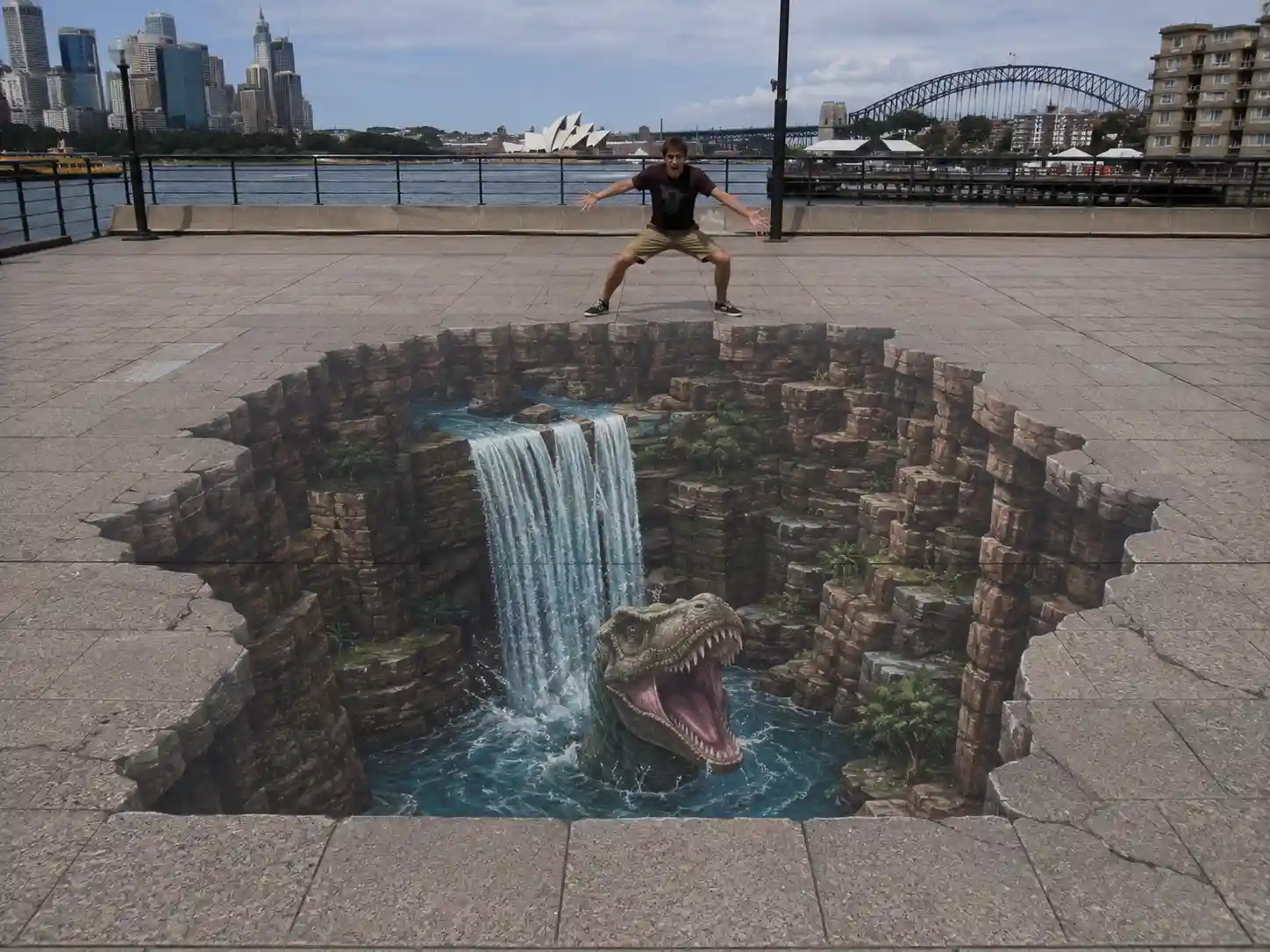
Anamorphic Chalk and Street Art Illusions
Street and chalk paintings drawn as heavily stretched, warped shapes that only resolve into a convincing 3D scene when viewed from one specific, carefully calculated angle.
 Size & Perspective
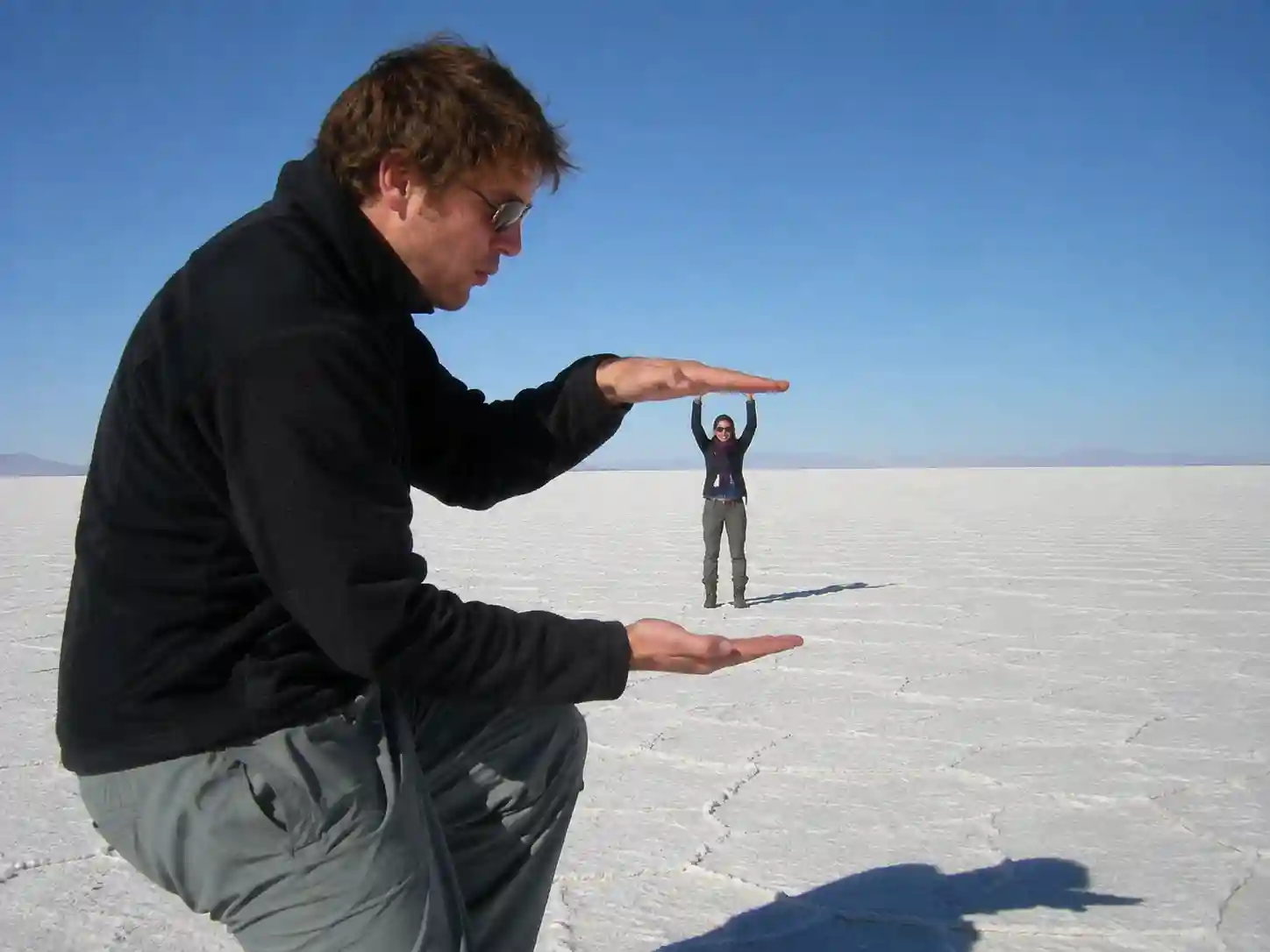
Forced Perspective (Photography Technique)
A deliberate camera trick that makes objects at different distances look like they're the same size, or vice versa, by carefully aligning them along a single line of sight.