 Optical Wonderful
Shepard Tone (Auditory Barber Pole)
A tone that seems to climb in pitch forever without ever actually getting any higher - the auditory equivalent of an Escher staircase that always ascends and never arrives.
What you're hearing
A tone plays and rises steadily in pitch. As it climbs, you'd expect it to eventually run out of room and either stop or loop back down, the way any real ascending scale must. Instead, the tone appears to keep climbing indefinitely, seamlessly, forever - a continuous ascent with no audible seam, no reset, no point where it obviously starts over. Played on a loop, the sensation of endless rising pitch can continue for as long as you're willing to listen.
Nothing about this is possible in an ordinary single tone; a sound generator has finite frequency range, and pitch can't rise without limit. What's actually happening is a carefully constructed illusion built from many tones at once, engineered so that your auditory system perceives a smooth, unbroken climb where none, in the literal sense, exists.
Why it happens
A Shepard tone isn't one sound - it's a stack of pure tones, each an octave apart (each one exactly double the frequency of the one below it), all rising in pitch together at the same rate. The trick lies in how loud each layer is allowed to be at any given moment. Each octave layer follows a volume envelope shaped like a bell curve across the audible frequency range: layers in the middle of human hearing are played loudly, while layers near the very top and very bottom of the audible range are faded down to near silence. As the whole stack rises in pitch, each individual layer gradually climbs out of the loud middle band and toward the quiet high end, fading out as it goes - while, at the same moment, a new layer fades in at the quiet low end and begins its own climb through the middle.
Your auditory system doesn't track each of these individual layers as separate events. It hears the composite: a dominant, audible band of pitch continuously present somewhere in the middle of the frequency range, always rising, with the actual "handoff" between one octave layer fading out at the top and a new one fading in at the bottom happening so smoothly, and so far into the quiet extremes of the loudness envelope, that no discrete transition is perceptible. The ear tracks perceived pitch height using cues that are dominated by which frequencies are currently loudest - and since the loudest band always seems to be climbing, never resetting, the composite percept is of endless ascent, even though every individual component tone is doing something far more mundane: rising through a fixed, finite range and then quietly disappearing.
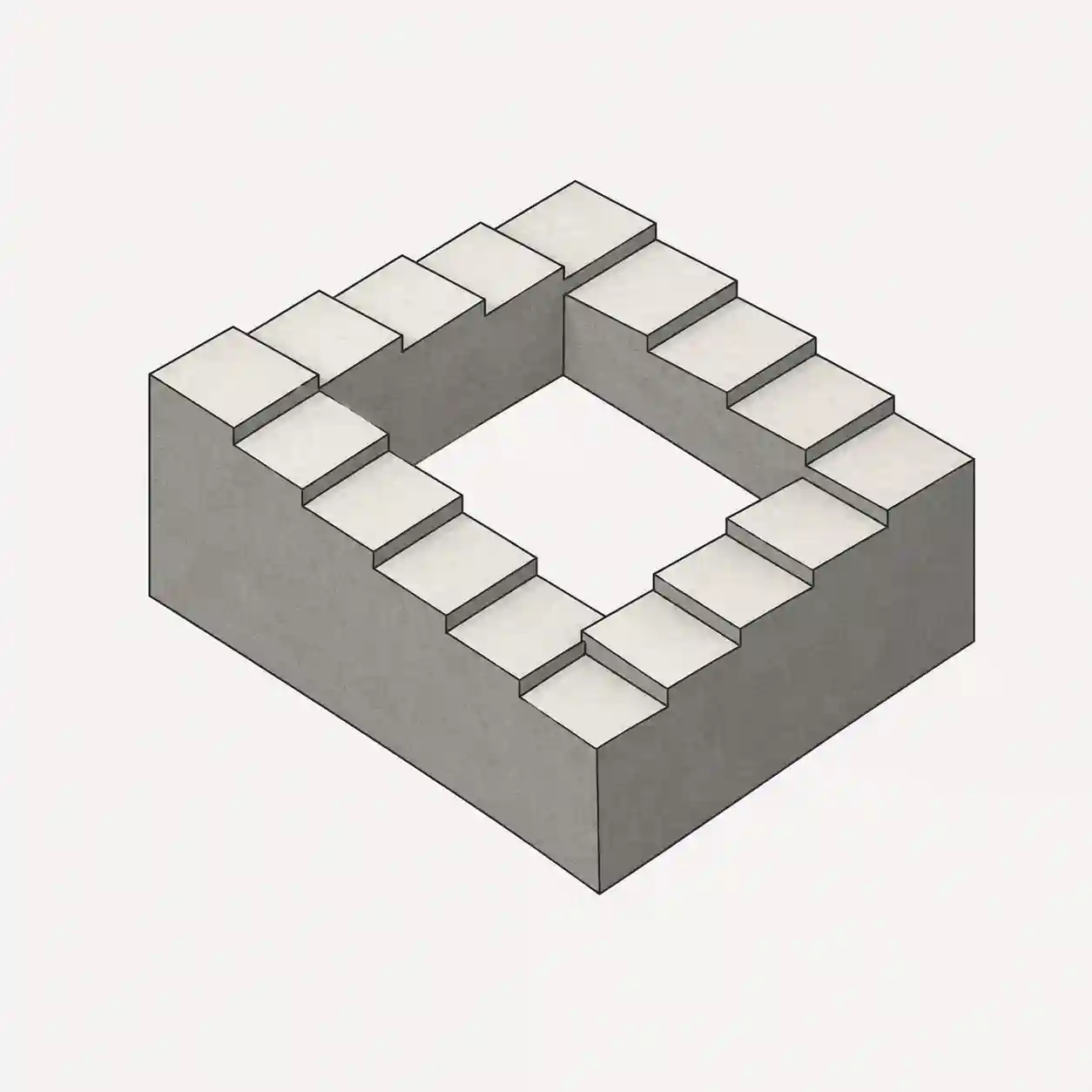
This makes the Shepard tone a genuine auditory analogue to visually impossible continuous structures like the Penrose stairs, the famous impossible staircase where a structure drawn correctly in local, piece-by-piece perspective nonetheless appears to climb endlessly by looping back into itself in a way no real staircase could. Both illusions work by making local transitions individually convincing and globally impossible - you can't point to the exact step or the exact octave-layer where the trick happens, because the deception is distributed smoothly across the whole structure rather than concentrated in one obvious cut.
Why "auditory barber pole"
The nickname draws a comparison to the visual barber pole illusion, in which diagonal stripes painted on a rotating cylinder appear to travel continuously upward (or downward) forever, even though the cylinder is just spinning in place and no paint is actually moving anywhere. In both cases, a genuinely cyclical, bounded physical process - a rotating cylinder, a bank of octave-spaced tones cycling in loudness - produces a percept of unbounded, linear motion in one direction, because the perceptual system tracks a local motion or pitch cue without registering that the underlying structure loops back on itself.
A little history
The illusion is named for cognitive scientist Roger Shepard, who described it in a 1964 paper while at Bell Labs, using it to explore how listeners perceive musical pitch as having two separate components: chroma (which note it is - C, D, E, and so on, repeating every octave) and height (how high or low it sounds in absolute terms). The Shepard tone isolates chroma from height by holding the perceived cyclic note identity in constant motion while destroying any stable sense of absolute height. Later researchers extended this work considerably. Composer and computer-music researcher Jean-Claude Risset created a continuous version built from overlapping glissandi rather than discrete stepped tones - now known as the Shepard-Risset glissando - while psychologist Diana Deutsch developed a range of other related pitch illusions and studied how musically trained listeners and speakers of different languages can perceive some of these effects differently, adding a layer of individual variability that continues to interest auditory researchers today.
Related reading
The impossible Penrose stairs are this library's fully visual counterpart to the endless-climb effect described above; for a different kind of audio-visual perceptual surprise, see the McGurk effect.
Read the science behind why this happens →
Related illusions
McGurk Effect (Audio-Visual Illusion)
Dub the audio 'ba' over video of a mouth silently saying 'ga,' and most listeners hear neither - they hear 'da,' a third sound their brain invents by fusing mismatched ears and eyes.
 Geometric
Penrose Stairs (The Impossible Staircase)
A staircase drawn so that each flight climbs upward into the next, all the way around a closed loop, with no floor that is ever the lowest or the highest.
MotionBarber Pole Illusion
The diagonal stripes on a barber's pole appear to travel upward forever, even though they're only ever rotating sideways around a cylinder - a classic case of the visual system solving an ambiguous motion problem badly.