 Optical Wonderful
Penrose Stairs (The Impossible Staircase)
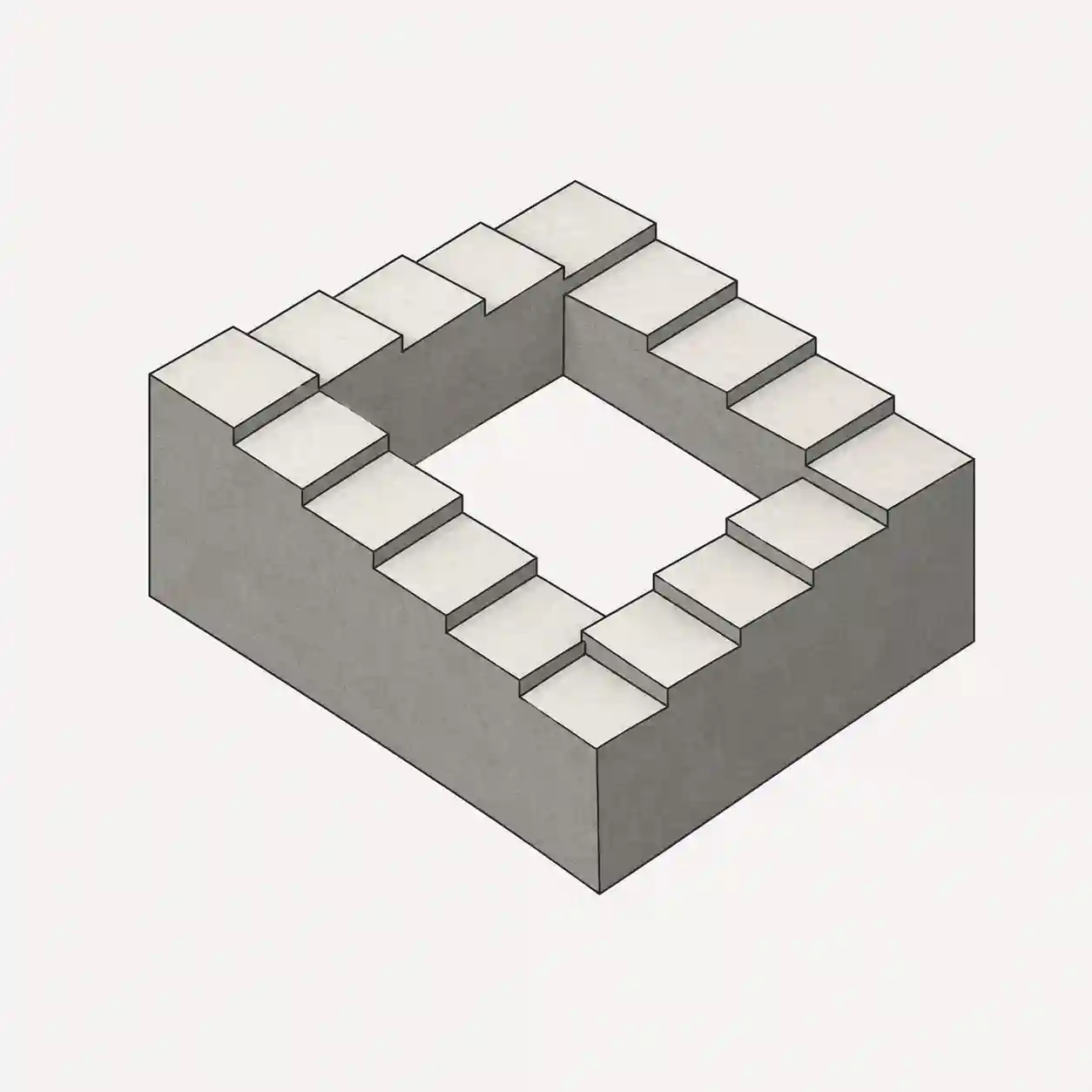
A staircase drawn so that each flight climbs upward into the next, all the way around a closed loop, with no floor that is ever the lowest or the highest.
What you're seeing
A square staircase, four flights long, each flight climbing from one corner to the next. Follow it clockwise and every single step you take is upward - you climb flight after flight, turn each corner, and keep climbing. Four flights later you're back where you started, having gone up the entire way around a closed loop, with no landing that ever dips back down to let that happen. Run it the other direction and the same trick works in reverse: every step down, forever, in a circle.
Unlike some impossible figures, the Penrose stairs don't rely on any hidden shading trick or false perspective line - the individual flights are drawn as ordinary staircases would be, each one perfectly plausible in isolation, in correct isometric or near-isometric projection. It's only the closed loop, the demand that four honestly-drawn uphill flights somehow return to their own starting height, that breaks.
Why it happens
Depth perception from a flat drawing is built almost entirely out of local cues - the way each step's tread and riser are foreshortened, how the steps' edges converge, which surfaces occlude which. Your visual system reads those cues one flight at a time and, at every stage, "uphill" is the only sensible conclusion. Nothing in any single flight tells your brain to expect a contradiction two corners later. By the time the loop closes, you've already built up a running mental tally of "climbing, climbing, climbing," and the final connection - which would require the top of the fourth flight to somehow equal the bottom of the first - gets forced into place anyway, because your visual system is far better at extending locally consistent structure than at auditing a structure's global consistency.
This ties into a broader point about how the visual cortex assembles a scene: it isn't running one unified geometric proof over the whole image at once. Depth and orientation are computed regionally and stitched together, with the assumption - nearly always safe in the real world - that regional judgments will agree with each other by the time you get all the way around. The Penrose stairs are a deliberately constructed exception to that assumption, exploiting the seam between "locally correct" and "globally coherent" the same way an audio illusion can exploit the seam between two individually correct pitch judgments.
An idea that outgrew its own paper
Lionel Penrose, a British psychiatrist and geneticist, and his son Roger Penrose, then a young mathematician, published the impossible staircase alongside the impossible triangle in their landmark 1958 British Journal of Psychology paper on "impossible objects." The staircase concept has clear kinship with earlier impossible-figure work - Swedish artist Oscar Reutersvärd had been drawing impossible cube arrangements since the 1930s, and impossible-perspective staircases share his general lineage of stacking locally valid isometric joints into globally invalid loops - but the endless-loop staircase as formalized in the Penroses' paper is the version that entered both the psychology literature and popular culture under their name. The paper reached the Dutch artist M. C. Escher directly, and he wrote back to Roger Penrose after building an entire lithograph, Ascending and Descending (1960), around monks trudging eternally around exactly this staircase.
Why the loop is worse than the triangle
Where the Penrose triangle presents its contradiction all at once - you can often catch it within a second or two of looking - the staircase tends to take longer to "break," because a staircase is something your body has procedural, almost muscular expectations about: climbing has a felt sense of continual effort and elevation gain that a wireframe triangle doesn't carry. Some viewers report a genuine moment of vertigo or disorientation the instant the loop clicks into place as impossible, which doesn't typically happen with the triangle. It's also the reason the staircase translates so well into animation and video game design - endless-staircase levels and non-Euclidean corridor tricks in games borrow directly from the Penrose loop, using camera cuts and perspective locking to simulate the same "always climbing, never arriving" effect in a space you can actually walk through.
Related reading
The Penrose triangle is the staircase's sibling figure from the same 1958 paper, and Escher's Waterfall applies closely related impossible-loop logic to flowing water instead of footsteps. For a real, physically built illusion that also plays with impossible-seeming spatial relationships, see the Ames room illusion.
Read the science behind why this happens →
Related illusions
 Geometric
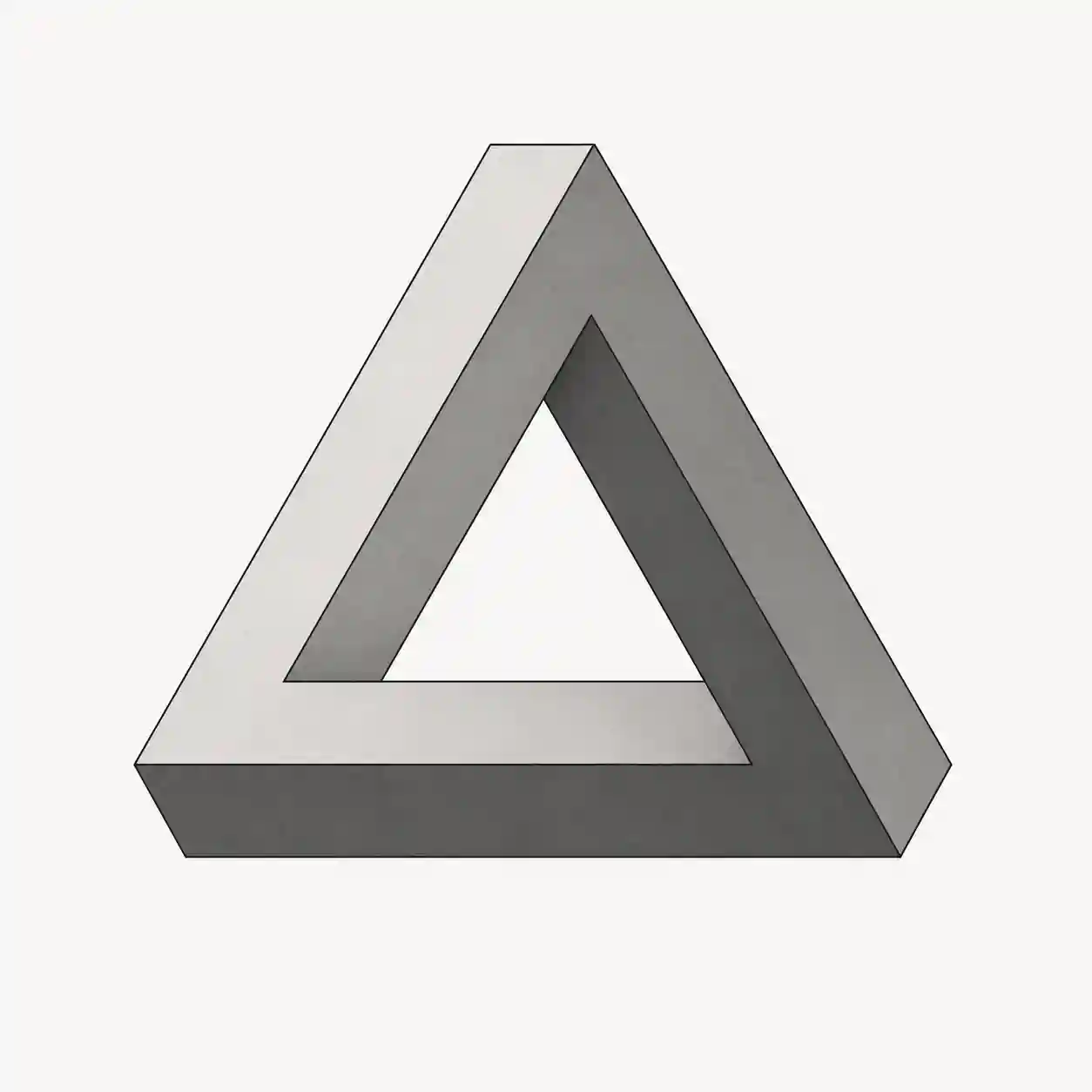
Penrose Triangle
A closed loop of three beams that each look like an ordinary 3D bar in isolation, yet together describe an object that cannot exist in three dimensions.
 Geometric
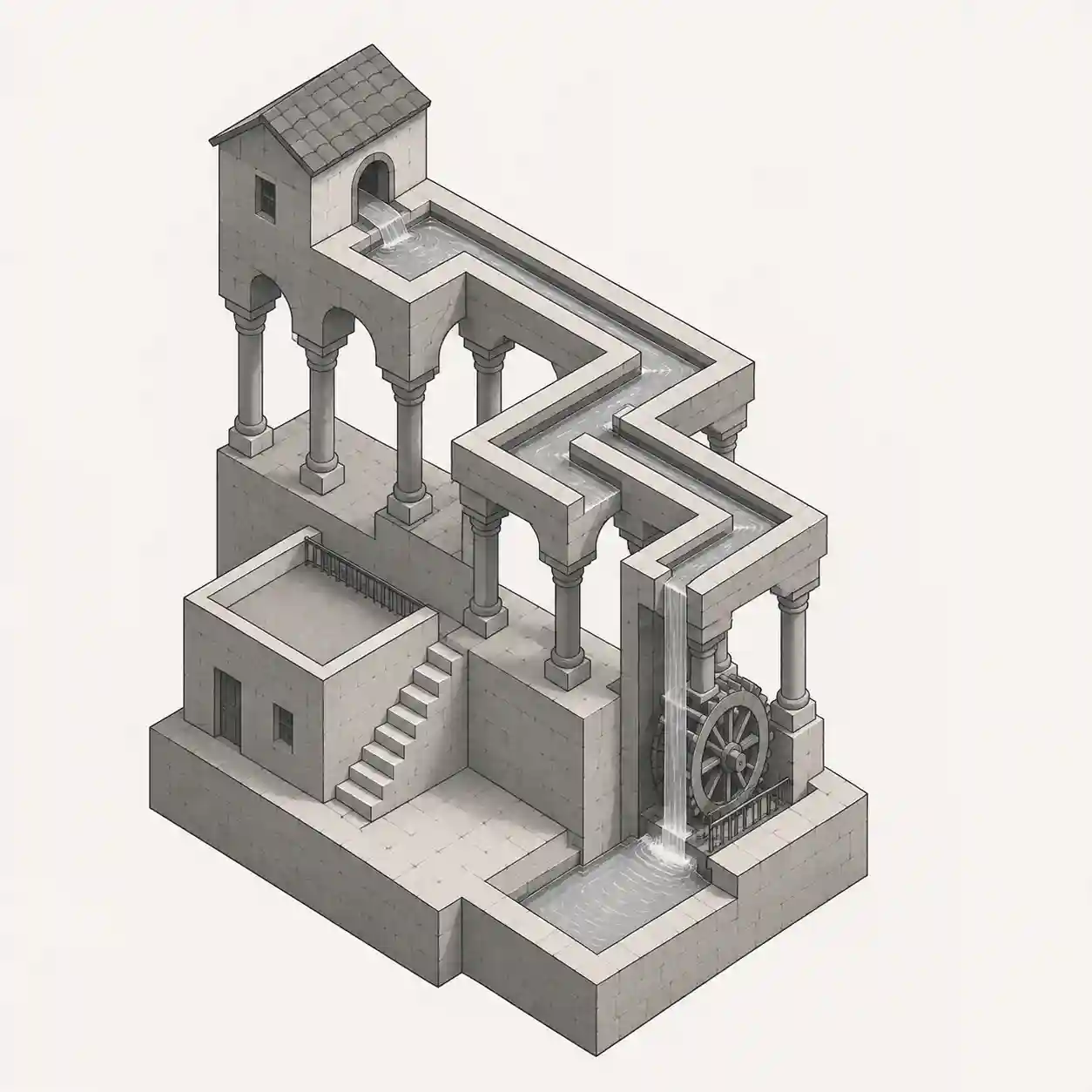
Escher's Waterfall (The Impossible Waterfall)
A lithograph in which water flows downhill through a zigzagging aqueduct, turns a mill wheel, and somehow ends up back at the top of the very same waterfall.
 Size & Perspective
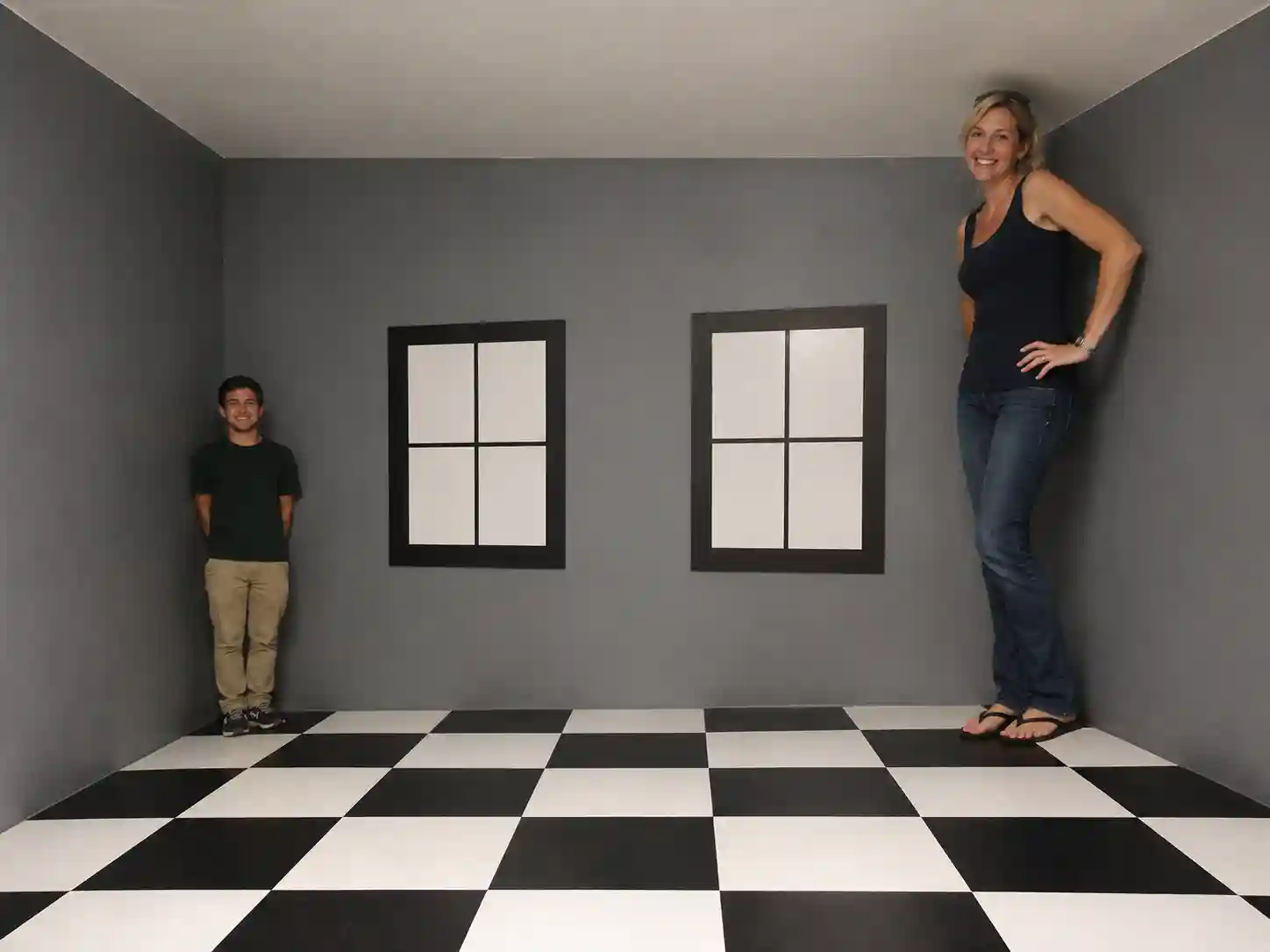
Ames Room Illusion
A distorted, trapezoidal room that looks perfectly rectangular from one exact viewing point, making people standing in opposite corners appear to shrink or grow to impossible sizes.