 Optical Wonderful
Barber Pole Illusion
The diagonal stripes on a barber's pole appear to travel upward forever, even though they're only ever rotating sideways around a cylinder - a classic case of the visual system solving an ambiguous motion problem badly.
What you're seeing
A traditional barber pole is a rotating cylinder wrapped in a diagonal red-and-white (or red-white-and-blue) stripe. The cylinder only ever spins around its vertical axis - every point on its surface moves in a simple horizontal circle. Yet what you perceive, reliably, is stripes flowing continuously upward (or downward), as if the pole were an endless conveyor belt feeding stripe material in from the bottom forever. Try the demo above: the same diagonally animated stripe pattern is shown through two different window shapes, and the direction it appears to travel changes depending on the shape of the window alone - not on anything about the stripes themselves.
The aperture problem
This is a textbook illustration of what vision scientists call the aperture problem. When a neuron - or your eye, looking through a restricted opening like the pole's cylindrical boundary - can only see a moving edge through a small window, it has no way to measure the edge's true, full direction of travel. All it can measure is the component of motion perpendicular to the edge itself. A diagonal stripe moving horizontally, when viewed only through a tall vertical opening, produces exactly the same local visual signal as a diagonal stripe of the same orientation moving vertically. Motion along the length of the stripe is invisible to any local detector confined to a narrow window - there's simply no information available at that edge to distinguish "moving sideways" from "moving diagonally along its own length." Your visual system has to guess, and it consistently guesses in favor of the boundary's dominant axis: because the pole itself is tall and narrow, the ambiguous diagonal motion gets resolved as vertical.
Why the pole's shape decides the direction, not the stripes
If you could see the entire, unbounded rotating cylinder at once - say, from directly above, or if the pole were somehow infinitely wide - the true horizontal rotation would be obvious and no illusion would occur. The illusion depends entirely on the pole's housing cutting the stripe pattern down to a tall, narrow visible strip. Swap that housing for a short, wide horizontal window instead, showing the identical diagonally moving stripes, and the perceived direction of travel flips to sideways instead of upward - exactly what the demo above demonstrates. The aperture's shape, not the pattern's actual direction of motion, ends up dictating what you perceive.
Where else the same trick shows up
The aperture problem isn't unique to barber poles - it's a fundamental limitation of how local motion detection works, and it shows up any time a moving pattern is viewed through a restricted opening: a diagonal pattern scrolling behind a keyhole, fabric with a diagonal weave viewed through a narrow gap, or certain camera and video-compression artifacts that arise from the same edge-versus-window ambiguity. The visual system generally resolves these ambiguities using extra information from an object's corners or endpoints, where the true direction of motion actually can be recovered unambiguously, which is part of why the illusion partly weakens if you can see the very top or bottom edge of the stripe pattern rather than an endless-seeming strip.
A little history
The perceptual puzzle behind the barber pole illusion was analyzed rigorously by German-American psychologist Hans Wallach in 1935, whose work on the visual perception of motion helped formalize the aperture problem as a general principle rather than a quirky one-off case. The barber pole itself long predates that analysis by centuries as a real-world object - historically signaling a barbershop that also performed bloodletting and minor surgery - but it took Wallach's mid-20th-century work to explain why its stripes always seem to defy their own actual rotation.
Related reading
For two more illusions rooted in how the visual system's motion detectors get fooled, see the rotating snakes illusion and the peripheral drift illusion; for what happens after sustained real motion rather than during it, see the motion aftereffect.
Read the science behind why this happens →
Related illusions
 Motion
Motion Aftereffect (Waterfall Illusion)
Stare at flowing water or a spinning pattern for half a minute, then look at something still - and the stationary scene will appear to drift in the opposite direction for a few seconds.
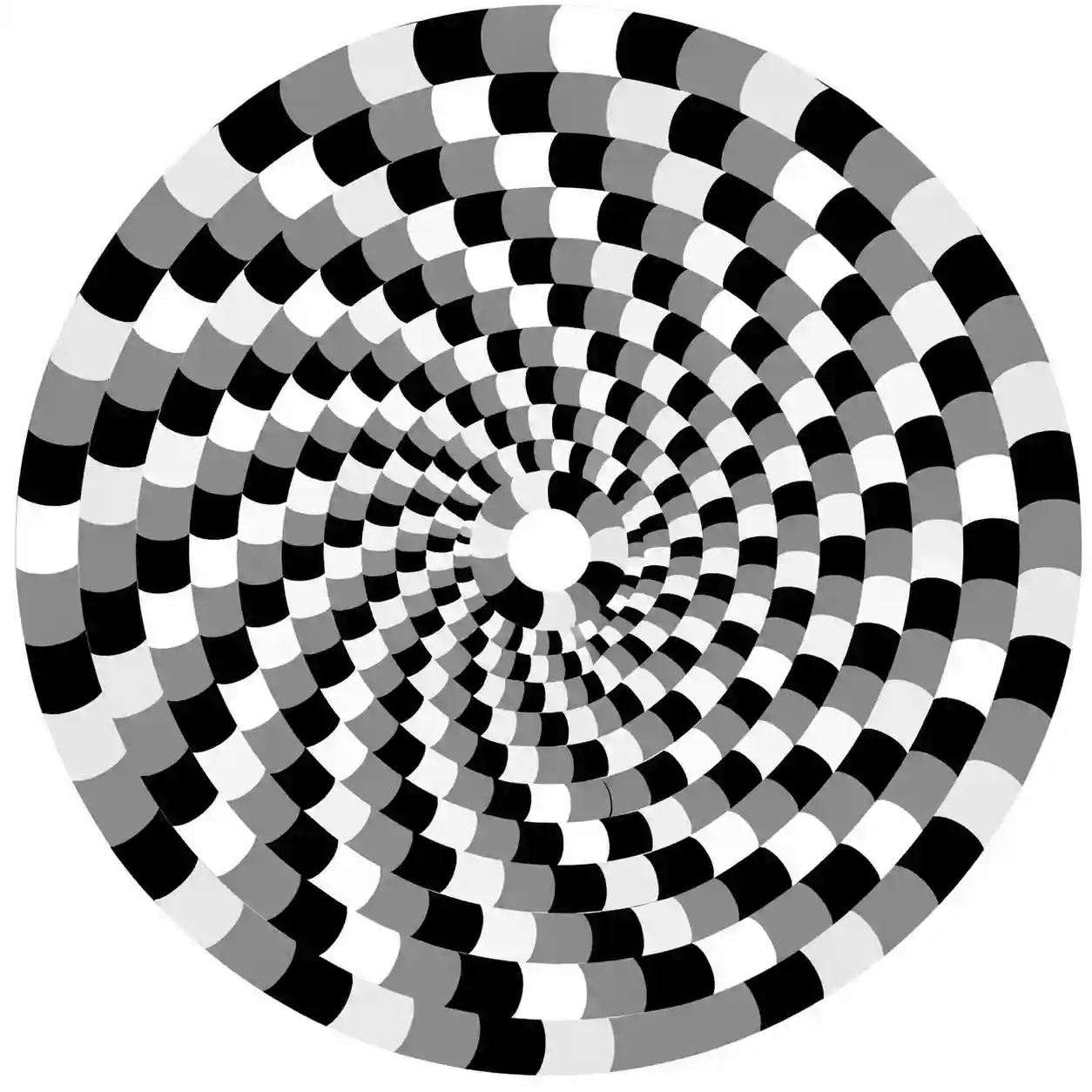 Motion
Rotating Snakes Illusion
A completely still image built from repeating rings of asymmetric color gradients that appears to writhe and rotate on its own - one of the strongest static-image motion illusions known.
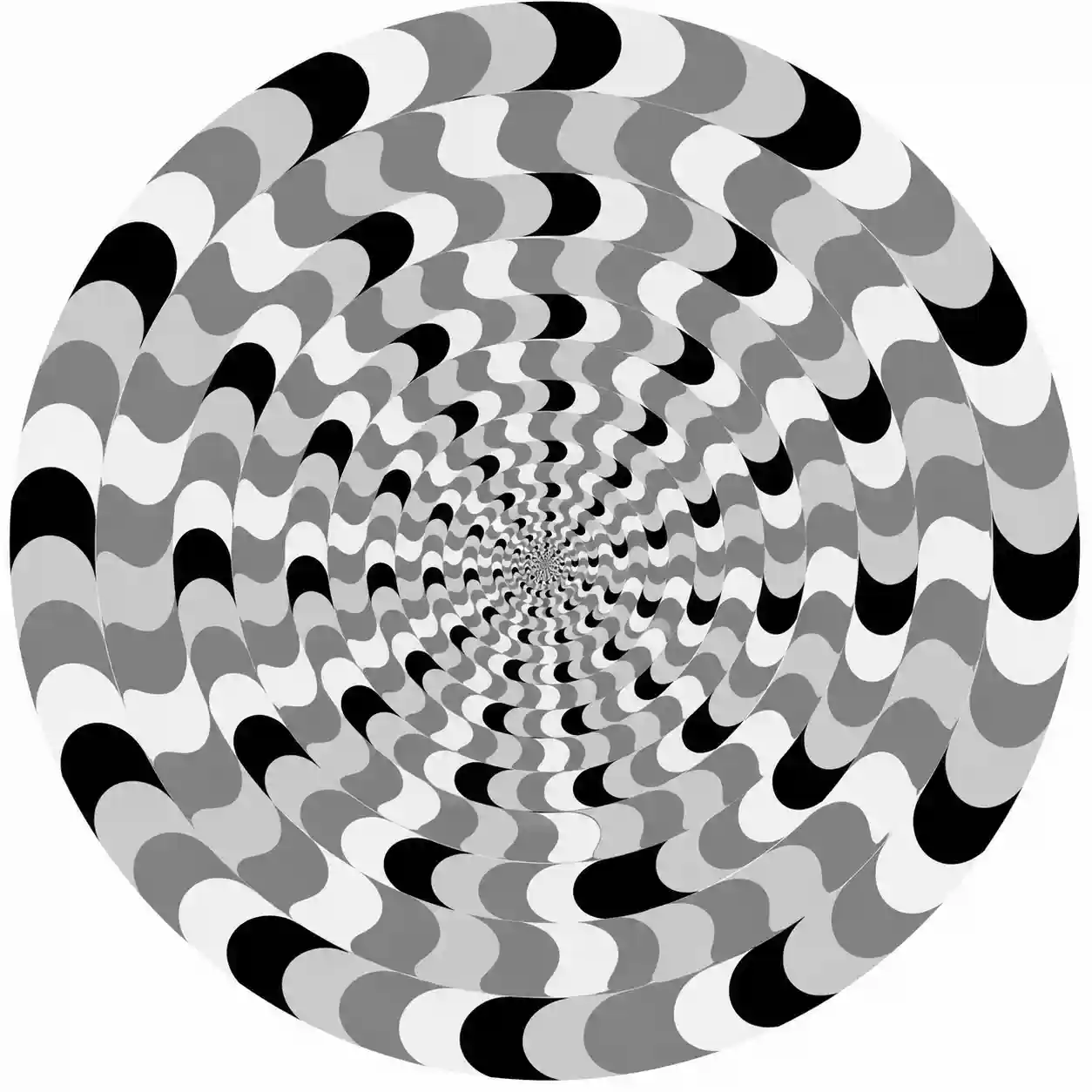 Motion
Peripheral Drift Illusion
A broad category of static repeating patterns that appear to drift or shimmer whenever they sit outside the direct focus of your gaze, thanks to asymmetric brightness gradients.