 Optical Wonderful
Moon Illusion (Why the Moon Looks Bigger at the Horizon)
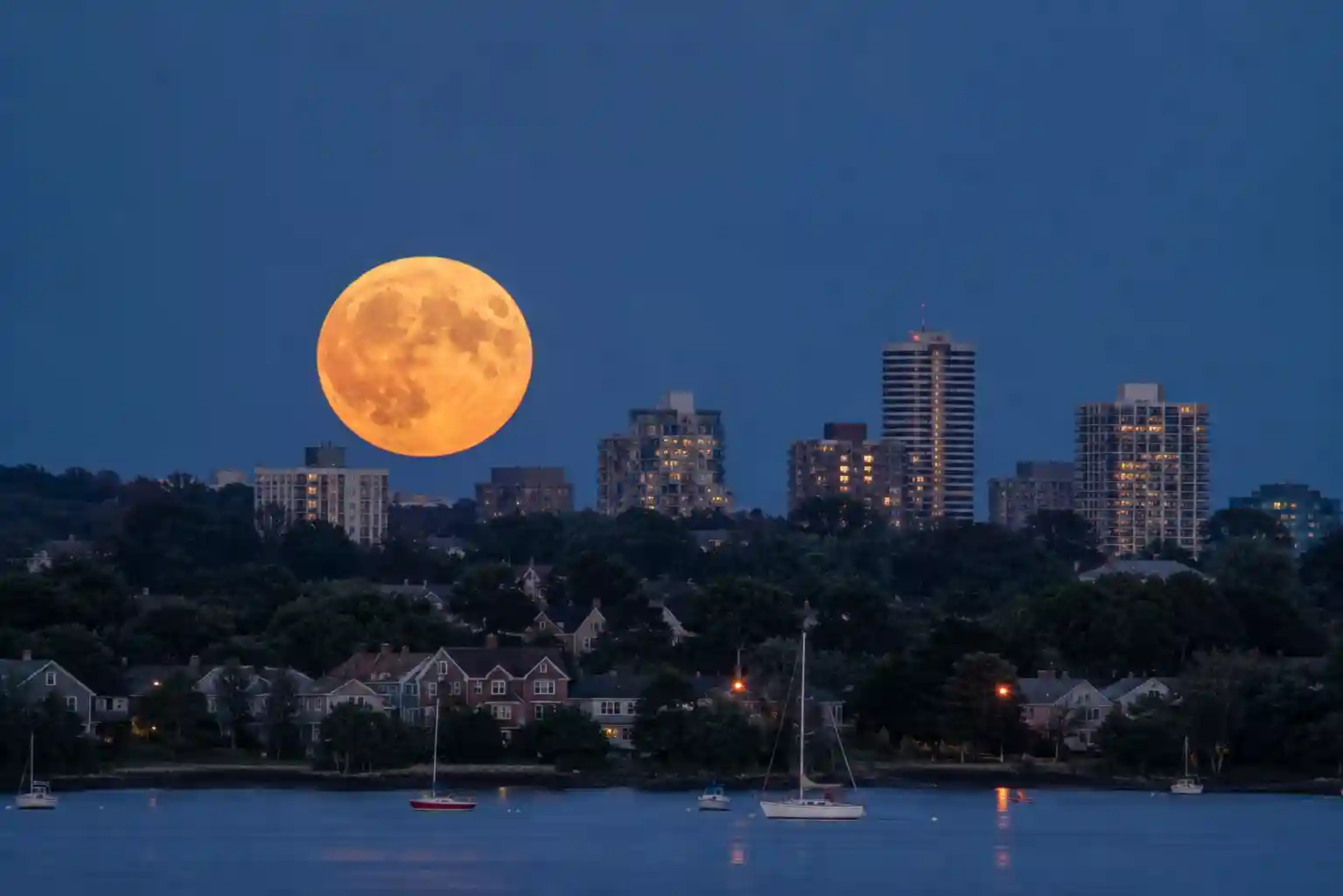
A full moon low on the horizon looks dramatically larger than the same moon high overhead, even though it casts an identical, measurable size on your retina in both positions.
What you're seeing
A full moon rising over a distant skyline can look enormous - noticeably, sometimes almost startlingly, bigger than the same moon a few hours later once it's climbed high overhead. Photograph both moments with a fixed camera setting, or simply hold a small object like a pencil eraser at arm's length against the moon in each position, and the two moons measure out to be exactly the same size. The moon's actual distance from Earth changes only trivially over the course of one night, nowhere near enough to explain a visible size difference - the entire effect happens in your perception, not in the sky.
An illusion without one settled explanation
Unlike most illusions on this site, the moon illusion doesn't have a single, broadly agreed-upon mechanism, despite having been noticed and written about for well over two thousand years. Several serious explanations remain in active discussion among vision scientists, and the honest, current answer is that more than one of them is probably contributing at once rather than any single theory being the full story.
The relative-size (or Ponzo-style) explanation
One leading account treats the horizon moon illusion as a variant of the same size-contrast logic behind the Ponzo illusion. Near the horizon, the moon sits close to buildings, trees, hills, and other objects of familiar, comparable scale, all of which the moon dwarfs - a direct size comparison that's simply unavailable when the moon is high in an empty sky with nothing nearby to judge it against. Under this account, it's less that the horizon moon looks abnormally large and more that the overhead moon, with no reference objects nearby, looks smaller than it otherwise would.
The apparent-distance theory
A second long-standing account, often traced back centuries and refined across the 20th century, argues that the sky itself doesn't look like a true dome to the human visual system - it looks flattened, like the inside of a shallow bowl, with the horizon subjectively read as farther away than the zenith directly overhead, even though both are, strictly, at the same effectively infinite astronomical distance. Under that flattened-sky perception, an object of fixed angular size that appears to be at the "farther" horizon distance gets automatically up-scaled by the same size-constancy machinery that makes a distant person judged to be far away look appropriately sized rather than tiny - the same size-constancy principle at work in the Ames room, just running in the opposite, size-inflating direction here.
The angle-of-gaze theory
A third explanation focuses on eye and head position rather than the surrounding landscape: looking up at an elevated moon requires tilting the eyes or head upward, while looking at a horizon moon involves a level, straight-ahead gaze, and some research has found that the angle of the eyes in their sockets alone - tested even with landscape cues removed, such as viewing the moon lying down versus standing up - can shift perceived size. This theory suggests part of the effect may be tied to oculomotor signals rather than purely to visual context, which would help explain why the illusion doesn't fully disappear even in situations where horizon reference objects are absent, such as over open ocean or from an airplane.
Why no single theory has won out
Each explanation accounts for part of the evidence but struggles with other parts on its own - the relative-size account struggles to fully explain why the illusion persists over featureless horizons like open ocean, while the apparent-distance and angle-of-gaze theories have had inconsistent experimental support across different studies and viewing setups. Most current researchers treat the moon illusion as most likely multi-causal, with contextual comparison, perceived sky shape, and gaze angle each contributing some share of the total effect, rather than looking for one explanation to displace the others entirely.
A trick you can prove to yourself
Whatever the ultimate cause, the moon illusion is one of the easiest illusions to personally verify with almost no equipment. Holding any small fixed reference object at arm's length against the moon at both horizon and zenith, or viewing the horizon moon through a small tube or rolled-up paper that blocks out the surrounding landscape - a rough test of the relative-size explanation - reliably shrinks or eliminates the perceived size difference for most people, even though nothing about the moon itself has changed between the two observations.
Related reading
The moon illusion shares its size-constancy foundation with the Ponzo illusion and the Ebbinghaus illusion, both of which isolate a piece of the same "size judged relative to context" principle in a controlled, drawn form rather than the sky.
Read the science behind why this happens →
Related illusions
Ponzo Illusion
Two identical bars look like different lengths when placed across a pair of converging lines, because the brain reads the converging lines as a hint about distance.
Size & PerspectiveEbbinghaus Illusion
Two identical center circles look like completely different sizes depending only on whether they're surrounded by a ring of large circles or a ring of small ones.
 Size & Perspective
Ames Room Illusion
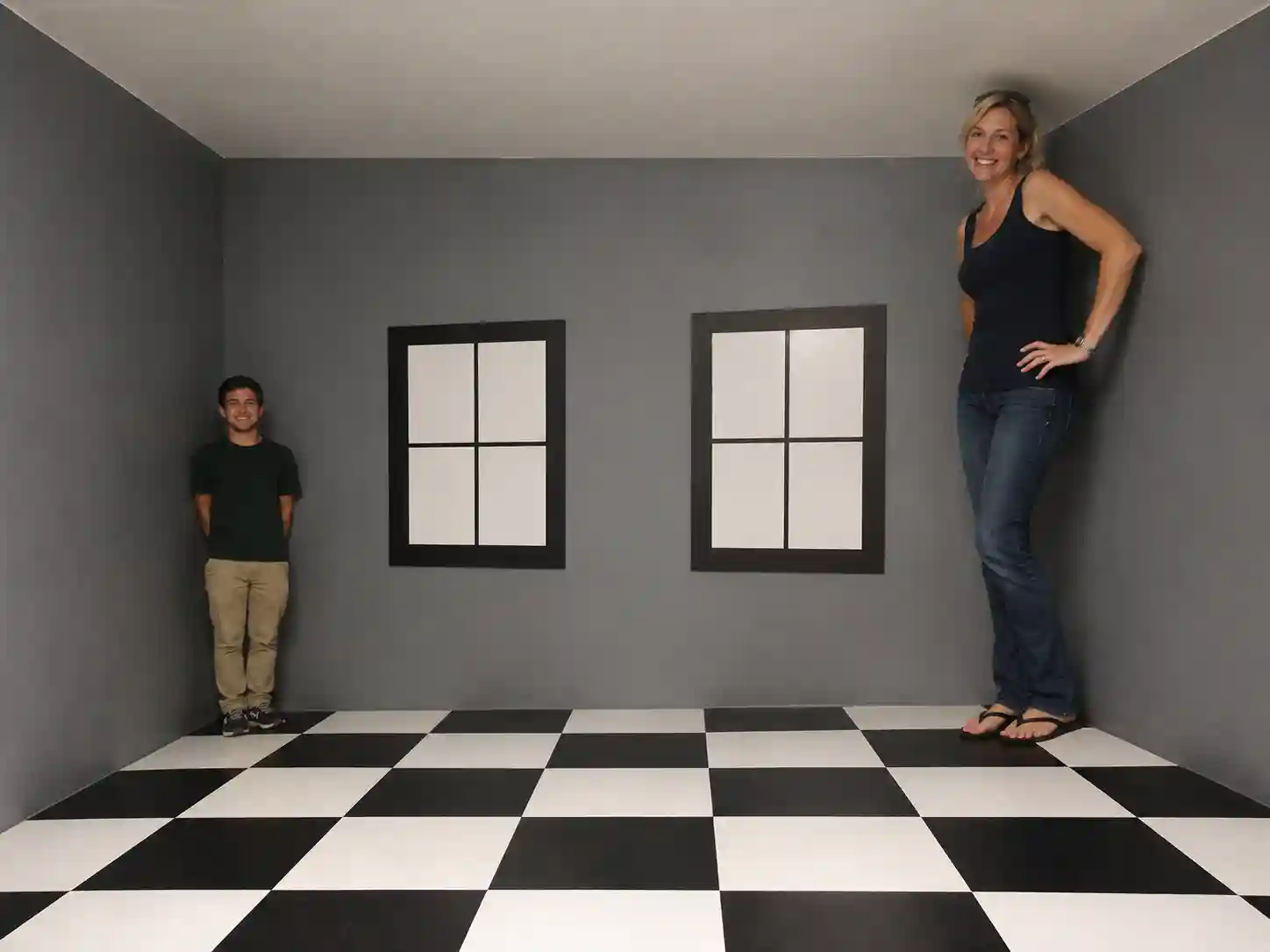
A distorted, trapezoidal room that looks perfectly rectangular from one exact viewing point, making people standing in opposite corners appear to shrink or grow to impossible sizes.