 Optical Wonderful
Akiyoshi Kitaoka
The Japanese psychologist behind Rotating Snakes and dozens of other peripheral-drift illusions that use color and contrast alone to create the sensation of motion in a completely static image.
Akiyoshi Kitaoka is a professor of psychology at Ritsumeikan University in Kyoto, Japan, and by a wide margin the most prolific creator of static motion illusions working today. Unlike most of the other figures in this collection, whose signature illusions were discovered or formalized decades ago, Kitaoka's most famous work is a product of the internet era - designed, published, and popularized largely from the early 2000s onward, spreading first through academic circles and then rapidly across email forwards and social media as an unusually shareable kind of visual puzzle.
Rotating Snakes
Kitaoka's best-known creation, Rotating Snakes (2003), is a grid of tiled, coiled patterns, each built from repeating high-contrast wedges of black, white, blue, and yellow arranged in a specific asymmetric sequence around each ring. Stare directly at the center of the image and the pattern appears mostly still; look slightly away, letting your peripheral vision take over, and the "snakes" appear to rotate continuously, even though nothing on the page is moving or animated in any way. The effect is strong enough that many viewers assume, on first encounter, that they are looking at a genuinely animated GIF rather than a static illustration - it is frequently misidentified this way when shared online.
The illusion belongs to a category researchers call peripheral drift illusions: static images that produce a strong illusory sense of motion, typically strongest in peripheral vision and driven by the specific luminance and color sequence of repeating asymmetric patterns. The leading explanation involves small differences in the processing latency of neurons responding to different luminance levels - dark, mid-tone, and light regions of the pattern are thought to be registered by the visual system at very slightly different speeds, and that timing mismatch gets misread by motion-detecting neurons as if the pattern itself were shifting.
A prolific output
Rotating Snakes is only the most viral entry in a very large body of work. Kitaoka maintains an extensive personal catalog of original illusions covering peripheral drift, brightness and color contrast effects, geometric distortion, and apparent-motion patterns, many of which he has also contributed to academic publications on visual perception. He has collaborated with vision scientists studying the neural basis of illusory motion, and several of his illusion designs have been used directly as stimuli in published perception research rather than existing only as popular curiosities - a relatively unusual position for an artist-researcher whose work also circulates as internet ephemera.
Why it matters to illusion research
Kitaoka's work is significant to the field for two distinct reasons. Scientifically, his illusions provide clean, strong, reproducible test cases for studying how timing differences in early visual processing can be misread by the brain as motion - useful stimuli precisely because the effect is so robust and so easy to vary systematically (changing the color sequence, contrast, or spacing of the pattern predictably strengthens or weakens the perceived rotation). Culturally, Kitaoka did more than almost anyone to demonstrate that optical illusions could function as native content for the social web: shareable, instantly graspable, and requiring no caption to communicate why they're remarkable. That combination - rigorous enough to appear in psychology papers, accessible enough to go viral - is a large part of why "rotating snakes" remains one of the most recognizable optical illusions of the twenty-first century, discovered by a great many people not in a classroom but in a shared link.
Illusions connected to Akiyoshi Kitaoka
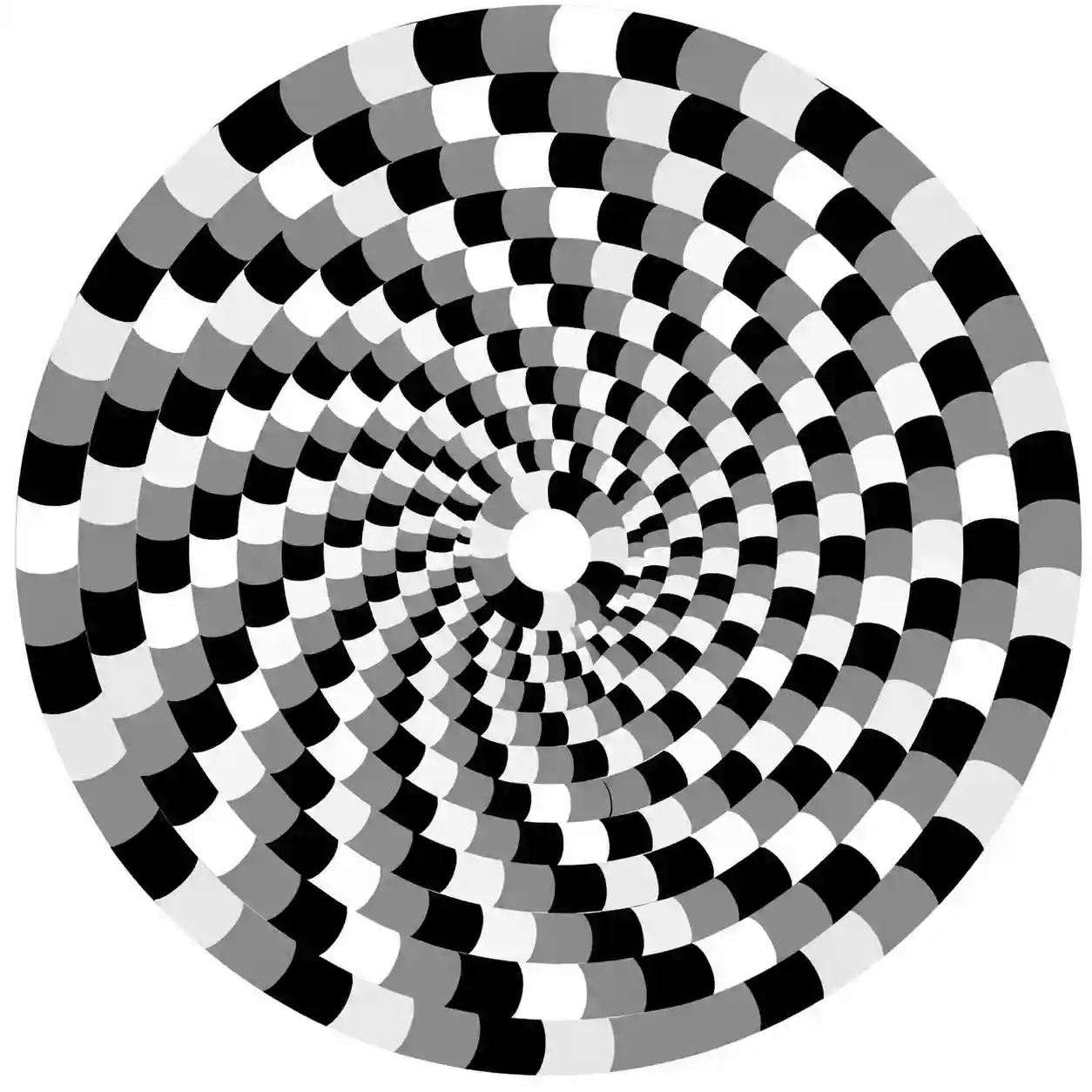 Motion
Rotating Snakes Illusion
A completely still image built from repeating rings of asymmetric color gradients that appears to writhe and rotate on its own - one of the strongest static-image motion illusions known.
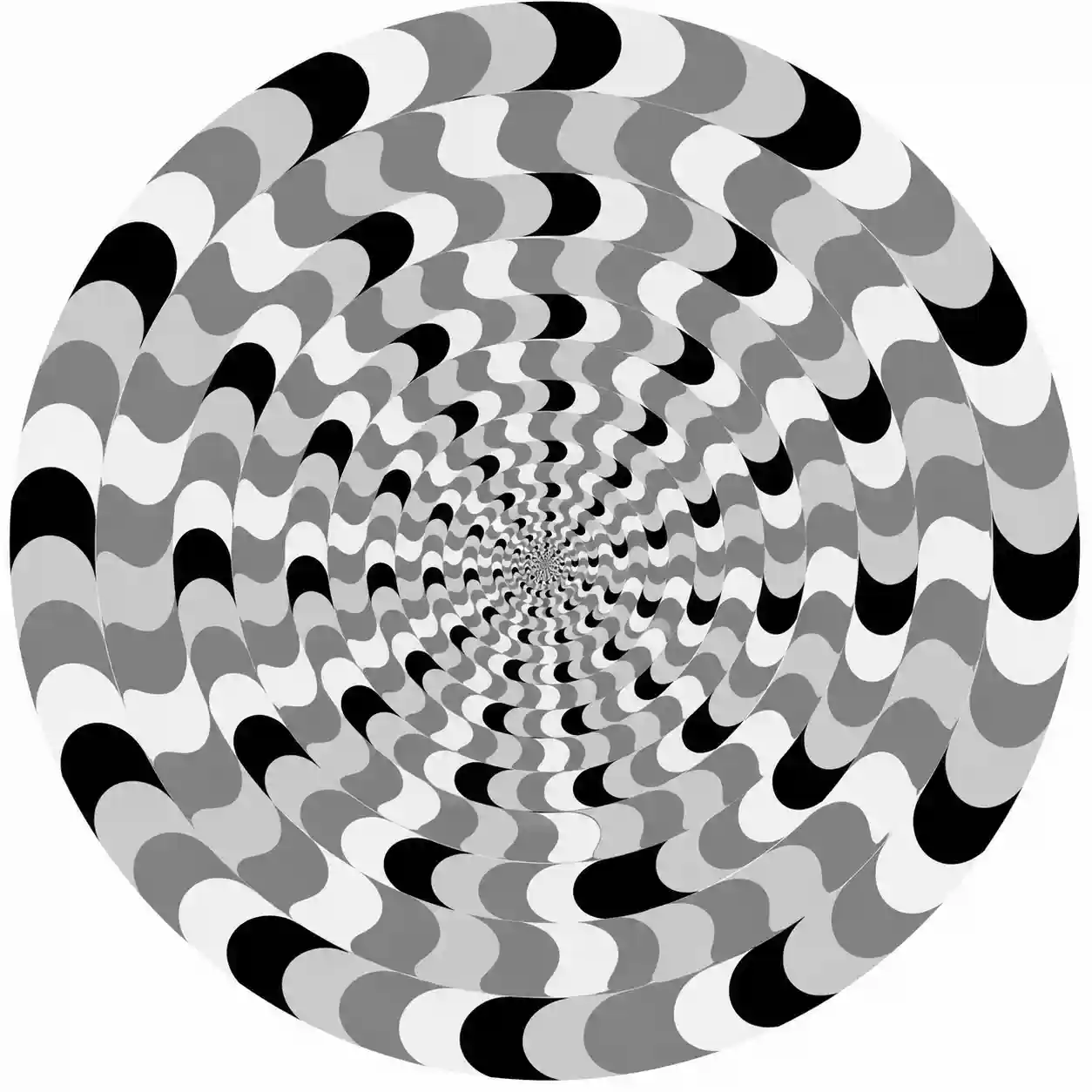 Motion
Peripheral Drift Illusion
A broad category of static repeating patterns that appear to drift or shimmer whenever they sit outside the direct focus of your gaze, thanks to asymmetric brightness gradients.
 Depth
Depth
Chromostereopsis (Color Depth Illusion)
Flat patches of saturated red and blue, printed at the exact same distance from your eye, can appear to float at different depths purely because of how your eye focuses different wavelengths of light.