 Optical Wonderful
Rotating Snakes Illusion
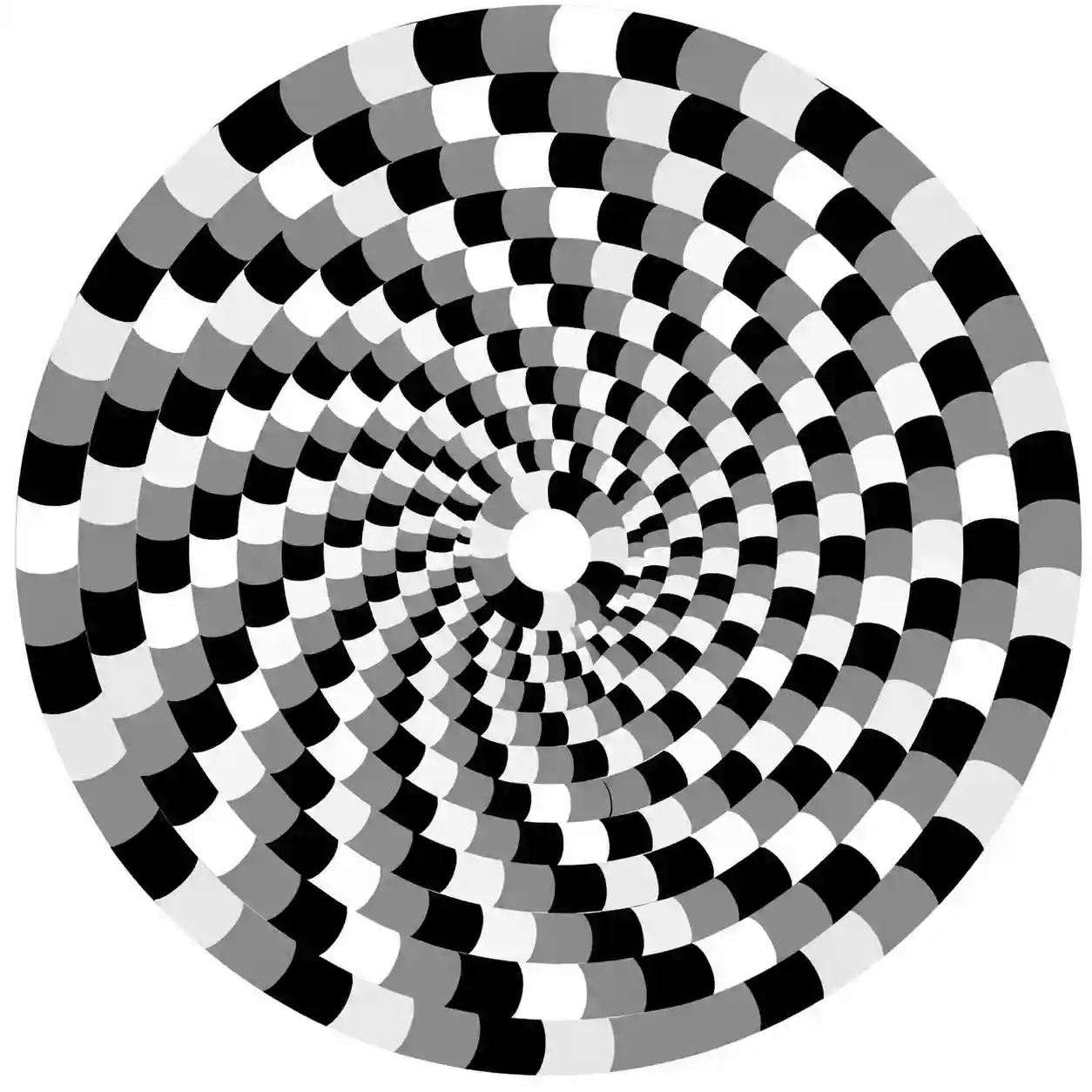
A completely still image built from repeating rings of asymmetric color gradients that appears to writhe and rotate on its own - one of the strongest static-image motion illusions known.
What you're actually looking at
Despite everything your eyes are telling you, the rotating snakes illusion is a single, unmoving, static image. There is no animation, no video loop, and no flicker hidden in the file - if you were to print it on paper, cut it out, and hold it perfectly still under steady light, it would do exactly what the screen version does: appear to crawl, drift, and rotate in lazy circles the moment your eyes leave center. Each "snake" is a ring made of repeating wedge-shaped segments, and each segment cycles through the same four-step sequence of tones: black, dark blue, white, light yellow, repeated around the circle. Several of these rings, nested or arranged in a grid, make up the full image.
Why a still image seems to crawl
The rotating snakes illusion belongs to a family of effects called peripheral-drift illusions, and the mechanism lives in how quickly your visual system processes different brightness levels. High-contrast, high-luminance regions (the whites) get registered slightly faster than low-luminance regions (the darks). Where the tonal sequence around each segment is symmetric, those timing differences cancel out. But Kitaoka's snake segments use a deliberately asymmetric ramp - a sharp jump from black to white on one side of the segment, and a slow, gradual fade from white back down to black on the other - and that asymmetry means the "fast" and "slow" signals don't cancel. Instead they leave a small residual signal that your brain's motion-detecting neurons interpret as consistent directional movement, even though nothing has physically moved. Stack that false motion signal across dozens of repeating segments in a ring, and the whole ring reads as spinning.
Why your peripheral vision makes it worse
The effect is strongest when the image sits in your peripheral vision rather than dead-center in your gaze, which is where "peripheral" in peripheral-drift illusion comes from. Peripheral vision has coarser spatial resolution and leans more heavily on exactly the fast, motion-sensitive visual pathways that this asymmetric gradient trick exploits, while your fovea - the sharp, central patch of your retina - is comparatively better at resolving fine static detail and less prone to being fooled. Small, involuntary eye movements called microsaccades, which happen constantly even when you think you're holding perfectly still, also feed the effect: each tiny jitter of the eye re-triggers the same asymmetric luminance response in the regions of the ring you aren't directly fixating. That's why staring hard at one exact point can calm a single ring down while the rings around it in your peripheral field keep churning.
Does everyone see it the same way?
Not identically. The strength of the illusion varies noticeably between individuals and tends to fade somewhat with age, likely tied to changes in retinal processing speed and contrast sensitivity. Fatigue, certain visual conditions, and simply how long you've been staring at a screen can all shift how strongly the snakes appear to move. It's also one of the illusions most commonly cited in discussions of photosensitivity, since the repeating high-contrast pattern can be uncomfortable - or worse - for some viewers even though nothing on the page is actually animating.
A little history
Akiyoshi Kitaoka, a professor of psychology at Ritsumeikan University in Japan, created the rotating snakes image around 2003 as part of a broader body of work on peripheral-drift and motion-illusion design. He and colleague Hiroyuki Ashida had studied the underlying peripheral-drift effect in earlier academic work, and Kitaoka's snake-ring composition became by far its most famous and widely circulated expression, reproduced constantly online, in textbooks, and in museum exhibits on visual perception. Kitaoka has since published dozens of variations built on the same asymmetric-gradient principle, but the original rotating snakes remains the version most people mean when they describe a "static image that moves."
Related reading
For two more illusions built on the same false-motion machinery, see the peripheral drift illusion and the motion aftereffect, which produces the opposite experience - real motion that leaves behind an illusion of movement in a scene that has actually stopped.
Read the science behind why this happens →
Related illusions
 Motion
Peripheral Drift Illusion
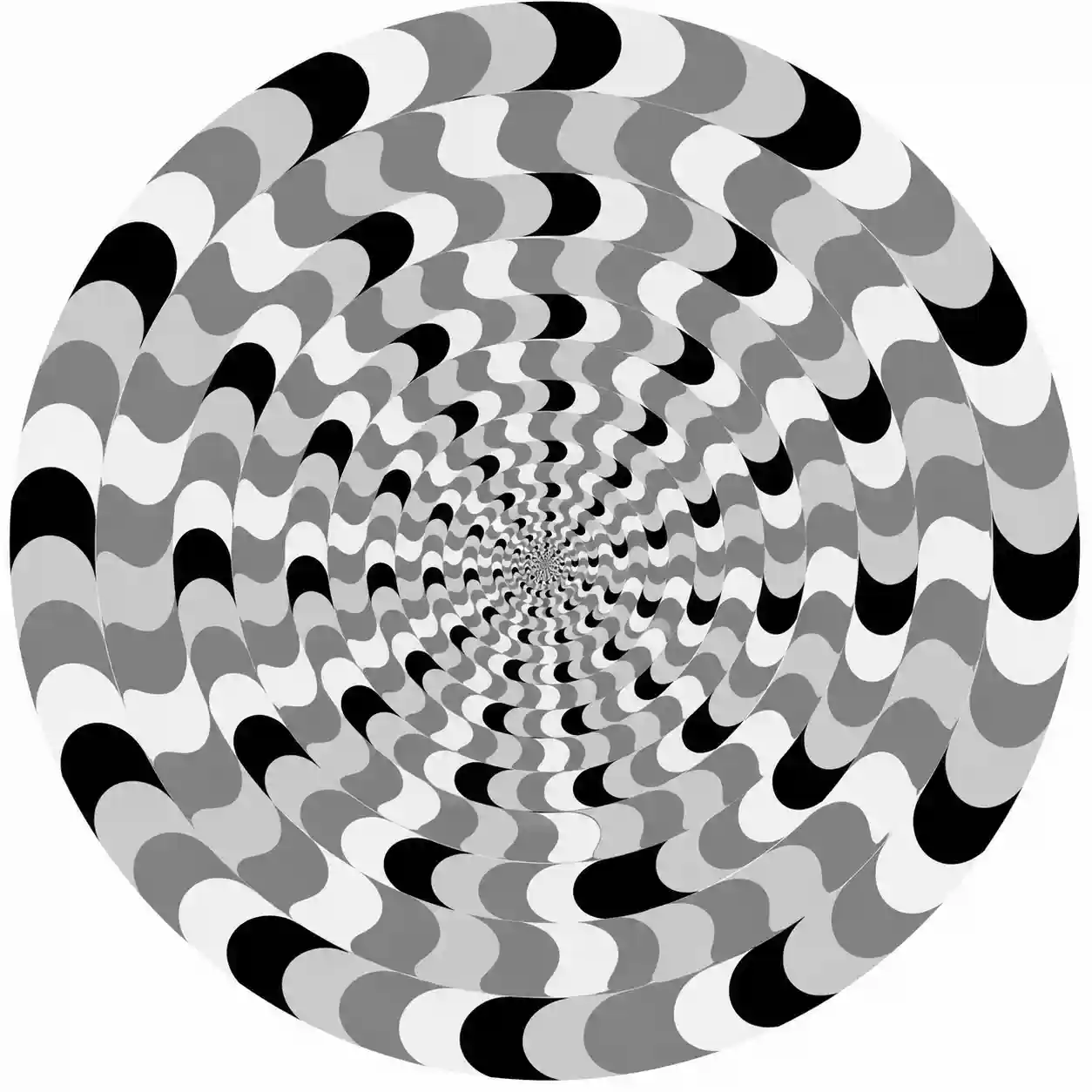
A broad category of static repeating patterns that appear to drift or shimmer whenever they sit outside the direct focus of your gaze, thanks to asymmetric brightness gradients.
 Motion
Motion Aftereffect (Waterfall Illusion)
Stare at flowing water or a spinning pattern for half a minute, then look at something still - and the stationary scene will appear to drift in the opposite direction for a few seconds.
MotionBarber Pole Illusion
The diagonal stripes on a barber's pole appear to travel upward forever, even though they're only ever rotating sideways around a cylinder - a classic case of the visual system solving an ambiguous motion problem badly.