 Optical Wonderful
Julian Beever
The English chalk artist who popularized photographable 3D pavement drawings - anamorphic street art that appears to leap off the ground, but only when viewed from one specific camera angle.
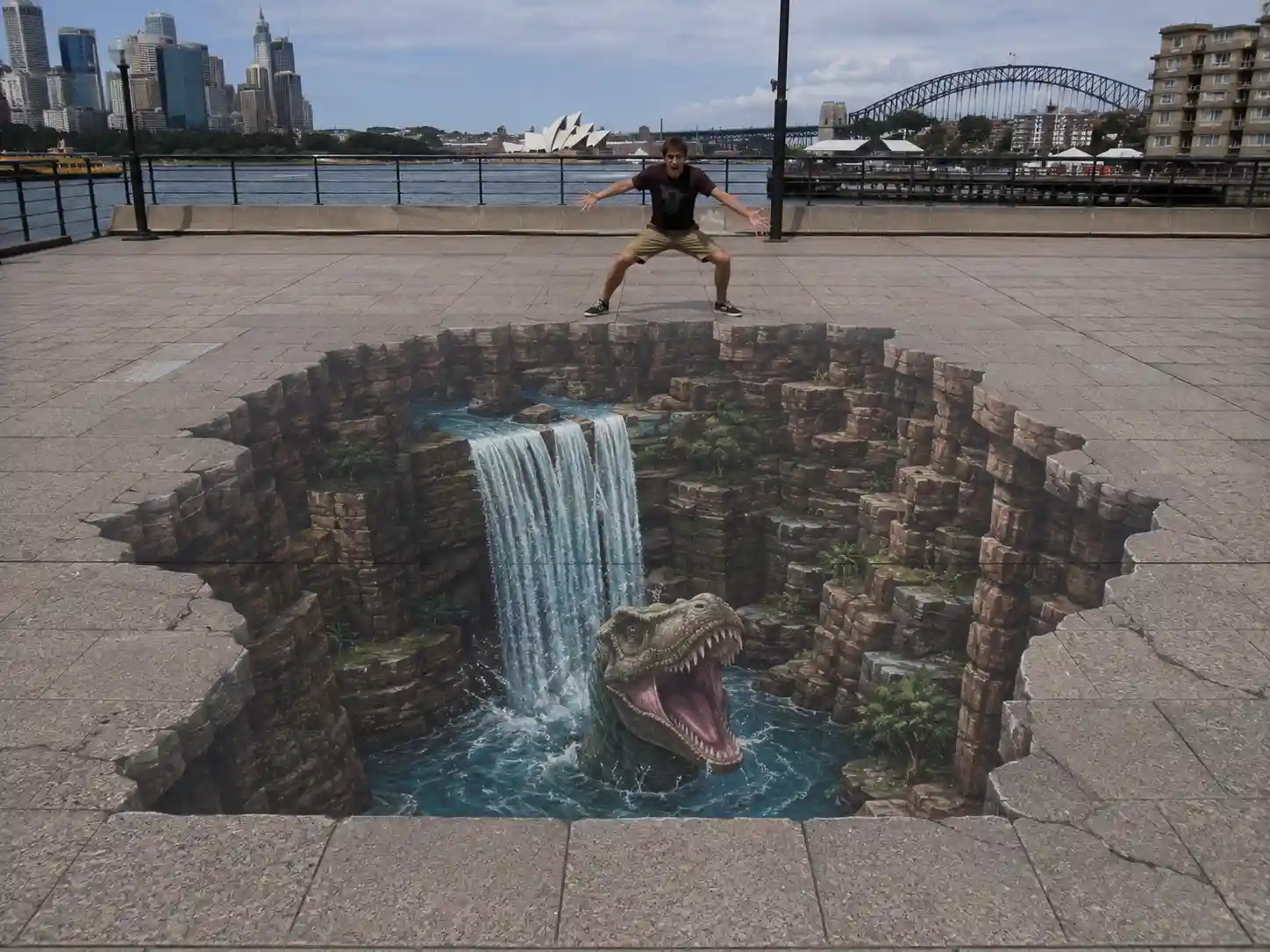
Julian Beever is an English artist widely credited with popularizing a specific, highly photogenic form of street art: chalk drawings on pavement that appear, from one specific vantage point, to be three-dimensional objects or scenes plunging into or rising out of the ground - collapsing swimming pools, yawning chasms, giant figures reaching up from the pavement toward passersby. From almost any other angle, the same drawing reveals itself as a stretched, distorted smear of chalk across flat concrete, bearing little resemblance to the crisp illusion it produces from the correct viewpoint.
The technique
Beever's method is a practical, hand-executed application of anamorphic projection: rather than drawing the intended scene as it would naturally look, he works out - traditionally through careful eye and grid-based measurement rather than digital tools in his earlier career - how a three-dimensional scene needs to be stretched and skewed across the flat ground so that it reconstructs correctly when photographed from one specific camera position, usually a fairly steep, elevated angle looking down and across the drawing. Because the human eye and a camera lens both interpret a scene by assuming a single consistent viewpoint, a drawing engineered for exactly that viewpoint will "snap" into apparent three-dimensionality when seen from the correct spot, in much the same way forced-perspective photography can make a person appear to hold up a distant building.
Beever began producing this work as street art in the 1990s, busking with chalk drawings on pavements in the UK and Europe, and gradually built a career and public profile around the pieces as they proliferated online through the 2000s - his images circulated widely as some of the earliest viral optical-illusion content on the internet, frequently reposted (and, notably, sometimes misattributed to other artists) well beyond the art-world audience such pavement work would traditionally reach. His drawings often incorporate real passersby into the photographed composition, who appear to be interacting with the illusory 3D scene - reaching into a chasm, standing on the edge of a pool - which added to the images' appeal as shareable, self-explanatory visual novelties.
Beyond the pavement
While pavement chalk drawings remain Beever's signature form, he has also produced anamorphic work using paint on larger surfaces and has spoken publicly about the underlying technique, helping popularize "3D street art" as a recognized genre that numerous other artists around the world have since adopted and extended, including some working with more elaborate multi-figure scenes and painted rather than chalk media.
Why it matters to illusion research
Beever's work is significant less for introducing a new perceptual principle - the anamorphic projection technique long predates him, with roots in Renaissance-era trompe l'oeil and perspective painting - and more for demonstrating how effectively that principle translates into ephemeral, public, camera-ready art in the internet era. His drawings function as an accessible, hands-on illustration of the same viewpoint-dependent geometry exploited by forced-perspective photography and by installation artists working at architectural scale: move away from the single calculated vantage point, and the illusion of depth collapses immediately into visibly distorted flat chalk, making the underlying mechanism unusually easy for a general audience to grasp and even attempt themselves with sidewalk chalk.
Illusions connected to Julian Beever
 Depth
Depth
Anamorphic Chalk and Street Art Illusions
Street and chalk paintings drawn as heavily stretched, warped shapes that only resolve into a convincing 3D scene when viewed from one specific, carefully calculated angle.
 Size & Perspective
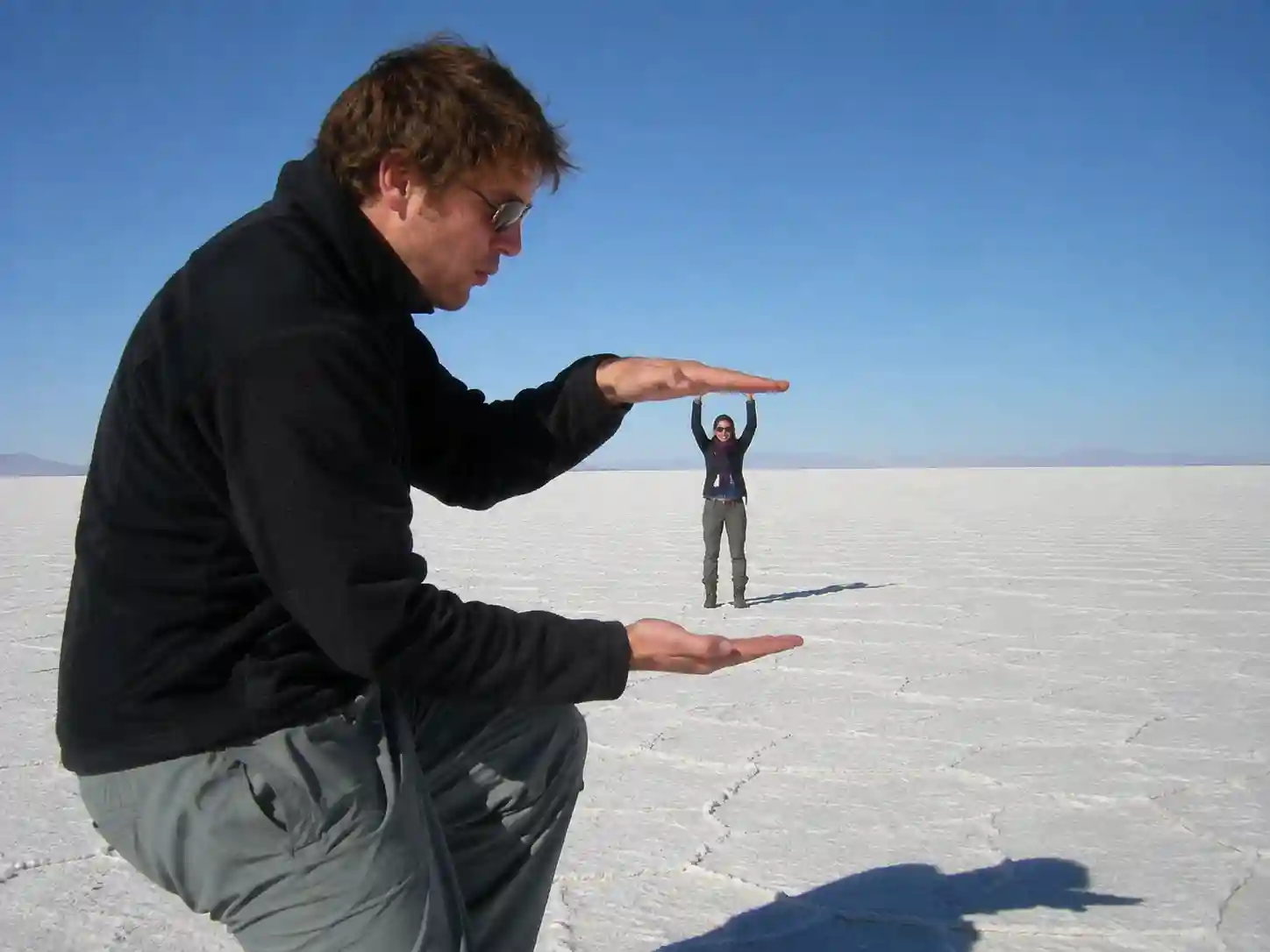
Forced Perspective (Photography Technique)
A deliberate camera trick that makes objects at different distances look like they're the same size, or vice versa, by carefully aligning them along a single line of sight.
 Size & Perspective
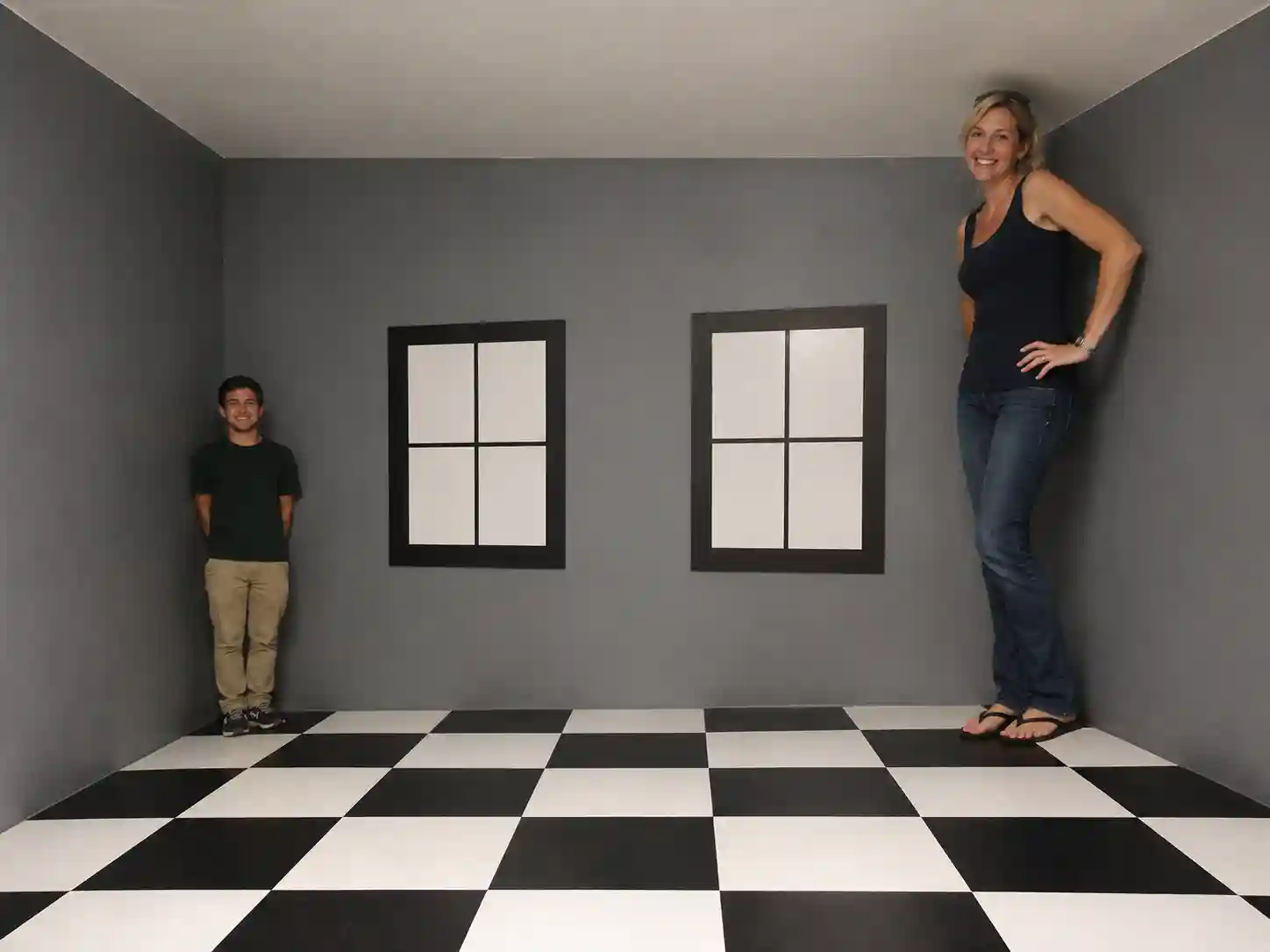
Ames Room Illusion
A distorted, trapezoidal room that looks perfectly rectangular from one exact viewing point, making people standing in opposite corners appear to shrink or grow to impossible sizes.