 Optical Wonderful
M.C. Escher
The Dutch graphic artist whose lithographs of impossible staircases, endless waterfalls, and interlocking tessellations turned mathematical paradox into some of the most recognizable images in art.
Maurits Cornelis Escher (1898–1972) never thought of himself as a mathematician, and for much of his career the art establishment wasn't quite sure what to do with him either. He trained as a graphic artist in Haarlem in the Netherlands, and his early work - while in Italy and Spain during the 1920s and early 1930s - was largely conventional: landscapes, portraits, and studies of Mediterranean towns. The turn that made him famous came from an unlikely source: a visit to the Alhambra in Granada, where he became fascinated by the Moorish tilework's interlocking geometric patterns. Islamic art traditionally avoided figurative imagery, but Escher wondered what would happen if those same tessellating principles were applied to birds, fish, lizards, and human figures instead of abstract shapes.
From tessellation to paradox
That fascination with pattern evolved, over the 1930s and 1940s, into something stranger: an interest in the boundaries of what a flat drawing could get away with. Escher began producing prints that looked, at first glance, like ordinary architectural or landscape scenes, but which contained a visual contradiction somewhere inside them - a structure that could be drawn consistently, line by line, yet could never exist as a physical object.
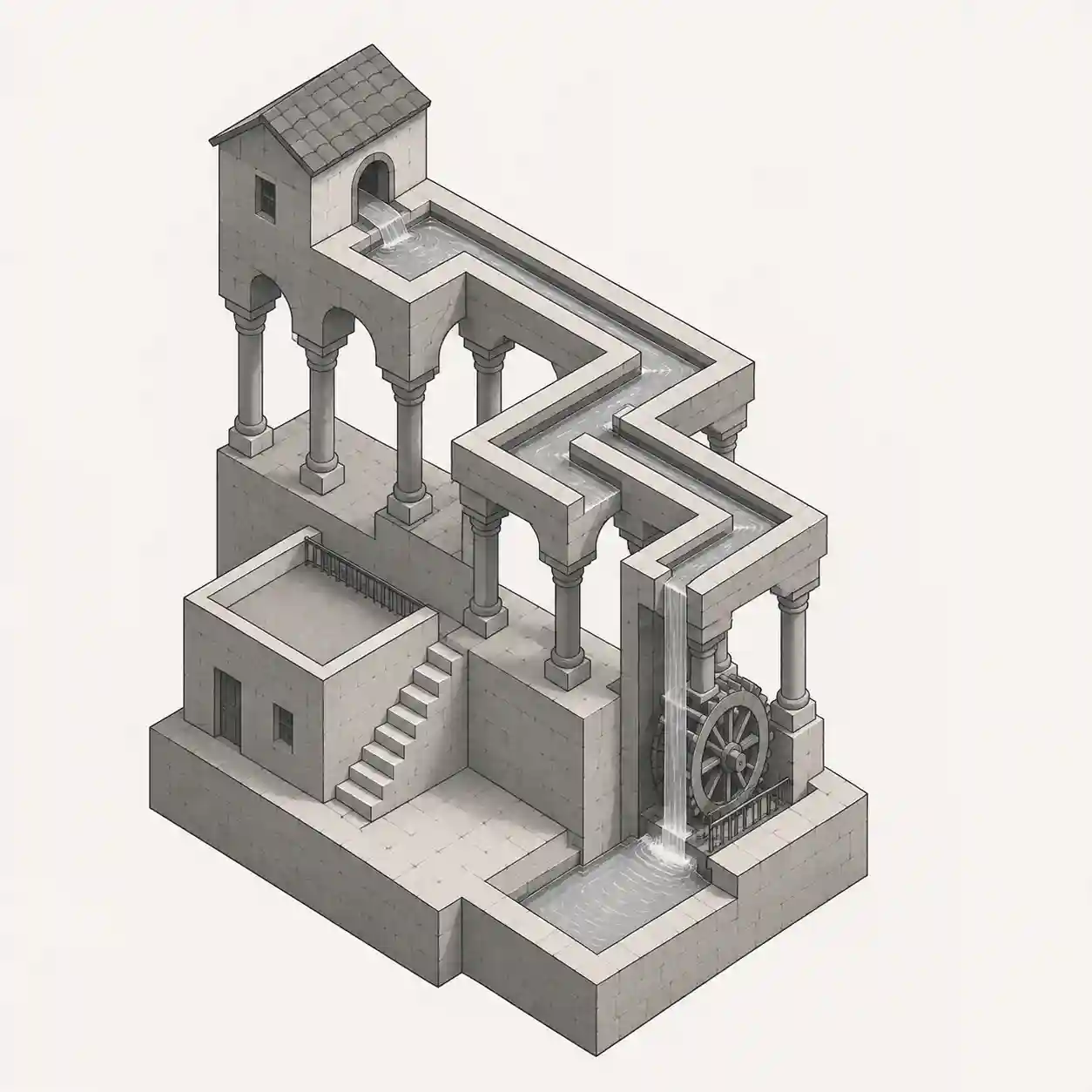
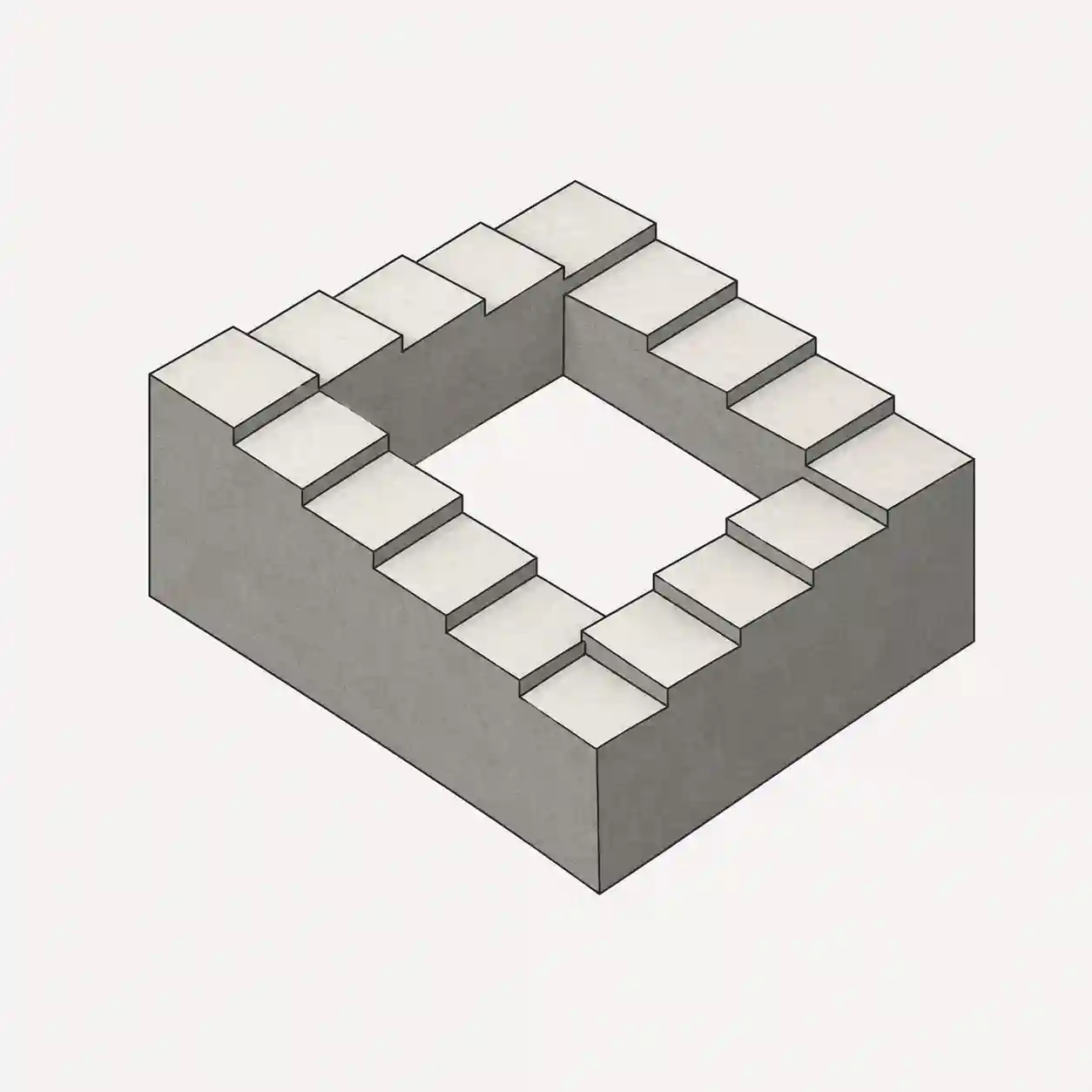
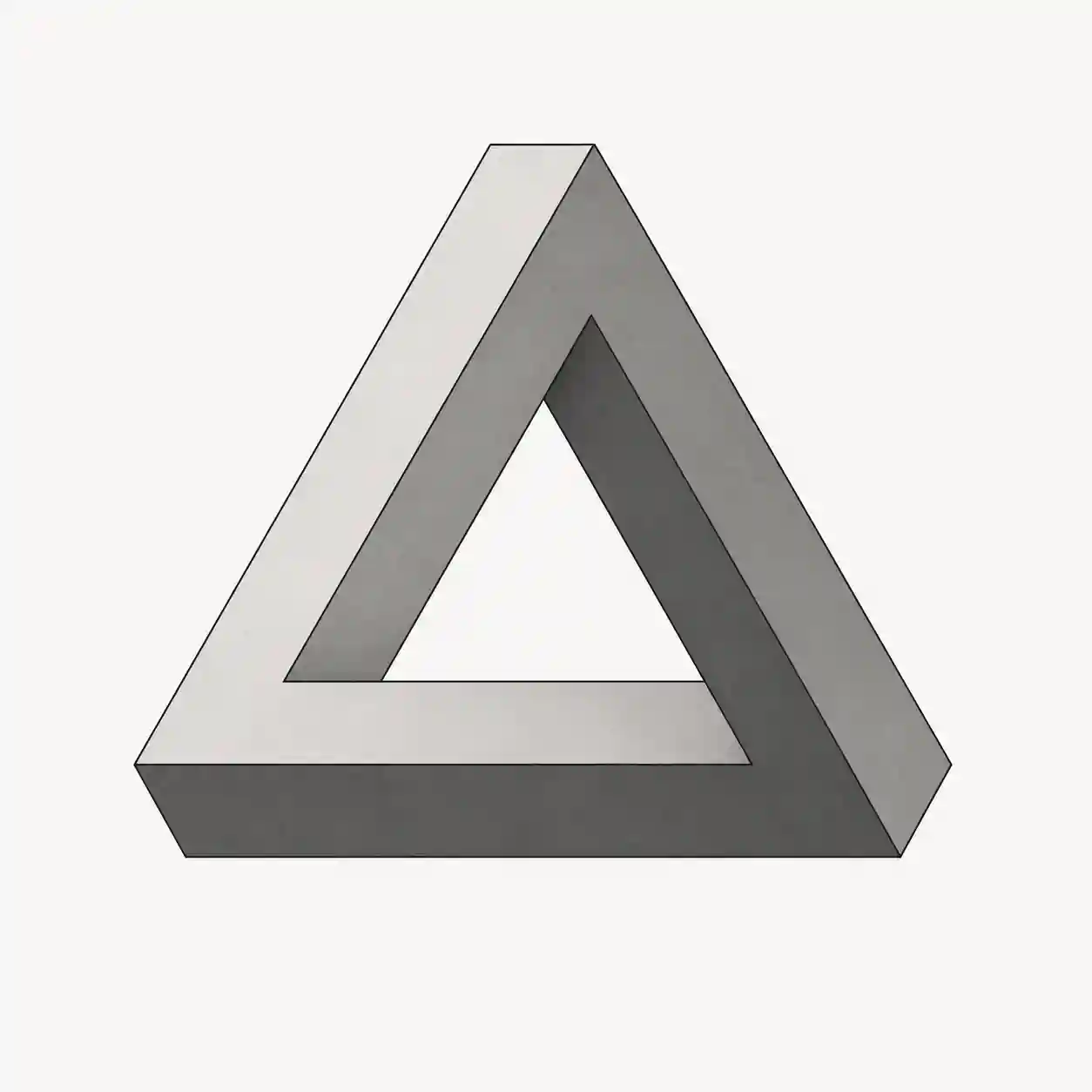
His best-known works in this vein date from the 1950s and 1960s. Ascending and Descending (1960) depicts monks endlessly climbing a staircase that loops back on itself without ever gaining height - a design directly inspired by the "Penrose stairs" concept that psychiatrist Lionel Penrose and his mathematician son Roger had published shortly before. Waterfall (1961) pushes the same trick into a different register, using a triangular impossible frame (based on the Penrose triangle) to construct an aqueduct where water appears to flow continuously downhill in a closed loop, turning a mill wheel that should be receiving no net energy at all. Escher had actually corresponded with the Penroses and openly credited their published paper as the trigger for these prints - a rare case of a working artist directly building on a peer-reviewed psychology paper.
Why it matters to illusion research
What makes Escher's work valuable beyond its visual appeal is precision. Each "impossible" print is locally correct - every joint, corner, and shadow obeys ordinary rules of perspective drawing when you look at it in isolation. The impossibility only emerges globally, once your visual system tries to assemble the local pieces into one coherent three-dimensional object and fails. This is exactly the structure that makes Penrose-style impossible figures useful to vision scientists: they show that the brain builds 3D interpretations from local, piecewise cues, and can be fooled into stitching together locally-consistent pieces that don't actually form a coherent whole.
Escher also worked extensively with tessellation, ambiguous figure-ground relationships (his Sky and Water prints slide birds into fish and back using shared contour lines), and recursive, self-referential imagery like Drawing Hands and Print Gallery. Because he approached these ideas as formal design problems rather than psychology experiments, his prints frequently anticipated or paralleled findings that vision researchers were formalizing around the same period.
Escher had no formal mathematical training, but he corresponded with mathematicians and crystallographers, including a documented exchange with Roger Penrose himself, and his notebooks show meticulous geometric planning behind even his most dreamlike compositions. Today his work sits at an unusual crossroads: reproduced constantly in psychology textbooks as a teaching example of depth-cue conflict, while also holding a permanent place in art history as one of the twentieth century's most distinctive printmaking bodies of work. Few artists have made the study of visual paradox this popular, or this rigorous.
Illusions connected to M.C. Escher
 Geometric
Escher's Waterfall (The Impossible Waterfall)
A lithograph in which water flows downhill through a zigzagging aqueduct, turns a mill wheel, and somehow ends up back at the top of the very same waterfall.
 Geometric
Penrose Stairs (The Impossible Staircase)
A staircase drawn so that each flight climbs upward into the next, all the way around a closed loop, with no floor that is ever the lowest or the highest.
 Geometric
Penrose Triangle
A closed loop of three beams that each look like an ordinary 3D bar in isolation, yet together describe an object that cannot exist in three dimensions.