 Optical Wonderful
Escher's Waterfall (The Impossible Waterfall)
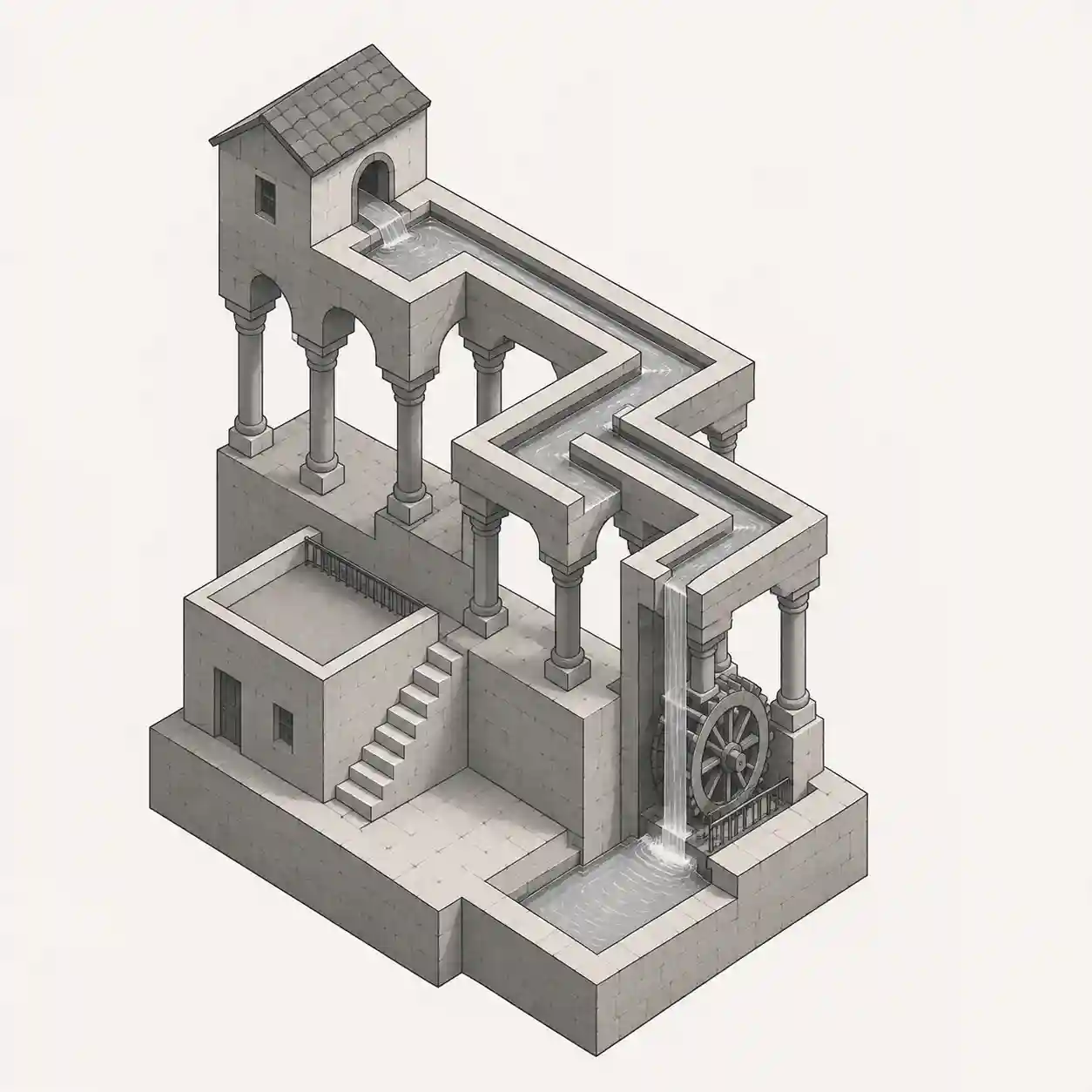
A lithograph in which water flows downhill through a zigzagging aqueduct, turns a mill wheel, and somehow ends up back at the top of the very same waterfall.
What you're seeing
M. C. Escher's 1961 lithograph Waterfall shows a zigzagging stone aqueduct carrying a channel of water. The water flows downhill, as water does, tumbles over a small waterfall, turns a mill wheel at the bottom, and then travels back up the aqueduct's channel to arrive at the very top of the same waterfall it just fell down - a closed loop that keeps the same water endlessly falling and somehow being back at the top, with no pump, no pipe running out of view, and (per the drawing's own internal logic) no elevation ever gained.
Trace the channel with your finger, one short stretch at a time, and every individual segment is completely reasonable: a stone trough running level or gently downhill, exactly as an aqueduct should. It's only the full loop - noticing that the channel has, section by section, quietly climbed the equivalent of two full stories by the time it gets back to the top of the fall - that reveals the trick.
Why it happens
Escher built Waterfall directly on top of the impossible triangle described in Lionel and Roger Penrose's 1958 paper "Impossible Objects: A Special Type of Visual Illusion," which the Penroses sent him not long after publication. Look at the two towers supporting the aqueduct and you'll find two Penrose triangles worked into the architecture, and the zigzagging channel itself is built from the same underlying trick as the Penrose triangle: a sequence of locally valid 3D joints that, followed all the way around a loop, turn out to be globally inconsistent.
What makes Waterfall especially effective - more so, many viewers report, than a bare-bones tribar diagram - is that Escher dressed the impossible geometry in a fully realized architectural scene, complete with buildings, terraces, foliage, and consistent-looking stonework. Your visual system doesn't process an isolated abstract shape here; it processes what looks like an ordinary piece of rustic engineering, rendered with enough incidental detail (moss on the stones, a person's laundry hanging nearby) that it registers as a real place before the geometric contradiction has a chance to raise a flag. The extra realism recruits the same "assume local structure predicts global structure" shortcut that makes impossible figures work in general, but it does so more convincingly, because the drawing is loaded with cues that ordinarily correlate with trustworthy, physically sound scenes.
Water that shouldn't run uphill
Part of the print's particular punch is that it isn't just a static impossible shape - it depicts continuous motion along an impossible path. Your brain has strong, well-practiced expectations about how flowing water behaves: it runs downhill, period, and any given stretch of channel is either level or sloping one way or the other. Escher's aqueduct never shows you an uphill stretch; every visible segment slopes appropriately downhill or is level, exactly the way the Penrose stairs never show you a downward step in their climbing loop. The contradiction is smuggled entirely into how the segments connect to each other, not into any individual segment, which is precisely why it survives a first, second, and often third look.
A little history
Maurits Cornelis Escher was already deep into a body of work exploring tessellation, reflection, and perspective paradoxes when he received the Penroses' 1958 paper, and he corresponded with them afterward about the geometry involved. Waterfall followed in 1961, after two earlier prints - Ascending and Descending (1960), built on the Penrose stairs, and the tessellation-heavy Relativity (1953), which predates the Penrose paper but explores related multi-gravity spatial paradoxes on its own terms. Waterfall is now among the most reproduced of Escher's impossible-object prints, frequently used in psychology and design courses specifically because it demonstrates how thoroughly a well-executed illustration can disguise a purely geometric trick as a plausible physical scene.
Related reading
Waterfall is a direct architectural expansion of the Penrose triangle, and it shares its impossible-loop logic with the Penrose stairs, the figure that inspired Escher's earlier print Ascending and Descending. The Kanizsa triangle shows a very different route to a geometrically impossible-feeling perception - one built from missing information rather than contradictory information.
Read the science behind why this happens →
Related illusions
 Geometric
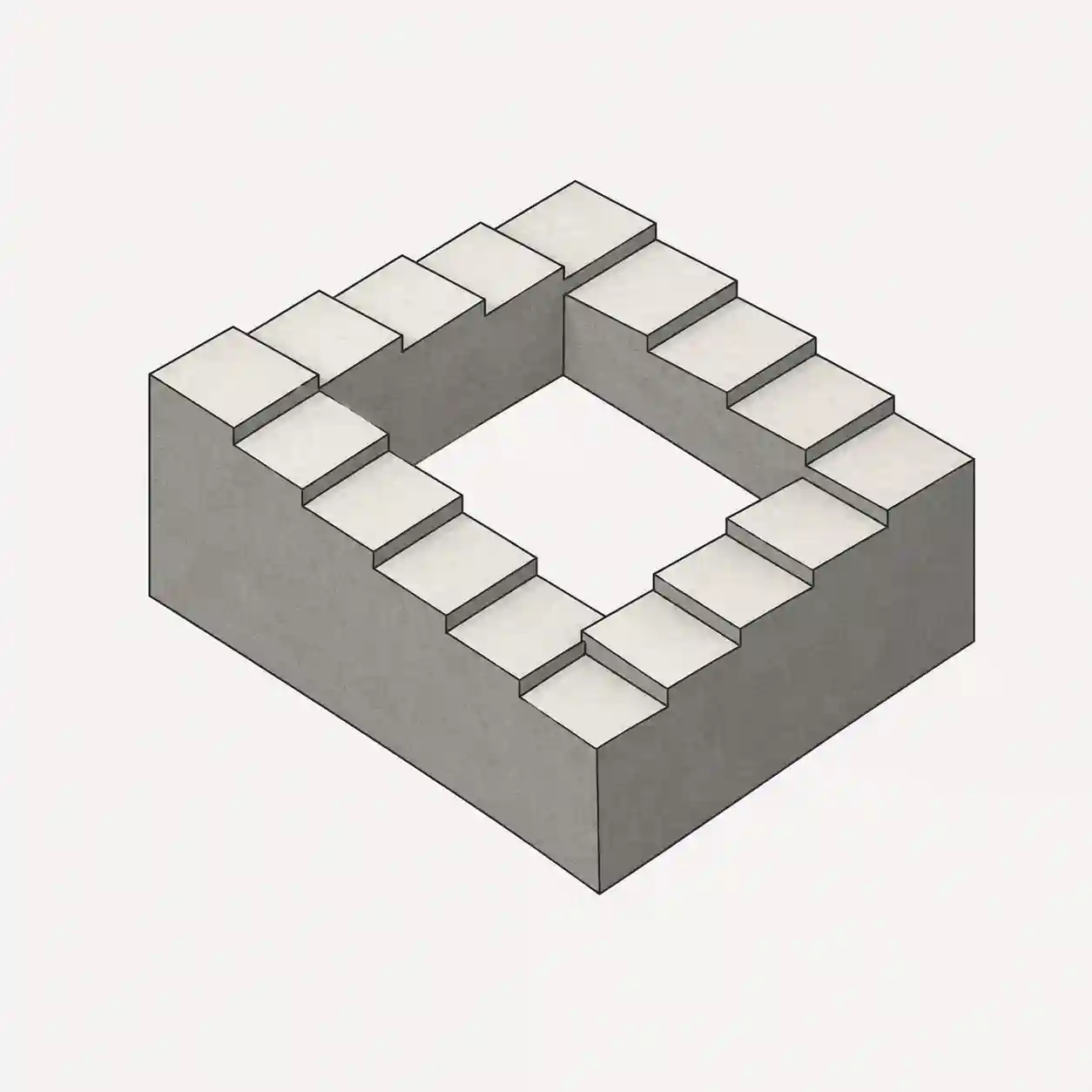
Penrose Stairs (The Impossible Staircase)
A staircase drawn so that each flight climbs upward into the next, all the way around a closed loop, with no floor that is ever the lowest or the highest.
 Geometric
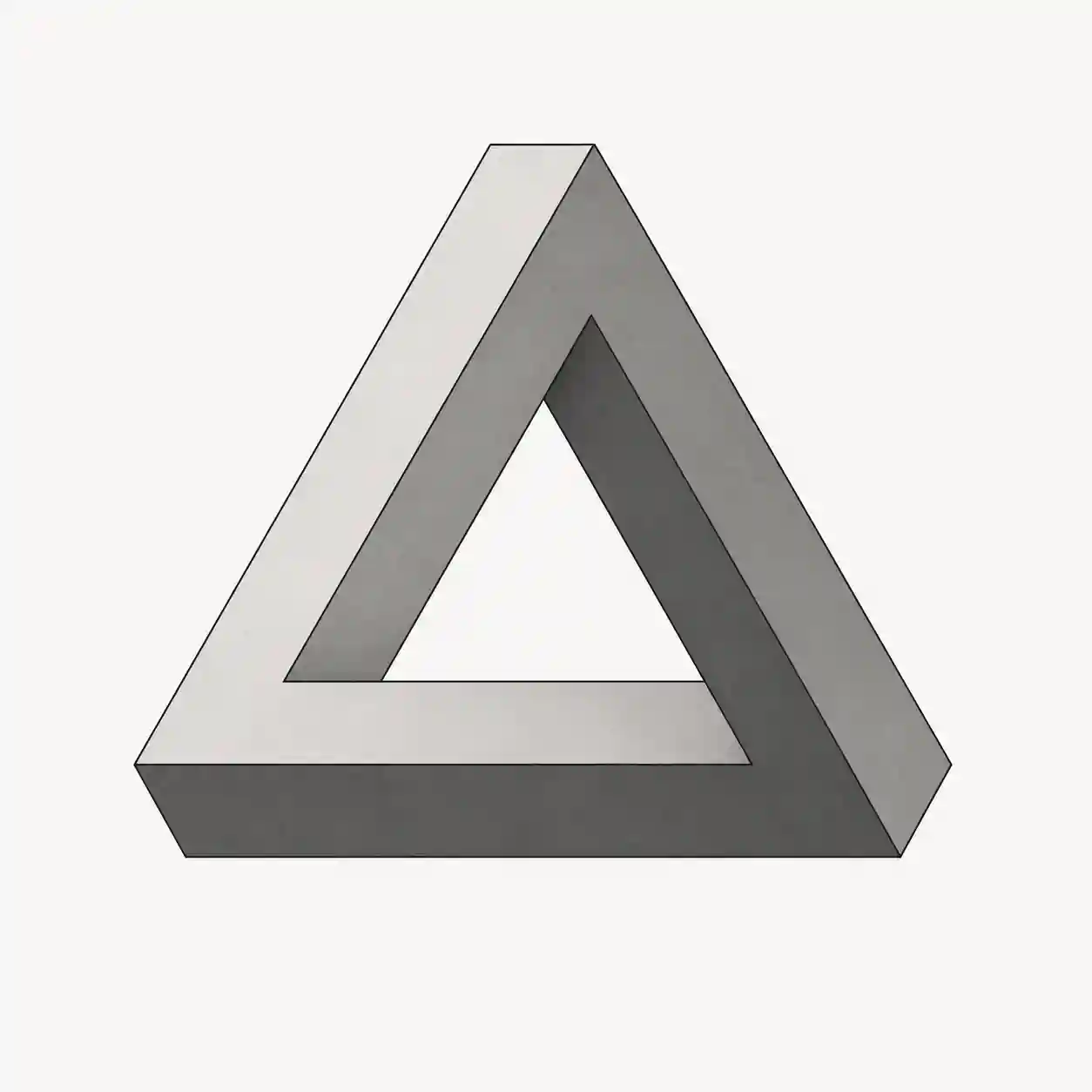
Penrose Triangle
A closed loop of three beams that each look like an ordinary 3D bar in isolation, yet together describe an object that cannot exist in three dimensions.
GeometricKanizsa Triangle
Three notched circles, arranged just so, produce a bright white triangle with crisp edges - even though no triangle is actually drawn anywhere in the image.