 Optical Wonderful
Duck-Rabbit Illusion
A single sketch of two bumps and a line reads as either a duck's bill facing left or a rabbit's ears facing right, and most viewers can't hold both readings at once.
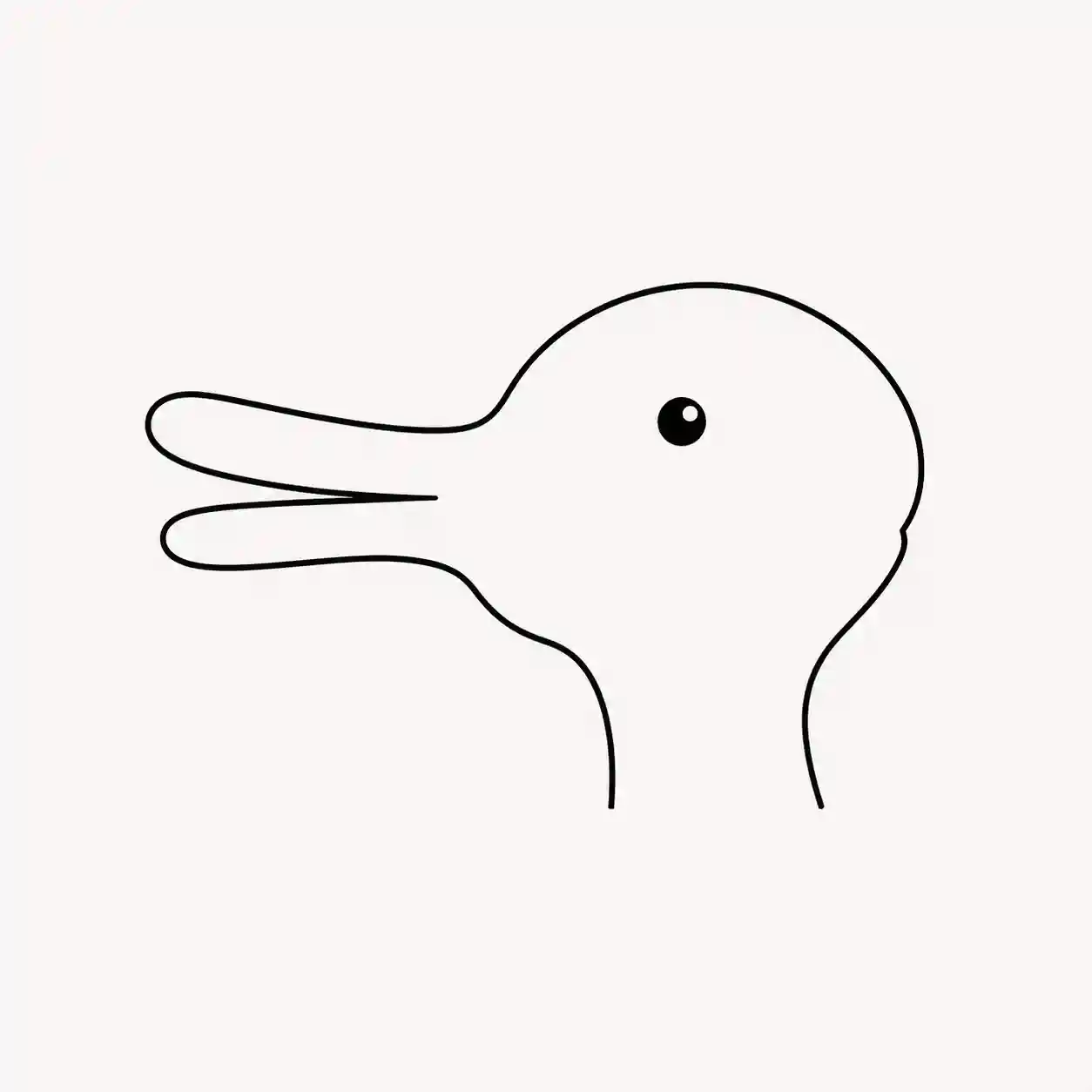
What you're seeing
A simple line drawing: a rounded head shape with two protrusions at one end and a line suggesting an eye. Read the protrusions as a bill and the whole thing is a duck, facing left, mouth slightly open. Read those same two protrusions as ears and the drawing becomes a rabbit, facing right, with the "bill" now doubling as a mouth and chin. Nothing about the ink on the page changes between the two readings - the exact same marks are doing service as bill-and-back-of-head in one interpretation and ears-and-face in the other.
Unlike Rubin's vase, which flips between figure and ground, the duck-rabbit flips between two full-blown category identifications of the same object - you're not deciding what's foreground versus background, you're deciding what animal you're looking at, using the same handful of lines as evidence for two entirely different conclusions.
Why it happens
The image is drawn to be genuinely ambiguous at exactly the point that matters most for animal recognition: the two protrusions at one end of the head. A bill and a pair of ears occupy roughly the same location on their respective animals' heads and, drawn simply enough, can share almost identical silhouettes. Once your visual system commits to "bill," the rest of the drawing's sparse detail gets folded into a duck-consistent interpretation - that same rounded shape reads as the back of a duck's head, and the little downward line reads as slack around a bill. Commit to "ears" instead, and the identical shape reorganizes into a rabbit's face pointed the opposite direction, with the downward line becoming the rabbit's mouth.
This is a case where object recognition, not just low-level depth or brightness processing, is doing the flipping. Your brain doesn't build a neutral, animal-agnostic 3D or 2D model of the shape and then separately label it; recognition and interpretation happen together, so once one label takes hold it actively reshapes how the rest of the sparse linework gets read. That's part of why the flip can feel more effortful for some viewers than the Necker cube's flip - you're not just re-assigning depth to an already-agreed-upon shape, you're re-categorizing the whole object, ears versus bill, front versus back, left-facing versus right-facing, all at once.
A hint that changes what you see
Because the switch depends on category recognition rather than raw geometry, the duck-rabbit is unusually sensitive to priming. Tell someone right before showing it that they're about to see a farm-animal picture, and duck tends to dominate their first impression; prime them with "pets" beforehand and rabbit tends to win. This kind of top-down, expectation-driven bias is much harder to demonstrate cleanly with something like the Necker cube, where there's no real-world category attached to either 3D reading - it makes the duck-rabbit a favorite for illustrating just how much prior expectation shapes what counts as "seeing," rather than seeing being a neutral report of what's on the page.
A little history
The sketch's earliest known appearance is in the German humor magazine Fliegende Blätter, in a caption-based joke published in 1892 - the exact artist behind that first version isn't reliably documented, and the image was likely adapted from or inspired by imagery already circulating rather than being wholly original to that issue. American psychologist Joseph Jastrow picked it up not long after and used it in his own research on mental set and perception, helping establish it as a serious tool for studying ambiguous figures rather than just a magazine gag. It later became philosophically famous through Ludwig Wittgenstein, who used it in Philosophical Investigations to draw a distinction between "seeing" and "seeing-as" - the idea that perceiving an ambiguous figure as one thing or another is itself a kind of interpretive act, not a passive report of raw sense data.
Related reading
The duck-rabbit sits alongside Rubin's vase and the "my wife and my mother-in-law" illusion as one of psychology's three most-cited reversible figures. The Necker cube shows the same involuntary-flip dynamic operating on 3D depth rather than object category.
Read the science behind why this happens →
Related illusions
Rubin's Vase (Face/Vase Illusion)
A single black-and-white silhouette that reads either as a vase or as two faces in profile, depending entirely on which region your brain currently treats as the object.
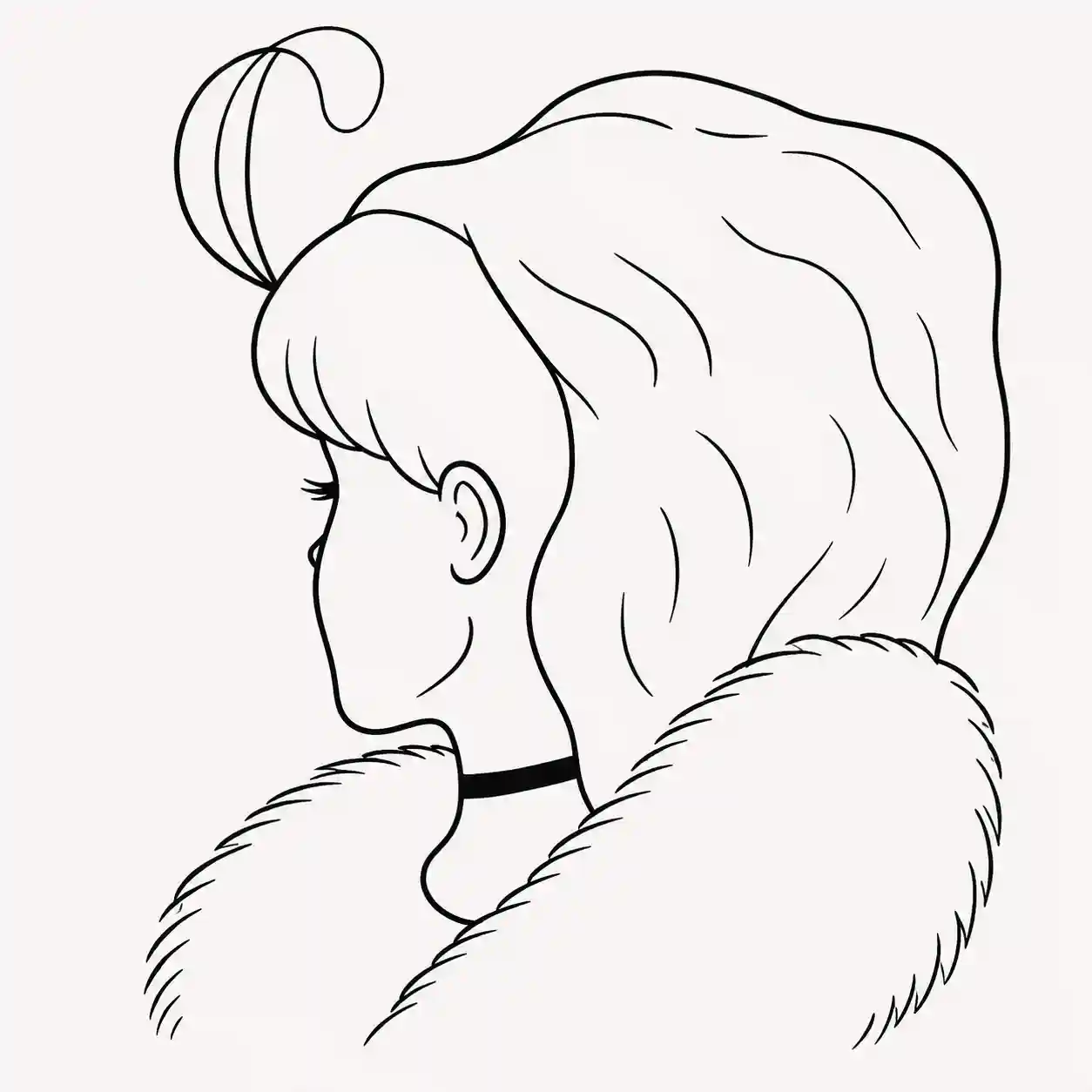 Ambiguous
My Wife and My Mother-in-Law (Old/Young Woman Illusion)
A single portrait sketch reads either as a young woman looking away or an elderly woman in profile, with the same curved line serving as a jawline in one reading and a nose in the other.
AmbiguousNecker Cube
A simple wireframe cube with no shading or perspective cues, which your brain reads as three-dimensional in two different - and equally valid - ways.