 Optical Wonderful
My Wife and My Mother-in-Law (Old/Young Woman Illusion)
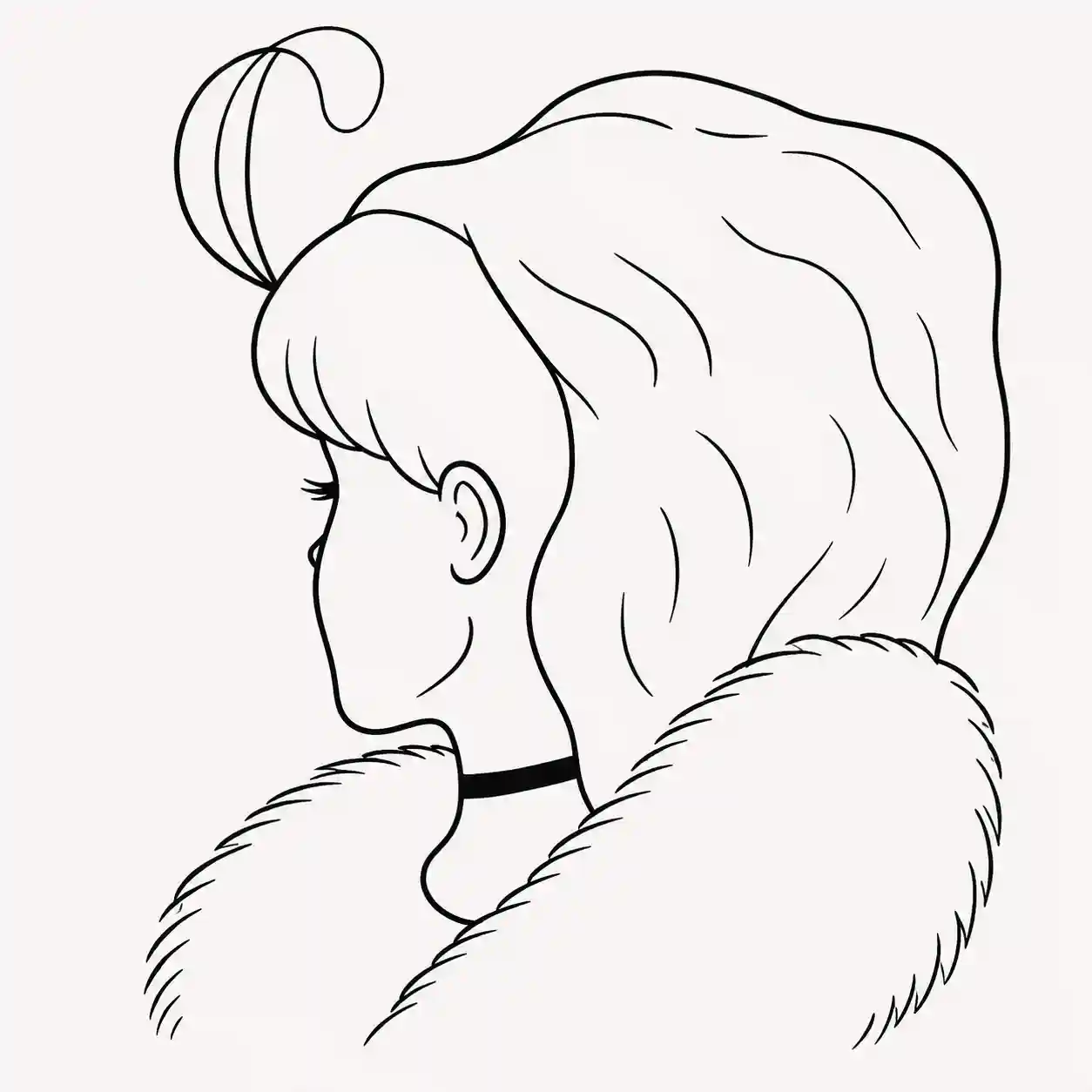
A single portrait sketch reads either as a young woman looking away or an elderly woman in profile, with the same curved line serving as a jawline in one reading and a nose in the other.
What you're seeing
A pen-and-ink portrait of a woman's head and shoulders. Read it one way and you see a young woman in a feathered hat, her face turned mostly away from you so you catch her in a delicate three-quarter view - a slim jawline, a hint of an eyelash, a choker at her neck. Read it another way and the same lines describe an elderly woman hunched into a shawl, her large hooked nose, sunken mouth, and heavy chin filling most of the frame, looking down and to the left.
The pivot point is the young woman's jawline and ear, which double as the old woman's nose and eye; the young woman's choker becomes the old woman's mouth; what reads as a stray lock of hair in one version reads as an eyelash in the other. Almost every line in the drawing is load-bearing for both readings simultaneously, which is a large part of why the switch, once you've seen both, keeps happening involuntarily rather than settling on one interpretation for good.
Why it happens
Face perception leans unusually hard on holistic, top-down processing - your brain doesn't build a face by first cataloguing an inventory of individual lines and then deciding what they add up to; it fits incoming shapes to whole-face templates almost immediately, and once a template locks in, ambiguous lines nearby get pulled into consistency with it. A curve that's genuinely compatible with "nose in profile" or "jawline plus ear," roughly the same length and orientation either way, gets resolved instantly into whichever full-face template currently has the upper hand, and every other ambiguous line in the drawing gets reinterpreted to match.
That's the same broader idea behind predictive processing accounts of vision: rather than passively receiving a scene and figuring out what it depicts afterward, your visual system is constantly generating a best-guess model of what it expects to see and testing incoming evidence against it. With a genuinely double-coded drawing like this one, two competing models fit the incoming lines about equally well, so perception locks onto one prediction, runs with it for a while, and periodically re-evaluates and swaps to the other - the same reversal dynamic that drives the Necker cube and Rubin's vase, here playing out over a face instead of an object's depth or a figure-ground boundary.
Priming decides your first look
This particular figure has become a favorite in classroom demonstrations of priming precisely because the effect is so reliable: show a group of people a clearly "young woman" image beforehand, then show them the ambiguous figure, and a strong majority report seeing the young woman first. Prime with a clearly elderly portrait instead, and the old woman dominates the first impression. Because the figure genuinely supports both readings on close to equal footing, whichever face-template your brain has recently been primed with tends to win the split-second race to interpret the ambiguous lines - a clean, repeatable demonstration that expectation actively shapes perception rather than merely following after it.
A little history
The cartoon most people encounter today, titled "My Wife and My Mother-in-Law," was published by cartoonist W. E. Hill in the American humor magazine Puck in 1915. Hill didn't invent the underlying dual-face concept from scratch - the same basic figure had already circulated on an anonymous German postcard some years earlier, and Hill's contribution was adapting and popularizing that existing image for an American audience with his now-famous caption. Psychologist Edwin Boring picked the figure up for a 1930 academic paper on the perception of ambiguous figures, which is where the "old/young woman" framing entered the psychology literature properly, and Boring's paper is often what gets cited even though Hill's cartoon predates it by fifteen years.
Related reading
This portrait belongs to the same small family of deliberately double-coded drawings as the duck-rabbit illusion and Rubin's vase. For the same kind of involuntary reversal applied to a wireframe object instead of a face, see the Necker cube.
Read the science behind why this happens →
Related illusions
 Ambiguous
Duck-Rabbit Illusion
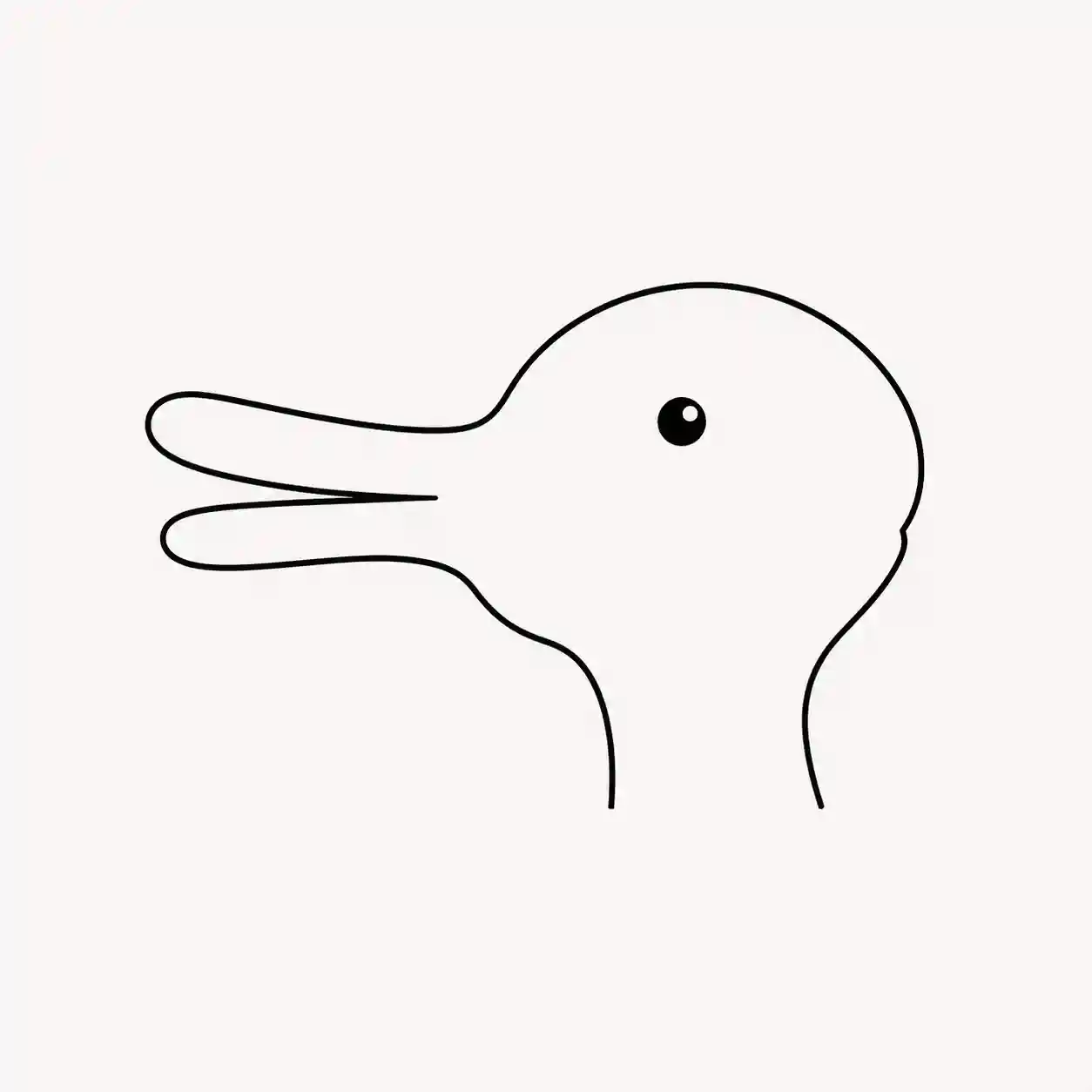
A single sketch of two bumps and a line reads as either a duck's bill facing left or a rabbit's ears facing right, and most viewers can't hold both readings at once.
AmbiguousRubin's Vase (Face/Vase Illusion)
A single black-and-white silhouette that reads either as a vase or as two faces in profile, depending entirely on which region your brain currently treats as the object.
AmbiguousNecker Cube
A simple wireframe cube with no shading or perspective cues, which your brain reads as three-dimensional in two different - and equally valid - ways.