 Optical Wonderful
Necker Cube
A simple wireframe cube with no shading or perspective cues, which your brain reads as three-dimensional in two different - and equally valid - ways.
What you're seeing
The Necker cube is about as stripped-down as an illusion gets: twelve lines, arranged as a wireframe cube, with every line drawn the same weight and no shading to indicate which face is nearer to you. Look at it for a few seconds and one square will seem to pop forward as the "front" of the cube. Keep looking, and at some point - often without you deciding to - the other square will suddenly seem to be the front instead, and the whole cube appears to flip inside out.
Nothing in the image changes. The flip happens entirely on your side of the equation, in how your visual system chooses to interpret a flat drawing as a solid object.
Why it happens
A real cube, viewed from an angle, casts a two-dimensional pattern of lines onto your retina - but so does the Necker cube's flat drawing, and so would the mirror-image cube, viewed from the opposite side. The line drawing is genuinely, mathematically ambiguous: it is consistent with two different three-dimensional objects, and your visual system has no additional information (shading, occlusion, motion parallax, binocular disparity) to break the tie.
Normally, that kind of ambiguity doesn't happen. The world gives your eyes far richer input than a wireframe sketch, and the brain resolves depth by combining dozens of cues almost instantly. Strip those cues away, as the Necker cube does, and you're left staring directly at the machinery: a perceptual system that insists on picking one three-dimensional interpretation, even when the evidence equally supports two.
This is a textbook case of bistable perception - a stimulus that supports two mutually exclusive interpretations, between which perception alternates involuntarily. Your brain won't let you see both readings of the cube at once, and it won't settle on "it's ambiguous, no verdict." It commits to one interpretation, holds it for a few seconds, and then - as the neurons encoding that interpretation fatigue and the alternative interpretation's evidence gets a relative boost - flips to the other.
Psychologists connect this to Gestalt principles of perception, particularly the idea that the brain doesn't build a scene from raw pixels upward; it imposes organizing structure on incoming data, and a flat set of lines gets organized into "a cube," full stop, because that's a far more useful hypothesis than "a meaningless tangle of lines." The reversal shows that this organizing process is an active, ongoing computation - not a one-time lookup.
With practice, many people can nudge the flip rate: staring at a specific corner, deliberately imagining one face as closer, or shifting attention around the figure can bias which interpretation dominates and how long it lasts, though the switches still tend to happen involuntarily even when you're trying to control them.
A little history
Swiss crystallographer Louis Albert Necker first described the effect in 1832, not from a drawing made to illustrate perception, but from a practical problem: he noticed that rhomboid crystal shapes viewed through a microscope would spontaneously seem to invert in depth, exactly like the cube that now bears his name. It's one of the oldest documented visual illusions in the scientific literature, predating the term "Gestalt psychology" by nearly a century, and it's still used today in vision-science labs to study bistable perception and the neural correlates of "which interpretation is currently winning" in the visual cortex.
Related reading
The Necker cube belongs to a small family of illusions where the image never changes but your interpretation of it does - see Rubin's vase and the duck-rabbit illusion for two more.
Read the science behind why this happens →
Related illusions
Rubin's Vase (Face/Vase Illusion)
A single black-and-white silhouette that reads either as a vase or as two faces in profile, depending entirely on which region your brain currently treats as the object.
 Ambiguous
Duck-Rabbit Illusion
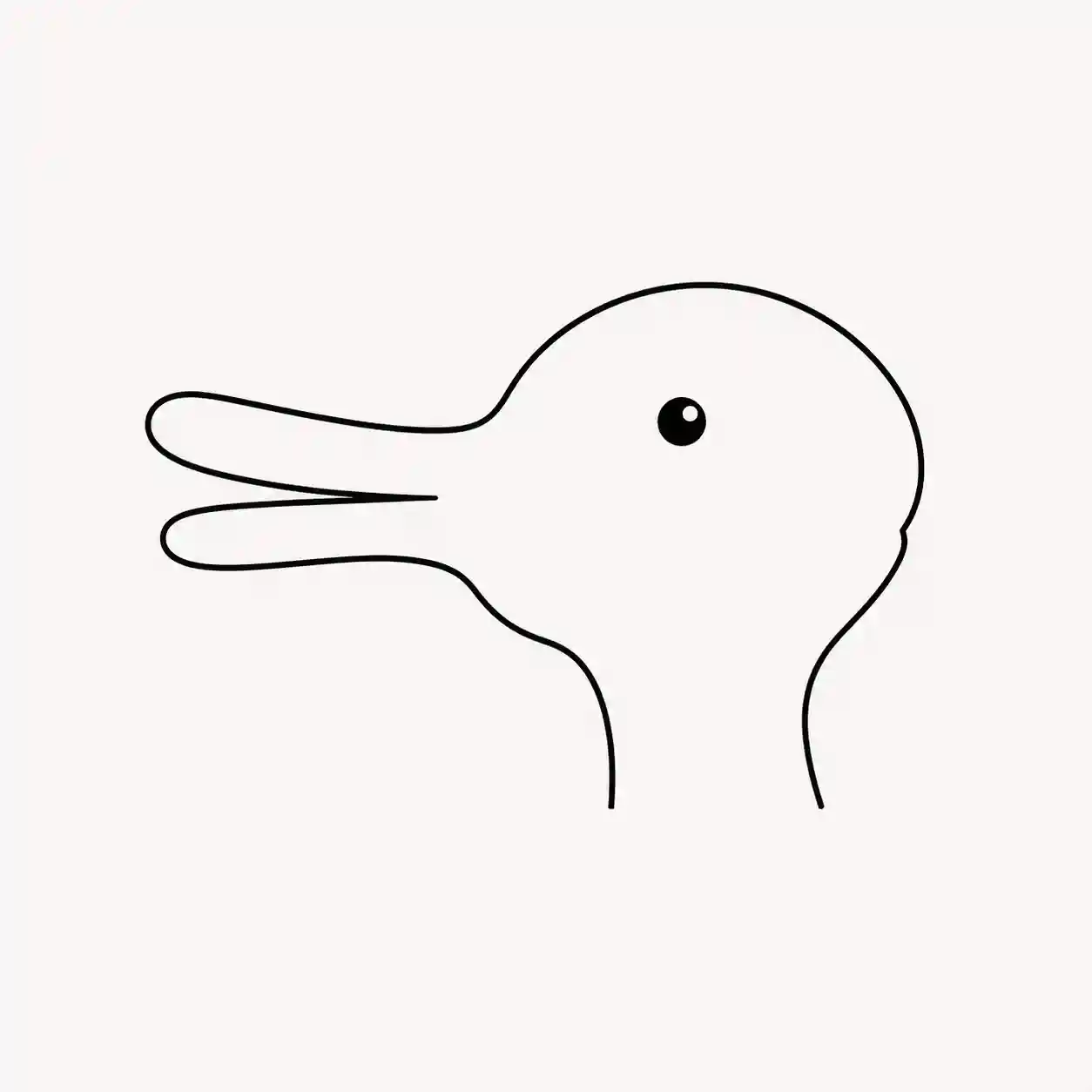
A single sketch of two bumps and a line reads as either a duck's bill facing left or a rabbit's ears facing right, and most viewers can't hold both readings at once.