 Optical Wonderful
Spinning Dancer Illusion
A rotating silhouette with no depth cues at all, which different viewers see spinning clockwise or counterclockwise - and can sometimes flip between the two without warning.

What you're seeing
A featureless black silhouette of a woman, one leg raised, appears to rotate steadily in place. Ask the person next to you which direction she's spinning and there's a real chance you'll disagree - one of you sees her turning clockwise, the other counterclockwise, and both of you are seeing the animation correctly. Watch long enough and the direction can even flip for you personally, usually snapping the instant you stop concentrating on it.
Why the direction is genuinely ambiguous
The trick is what's missing from the image, not what's added to it. The dancer is a flat, uniformly shaded silhouette - no shading gradients, no visible facial features, no shadow, no perspective lines, nothing that would normally tell your visual system which of her sides is facing toward you and which is facing away. A real rotating three-dimensional figure, lit normally, gives your eyes a constant stream of depth cues: the near arm looks slightly bigger or catches more light, foreshortening changes as limbs rotate through different angles, and binocular and motion-parallax cues pin down orientation instantly. Strip all of that away, as a pure silhouette does, and the two-dimensional shadow shape on screen is equally consistent with a figure spinning one way or the exact mirror-image figure spinning the other way. Nothing in the actual pixel data favors either reading - the ambiguity is mathematically real, not a trick of attention.
The "left brain / right brain" myth
The spinning dancer went viral in the late 2000s carrying a popular claim that which direction you first see reveals whether you're more "right-brained" or "left-brained" - intuitive versus analytical. That claim is not supported by vision science and should be treated as internet folklore, not fact. The rotation direction you perceive has nothing measurable to do with hemispheric dominance, a concept that itself oversimplifies how brain lateralization actually works. What actually predicts which direction you'll see first is a mix of arbitrary starting bias, recent visual context, and simple chance - the same kind of factors that determine which face of the Necker cube looks "forward" the instant you first glance at it. The dancer is genuinely bistable, like the Necker cube, and bistable perception doesn't sort people into brain-hemisphere personality types; it's a property of the ambiguous stimulus, not a diagnostic test of the viewer.
Can you control which way she spins?
To an extent, yes - with effort. Many viewers find they can deliberately flip the perceived direction by consciously imagining the near leg as the left or right leg, by tracking a specific point (like the raised foot) and mentally assigning it a path toward or away from the viewer, or by looking away and back while holding a specific interpretation in mind. This voluntary control resembles what some practiced viewers can do with the Necker cube, and it demonstrates the same underlying point: the rotating figure itself never changes, only your visual system's current best guess about its three-dimensional structure does.
A little history
Japanese web designer Nobuyuki Kayahara created the animation in 2003, originally as a piece of stock content rather than a deliberate perception experiment. It spread rapidly after being picked up by blogs and forwarded widely by email around 2007-2008, frequently accompanied by the unfounded brain-hemisphere claim, which likely helped it go viral far beyond what a purely academic illusion would have. Vision scientists have since used the spinning dancer and similar silhouette animations in genuine research on bistable structure-from-motion perception - how the brain resolves 3D shape from featureless, ambiguous 2D motion - even though the "which side of your brain" framing that made it famous online has no scientific basis.
Related reading
The dancer's ambiguity is the motion-based cousin of the Necker cube, which flips between two equally valid 3D readings of a static wireframe. For two more illusions where a genuinely still or unmoving scene produces an illusory sense of motion, see the rotating snakes illusion and the motion aftereffect.
Read the science behind why this happens →
Related illusions
Necker Cube
A simple wireframe cube with no shading or perspective cues, which your brain reads as three-dimensional in two different - and equally valid - ways.
 Motion
Rotating Snakes Illusion
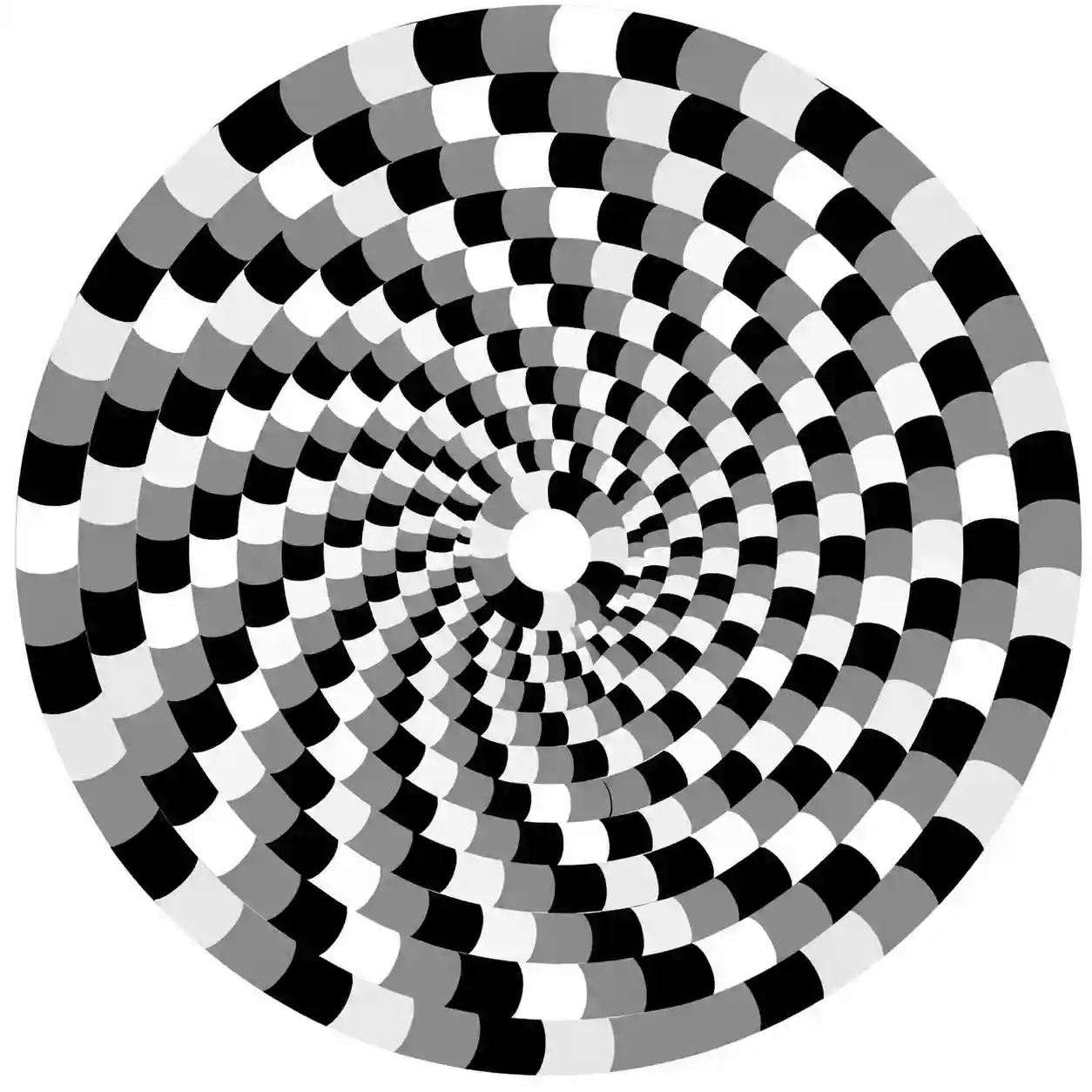
A completely still image built from repeating rings of asymmetric color gradients that appears to writhe and rotate on its own - one of the strongest static-image motion illusions known.
 Motion
Motion Aftereffect (Waterfall Illusion)
Stare at flowing water or a spinning pattern for half a minute, then look at something still - and the stationary scene will appear to drift in the opposite direction for a few seconds.