 Optical Wonderful
Change Blindness Illusion
Two versions of the same photo, flashed back and forth with a large object added, removed, or recolored between them, and most viewers stare right through the difference without noticing.


What you're seeing
Two photographs of the same scene are shown one after another, over and over, with a brief blank flash inserted between each swap. The two photos are identical except for one change - a helicopter's engine disappears from the background, a railing changes color, a large building vanishes entirely. The change is not subtle in the way a "spot the difference" puzzle sometimes is; it's often a large, high-contrast object sitting in plain view.
And yet, watching the pair flicker back and forth, most people take a surprisingly long time to spot it - sometimes many seconds, sometimes not at all until it's pointed out. Once you do see it, the change becomes almost impossible to un-see, and it can seem baffling in retrospect that it took so long. This gap between how obvious a change seems once found and how invisible it was moments before is called change blindness.
Why it happens
Change blindness is not a failure of the eyes. Visual acuity, contrast sensitivity, motion detection - none of these are impaired in someone experiencing it. The failure is upstream, in how attention and visual working memory work together to build what feels like a rich, continuously updated picture of the world.
That feeling is largely an illusion in its own right. At any given instant, your visual system only encodes a small amount of a scene in enough detail to compare it against a later view - roughly, whatever you happen to be attending to. The rest of the scene is represented much more sparsely, often as a kind of statistical summary (this region is grassy, that region has a person in it) rather than as pixel-level detail held in memory. Ordinarily this doesn't matter, because the world doesn't change out from under you between glances, and your eyes can dart back to check anything in question. Detecting change usually relies on a very simple, very effective cue: motion. When something in a scene moves or transforms while you're looking directly at it, the transient itself grabs attention automatically, and you notice immediately.
The classic change-blindness demonstrations exploit exactly that gap. By inserting a blank flash - or, in real-world versions, an actual physical obstruction - between the "before" and "after" states, researchers remove the motion transient that would otherwise flag the change. Without that automatic pop-out cue, detecting the difference requires actively comparing your sparse, incomplete memory of the first image against the second image, region by region, which is slow, effortful, and depends heavily on whether you happen to be attending to the exact part of the scene that changed. If your attention was elsewhere at the moment of comparison, the change simply doesn't register, no matter how large it is.
Two classic demonstrations
Vision scientists Ronald Rensink, Kevin O'Regan, and James Clark formalized this using what's often called the flicker paradigm: an original photograph and a modified version are alternated rapidly, separated by a brief gray blank screen, and viewers are asked to press a button the moment they spot the difference. Their 1997 studies found that detection could take many seconds even for large, meaningful changes, and that the blank flash was doing most of the work - remove it, and the same change becomes nearly instantaneous to spot, because the motion transient is no longer masked.
A separate, equally well-known line of work moved change blindness out of the lab. Daniel Simons and Daniel Levin's 1998 "door study" had an experimenter stop a pedestrian to ask for directions; partway through the conversation, two people carrying a door walked between them, and during that brief visual obstruction the original experimenter was swapped for a different person entirely - different height, build, clothing, and voice. A substantial share of pedestrians failed to notice they were now talking to someone else, continuing the conversation as though nothing had happened. The obstruction served the same function as the blank flash in the lab studies: it removed the continuous visual and motion information that would normally make such an obvious change impossible to miss.
Why it matters beyond the lab
Change blindness has real implications well outside psychology demonstrations - it's part of why eyewitness testimony can be unreliable, why drivers sometimes fail to notice a pedestrian who was obscured for even a moment, and why film editors can get away with continuity errors that seem glaring only once frozen on a single frame. It's a close relative of inattentional blindness, which shows that even fully visible, unobstructed events can go unnoticed when attention is occupied elsewhere.
Related reading
See inattentional blindness for the companion phenomenon of missing things that were never hidden at all, and the Thatcher effect for another case where the brain's usual scrutiny of a scene quietly switches off.
Read the science behind why this happens →
Related illusions
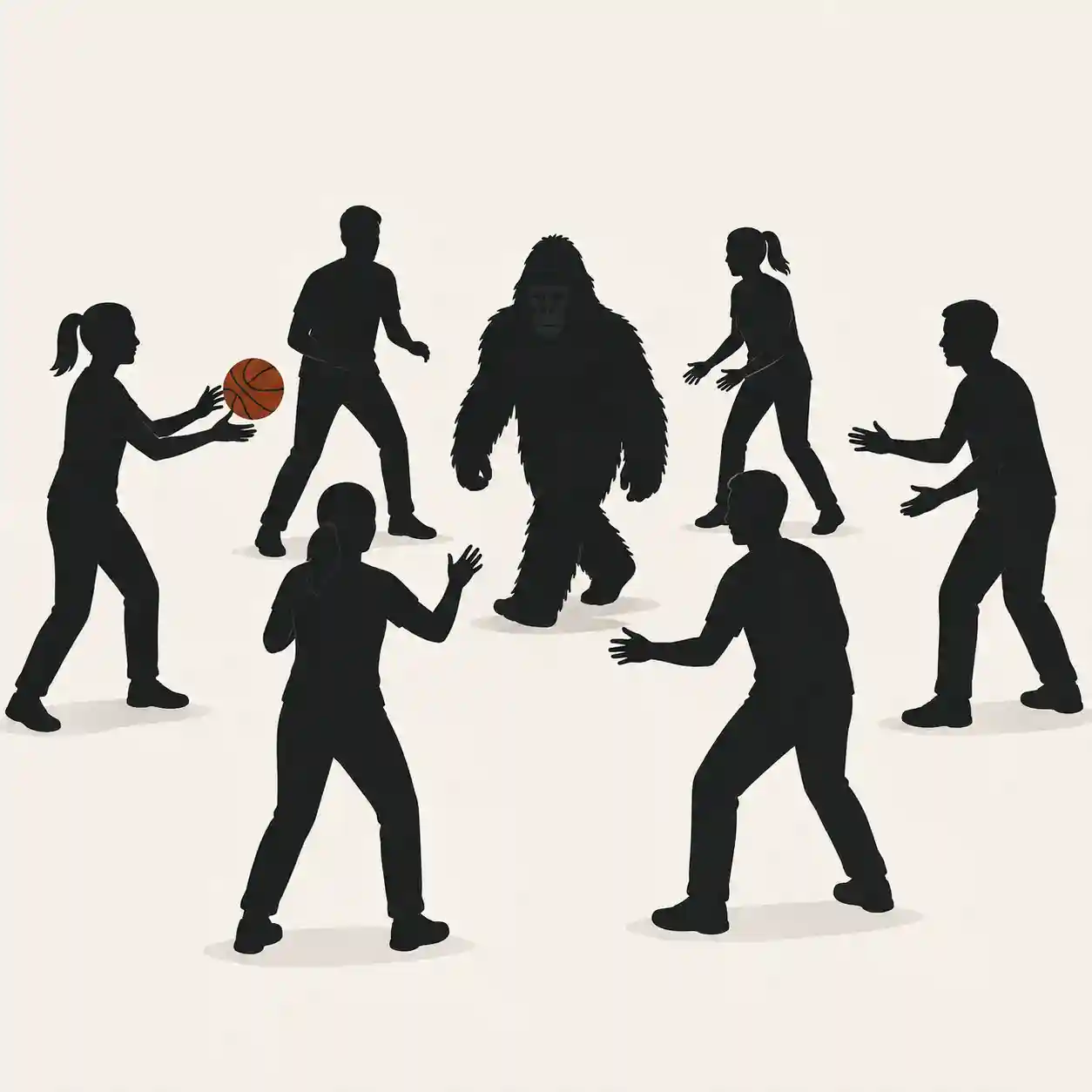 Cognitive
Inattentional Blindness (The Invisible Gorilla Experiment)
Ask viewers to count basketball passes in a short video and roughly half never notice a person in a gorilla suit walking through the middle of the scene.
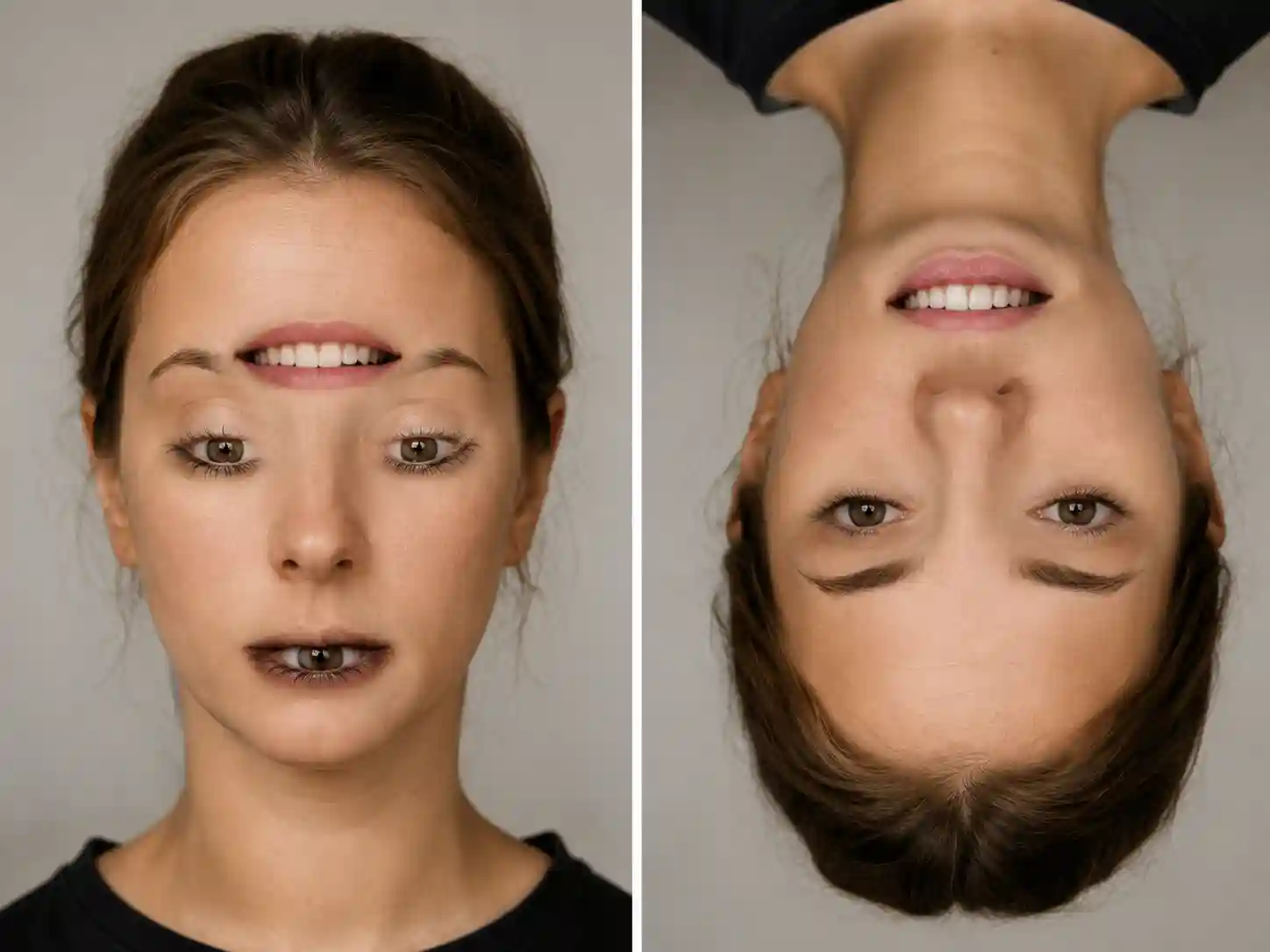 Cognitive
Thatcher Effect (Upside-Down Face Illusion)
Flip a photo of a face upside down after crudely inverting the eyes and mouth, and the distortion becomes almost invisible - proof that upright face recognition runs on rules that flip off along with the picture.
AmbiguousNecker Cube
A simple wireframe cube with no shading or perspective cues, which your brain reads as three-dimensional in two different - and equally valid - ways.