 Optical Wonderful
Inattentional Blindness (The Invisible Gorilla Experiment)
Ask viewers to count basketball passes in a short video and roughly half never notice a person in a gorilla suit walking through the middle of the scene.
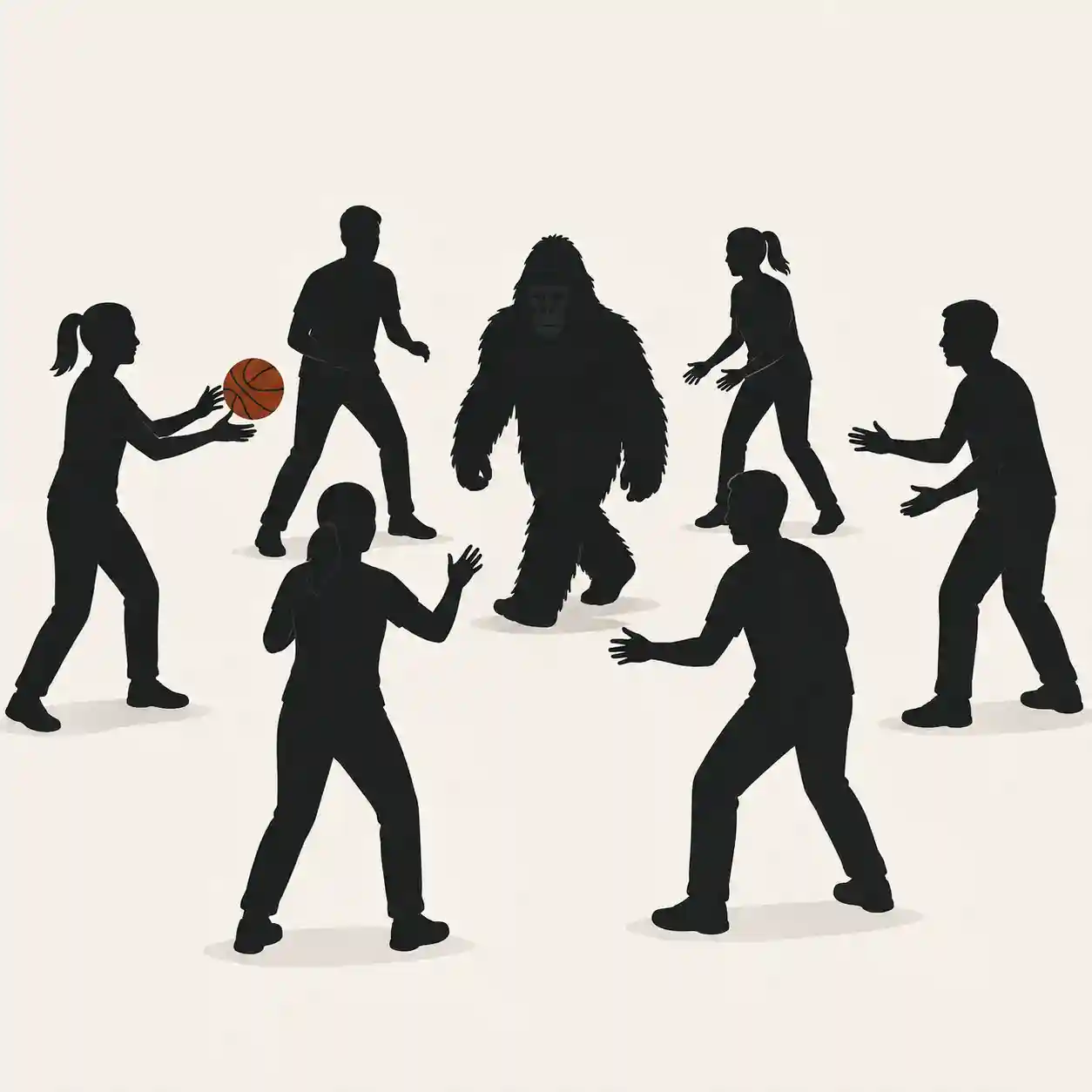
What you're seeing
You're shown a short video of two teams passing basketballs - one team in white shirts, one in black - and given a simple task: count how many times the players in white pass the ball. The video runs under a minute. It requires real, sustained attention to track accurately, since players move around, overlap, and pass quickly.
Partway through, a person in a full gorilla costume walks directly into the middle of the scene, pauses, thumps their chest, and walks off - on screen for about nine seconds, in full view, never hidden or obscured.
Afterward, viewers are asked whether they saw anything unusual. In the original study, roughly half of participants said no. They hadn't seen a gorilla at all. When shown the video a second time, without the counting task, the gorilla becomes almost impossible to miss, and many first-time non-noticers are stunned that they could have looked directly at something so obvious and registered nothing.
This is inattentional blindness: the failure to perceive a fully visible, unhidden object or event, simply because attention was engaged elsewhere.
Why it happens
The gorilla study cuts against a deeply held intuition - that if something is in your direct line of sight and you're looking right at that part of the screen, you must be "seeing" it in any meaningful sense. Inattentional blindness shows that this intuition is largely wrong. Seeing, in the sense of forming a conscious percept you can later report, is not a passive byproduct of light hitting your retina. It depends heavily on attention - a limited resource that has to be allocated, and that gets consumed by whatever task is currently demanding it.
Counting basketball passes accurately requires continuously tracking a specific subset of moving figures (the white-shirted players) while actively filtering out everything else, including the black-shirted team, as irrelevant. This kind of goal-directed, effortful attention is thought to work partly by suppressing processing of task-irrelevant information, not just by ignoring it. A gorilla suit is visually salient in the abstract, but it isn't part of the search template your brain built for "count white-shirt passes," and a substantial chunk of the visual processing that would normally flag something so unusual gets crowded out by the demands of the primary task.
Notice what this implies: inattentional blindness isn't about a dim or degraded image, and it isn't about the gorilla being obscured, as in change blindness demonstrations. The visual information reaches the eyes and enters early visual processing just fine. What fails is the later stage where information gets bound into a conscious, reportable percept - a stage that appears to require attention as a gatekeeper, at least for anything outside the current task's focus.
The original study
The demonstration was designed and run by psychologists Daniel Simons and Christopher Chabris, published in 1999, building on decades of earlier attention research (including work by Ulric Neisser in the 1970s that first hinted at similar effects with overlapping video footage). Simons and Chabris's version became famous largely because of how deliberately blatant the "missed" stimulus was - earlier attention studies had often used subtle or brief target objects, while a person in a gorilla costume thumping their chest for nine seconds removed any excuse that the miss was due to the stimulus being hard to see. The stark contrast between the object's obviousness and the miss rate is what made the study a fixture of psychology courses and popular science writing, and it later became the centerpiece of Chabris and Simons's book The Invisible Gorilla, which explores how badly people tend to overestimate their own awareness and attentional capacity in everyday life.
Why this differs from an "illusion" in the usual sense
Most illusions on this site involve the visual system actively misinterpreting a stimulus - filling in an edge that isn't there, or misjudging a color. Inattentional blindness is closer to the opposite problem: not a false perception, but an absent one, for something perfectly ordinary to perceive under different circumstances. It belongs to the same family as change blindness, which shows that even large changes between two views of a scene routinely go unnoticed - but where change blindness hides the transition (with a flash or an obstruction), inattentional blindness needs no hiding at all. Attention alone does the work.
Practical stakes
Beyond the lab, inattentional blindness has been used to help explain real-world failures of noticing: drivers who look directly at a motorcyclist and still pull out in front of them, radiologists who miss an unexpected abnormality on a scan while focused on the specific pathology they were asked to check for, and pilots who fail to notice an obstruction on a runway while focused on instrument readings. In each case, the person's eyes were pointed at the missed object. Their attention, and therefore their conscious perception, was somewhere else.
Related reading
Pair this with change blindness for the closely related phenomenon of missing changes rather than missing objects, and the Thatcher effect for a case where the brain's usual scrutiny fails for a very different reason.
Read the science behind why this happens →
Related illusions
 Cognitive
Change Blindness Illusion
Two versions of the same photo, flashed back and forth with a large object added, removed, or recolored between them, and most viewers stare right through the difference without noticing.
 Cognitive
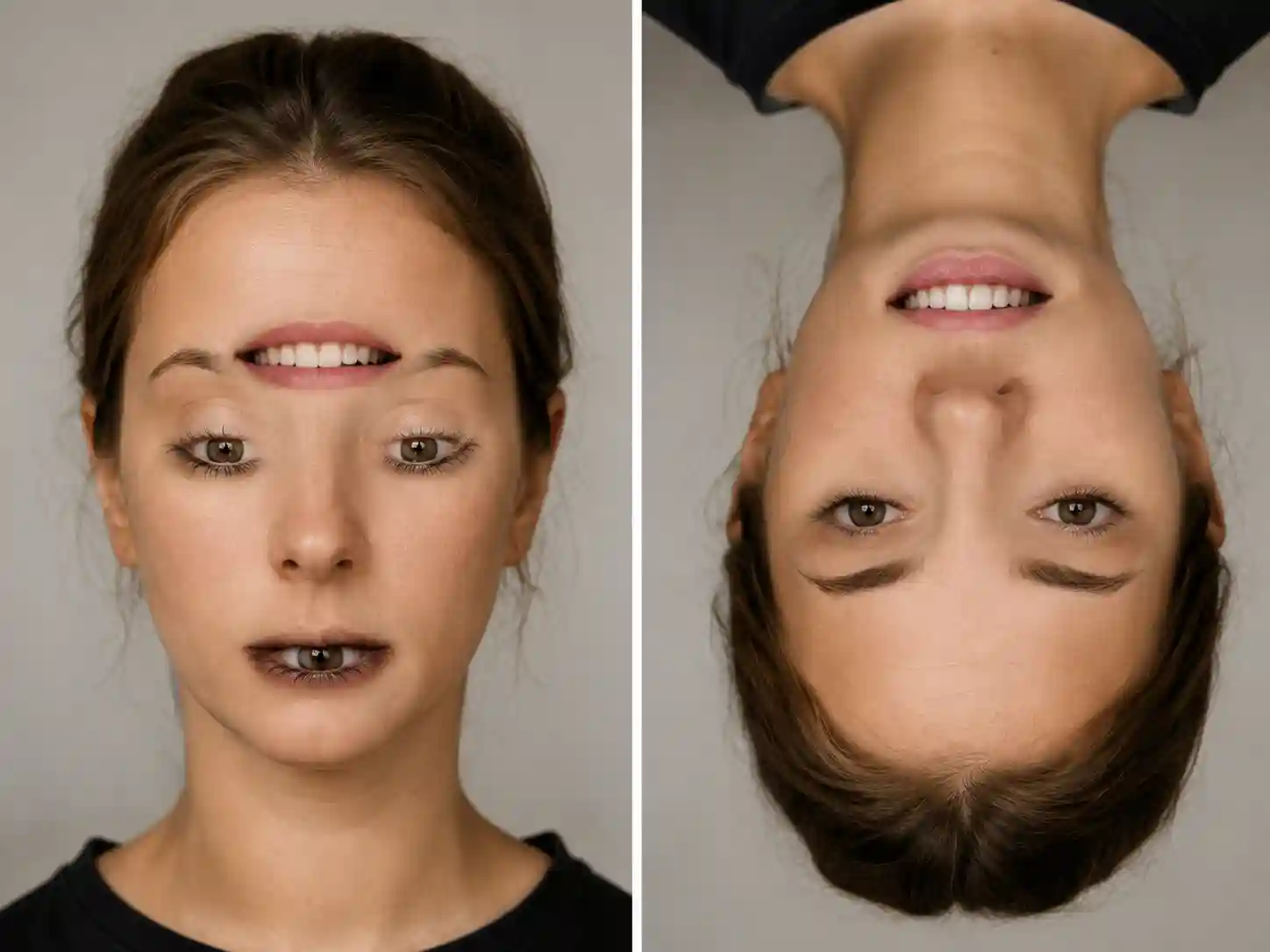
Thatcher Effect (Upside-Down Face Illusion)
Flip a photo of a face upside down after crudely inverting the eyes and mouth, and the distortion becomes almost invisible - proof that upright face recognition runs on rules that flip off along with the picture.
AmbiguousNecker Cube
A simple wireframe cube with no shading or perspective cues, which your brain reads as three-dimensional in two different - and equally valid - ways.