 Optical Wonderful
Thatcher Effect (Upside-Down Face Illusion)
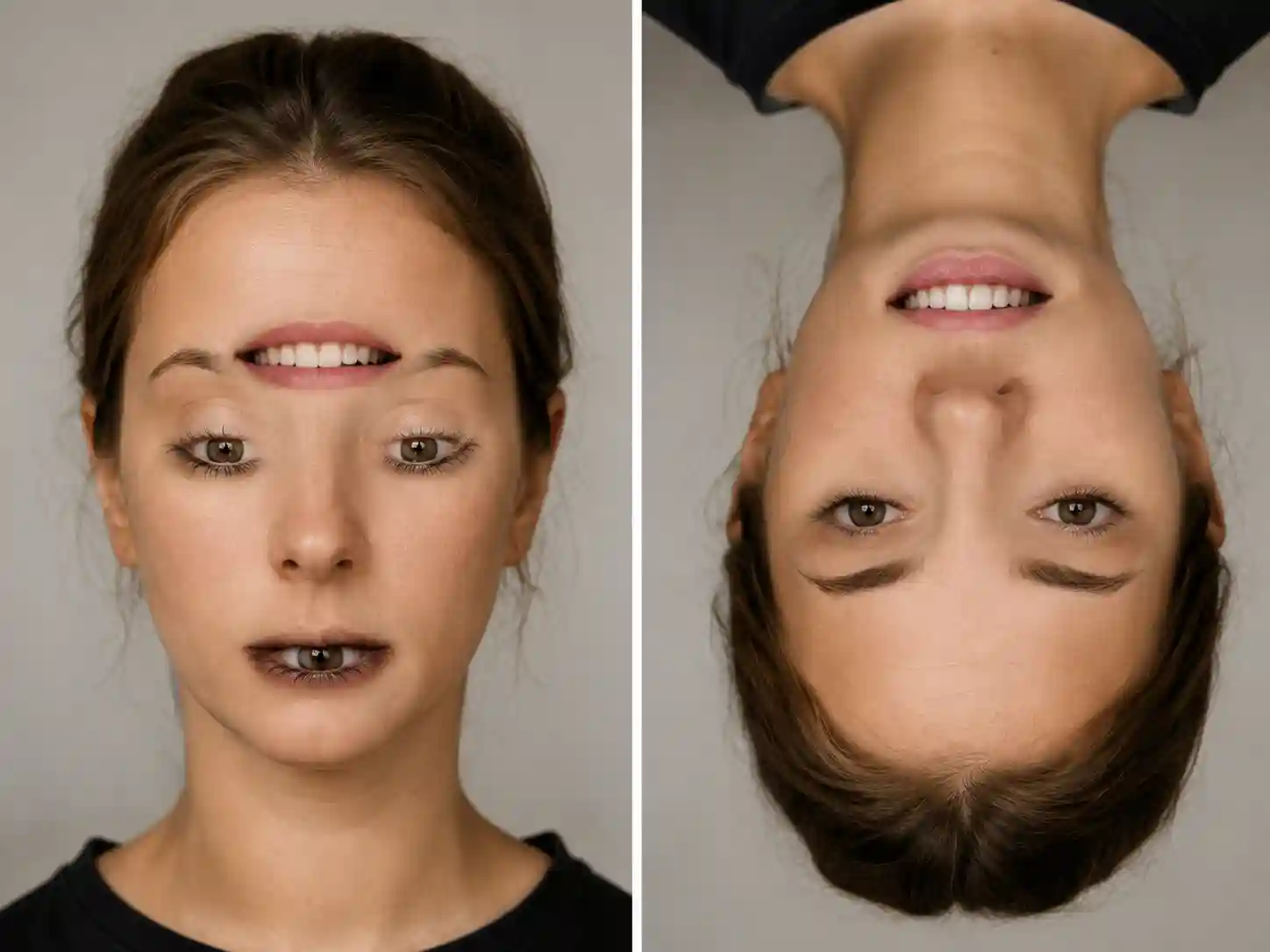
Flip a photo of a face upside down after crudely inverting the eyes and mouth, and the distortion becomes almost invisible - proof that upright face recognition runs on rules that flip off along with the picture.
What you're seeing
Take an ordinary photograph of a face. Now cut out just the eyes and mouth, rotate that small region 180 degrees, and paste it back into the same spot on the otherwise unchanged photo. Viewed right-side up, the result is grotesque - a leering, uncanny distortion that's obvious within a fraction of a second and honestly a little disturbing to look at.
Now turn the entire photo upside down. The same distorted eyes and mouth are still there, unchanged, in the same relative positions. But something remarkable happens: the grotesqueness largely disappears. The upside-down face reads as a more or less normal upside-down face, and you often have to consciously search for what's wrong, or flip it right-side up again, to confirm the distortion is even present.
This gap between "obviously monstrous" and "barely noticeable," produced by nothing more than rotating the whole image, is the Thatcher effect.
Why it happens
Human face recognition is not simply a matter of cataloguing individual features - the shape of the eyes, the curve of the mouth - and matching them against memory one by one. Decades of vision research point to something more integrated: the brain processes upright faces holistically or configurally, evaluating the spatial relationships between features (how far apart the eyes sit relative to the nose, how the mouth's position relates to the chin) as a single, unified pattern rather than a checklist of parts. This kind of processing is thought to rely heavily on a region of the brain called the fusiform face area, which shows unusually strong, specialized responses to upright faces and comparatively weak responses to the same faces turned upside down.
Configural processing is fast, automatic, and - crucially - highly tuned to a lifetime of experience with faces in their normal, upright orientation. Flip a face upside down and that finely tuned machinery essentially disengages. You still recognize that you're looking at a face, and you can still identify who it belongs to given enough time, but the spatial "grammar" your brain normally uses to instantly flag something as wrong with a face's internal layout stops applying. Without holistic processing running smoothly, your visual system falls back on cruder, more piecemeal feature analysis, and localized distortions like inverted eyes or an inverted mouth simply don't register as strongly, because nothing is comparing them against the fine-grained relational template that only kicks in right-side up.
This is also why the Thatcher effect is considered a genuinely different phenomenon from most other face-inversion difficulties, like the general trouble people have recognizing an upside-down stranger. It isn't just that upside-down faces are harder to process in general - it's that a specific type of distortion becomes selectively, almost completely invisible, revealing that the brain's sensitivity to feature configuration is switched on by orientation, not by the presence of a face alone.
A little history
The effect is named after its very first demonstration: in 1980, psychologist Peter Thompson, then at the University of York, published a short paper using a doctored photograph of British Prime Minister Margaret Thatcher, with her eyes and mouth locally inverted. Thompson's original point was methodological as much as perceptual - he used the manipulation to argue that face processing depends on orientation-specific mechanisms distinct from general object recognition. Follow-up research in the same tradition backed that argument up further, showing that a comparable local-inversion trick applied to photographs of houses or other everyday objects doesn't produce anything like the same effect. The choice of Thatcher, a highly recognizable public figure at the time, made the demonstration especially striking and memorable, and the name stuck. The effect has since been replicated with countless other faces, including composites, cartoon faces, and even some animal faces with human-like feature arrangements, and it remains a staple demonstration in psychology and neuroscience courses on face perception.
What it reveals about attention and expectation
The Thatcher effect sits alongside other illusions that expose limits in how much detail the brain actually verifies at any given moment, rather than limits in raw visual acuity. Much like change blindness shows that large chunks of a scene can change without being consciously registered, and ambiguous-figure illusions elsewhere in this library show that the same image data can support wildly different interpretations, the Thatcher effect shows that even something as biologically important as a face's internal layout is checked by a specialized, orientation-dependent process - and that process can be switched off with nothing more than a 180-degree rotation.
Related reading
For more on how the brain quietly fails to notice things that should be obvious, see change blindness and inattentional blindness, two close cousins in the cognitive-illusion family.
Read the science behind why this happens →
Related illusions
 Cognitive
Change Blindness Illusion
Two versions of the same photo, flashed back and forth with a large object added, removed, or recolored between them, and most viewers stare right through the difference without noticing.
 Cognitive
Inattentional Blindness (The Invisible Gorilla Experiment)
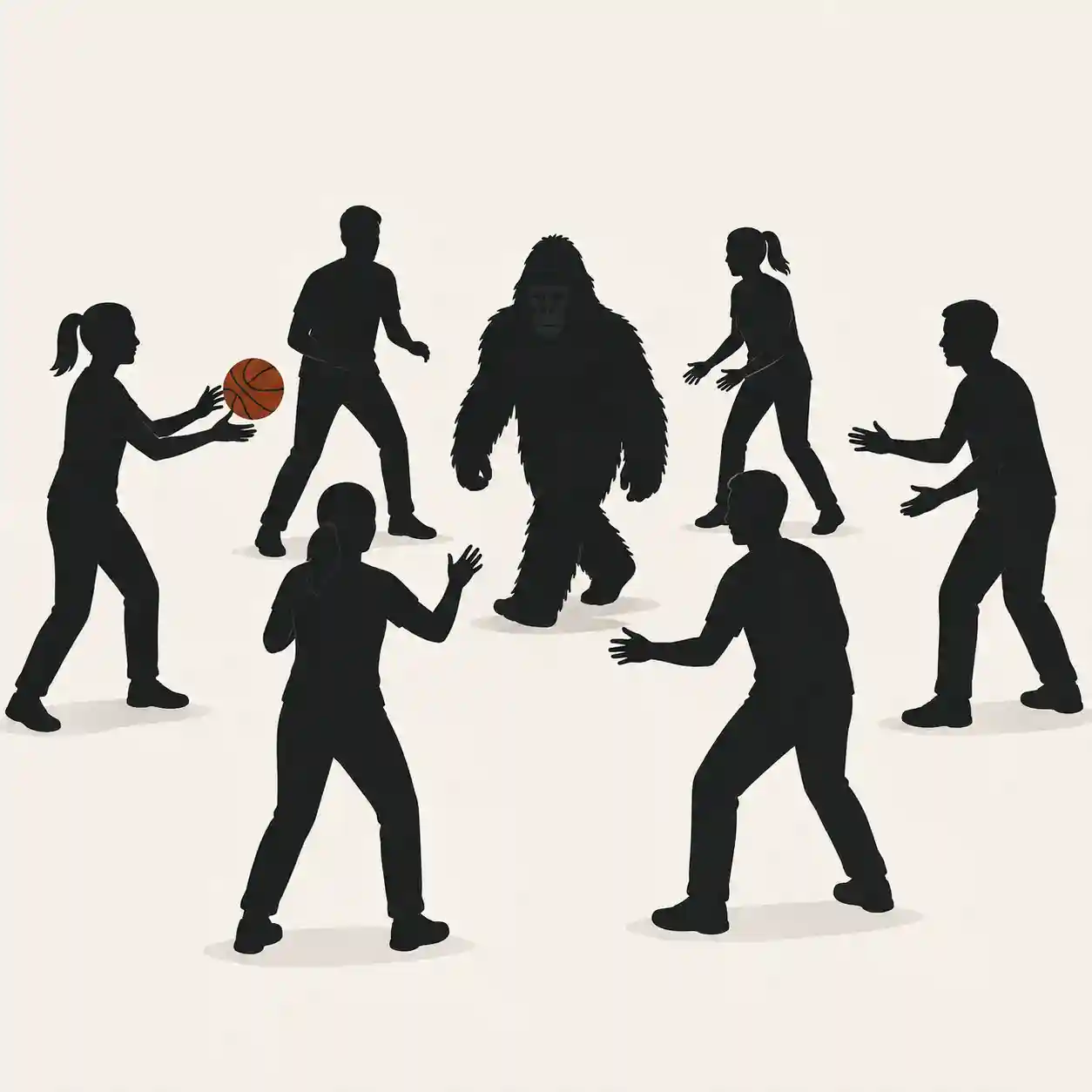
Ask viewers to count basketball passes in a short video and roughly half never notice a person in a gorilla suit walking through the middle of the scene.
 Ambiguous
My Wife and My Mother-in-Law (Old/Young Woman Illusion)
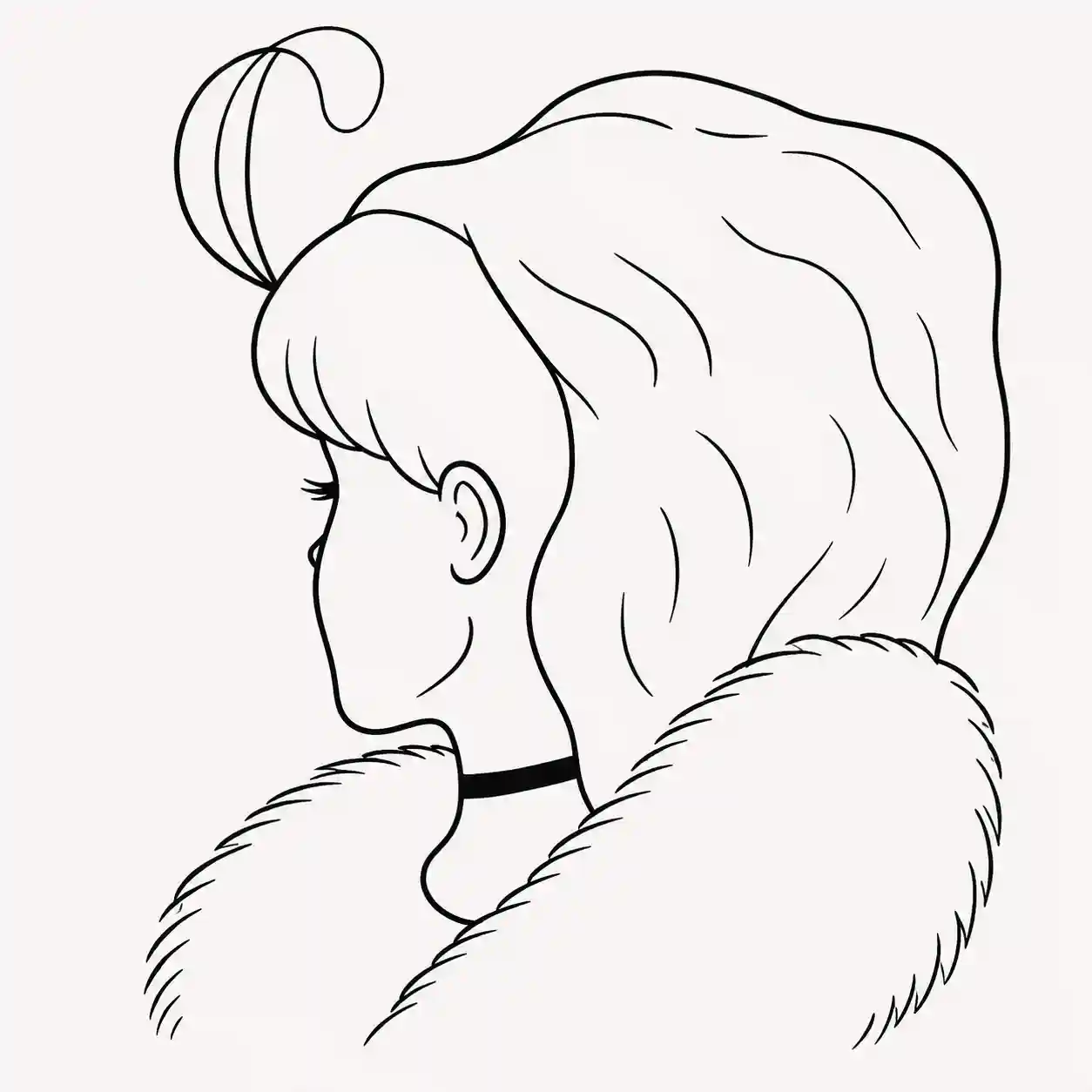
A single portrait sketch reads either as a young woman looking away or an elderly woman in profile, with the same curved line serving as a jawline in one reading and a nose in the other.