 Optical Wonderful
Autostereograms ("Magic Eye" Images)
A flat pattern of repeating texture that, viewed with deliberately unfocused or crossed eyes, suddenly resolves into a hidden 3D shape floating above or below the page.
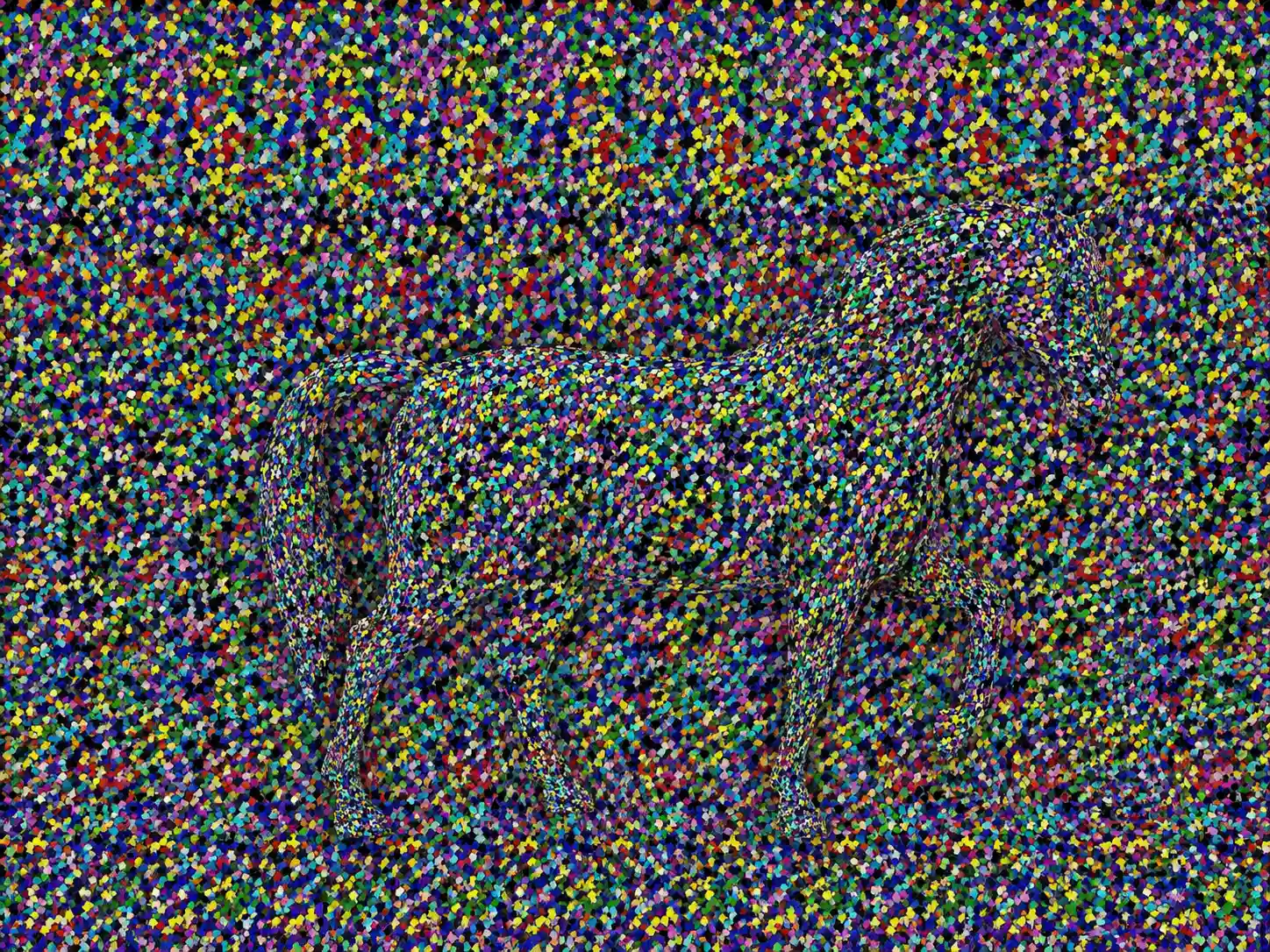
What you're seeing
At first glance, an autostereogram is just visual noise: a repeating pattern of dots, or a seemingly random texture, tiled across the whole image with no obvious picture in it. Relax your focus the right way - either by looking "through" the page as if at something far behind it, or by deliberately crossing your eyes slightly - and, for many viewers, a hidden shape suddenly rises up out of the flat pattern in convincing three dimensions: a dolphin, a heart, a staircase, floating visibly in front of or behind the surrounding texture.
The shape isn't hidden by any kind of trick ink or special lighting - it's built entirely out of extremely small, precise horizontal shifts in the repeating pattern. Those shifts are invisible to casual inspection and mean almost nothing when you look at the image normally, using your usual way of focusing your eyes. It's only when you deliberately decouple where your eyes are pointed from where they're focused that the pattern's hidden structure becomes visible as depth.
Why it happens
Ordinary depth perception from two eyes relies on binocular disparity: because your eyes are a few centimeters apart, each one gets a very slightly different view of the world, and your brain measures the tiny horizontal offset between what the left eye sees and what the right eye sees to compute how far away things are. Closer objects produce a bigger offset between the two eyes' images; farther objects produce a smaller one. Normally, your eyes converge and focus together, pointed at and focused on the same real point in space.
An autostereogram breaks that pairing on purpose. The image is built from a repeating pattern where a hidden shape is encoded by shifting certain regions of the repeat slightly left or right compared to their neighbors - shifts far too small to notice as pattern irregularities under normal viewing. By deliberately unfocusing or crossing your eyes so that each eye locks onto a different repetition of the pattern rather than the same one, you present your brain with two views that have exactly the kind of small horizontal offset a real 3D object would produce. Your visual system, doing precisely what it always does with binocular disparity, reconstructs depth from that offset - the mechanism is completely real and completely ordinary, it's just being fed a manufactured disparity signal rather than one coming from an actual object at a different distance.
Why some people can't see it
A meaningful fraction of viewers, even after real effort, never manage to see the hidden shape. This isn't usually a flaw in the artwork; it more often reflects genuine differences in binocular vision - anyone with reduced stereo vision, whether from amblyopia ("lazy eye"), strabismus, or simply less practice decoupling eye convergence from eye focus, may find the depth effect faint, fleeting, or entirely absent. Learning to see one at all is also a real, trainable skill: most first-time viewers need multiple attempts, and deliberately practicing the "look through the page" technique on an easy, low-detail example first tends to help far more than attempting a dense, detailed one right away.
A little history
The underlying science traces to Hungarian-American vision researcher Béla Julesz, who in 1959 developed random-dot stereograms - image pairs, one for each eye, that revealed hidden shapes only when viewed stereoscopically and contained no monocular cue to the shape at all, since each individual image genuinely looked like pure random noise on its own. Julesz used the technique as a rigorous tool for studying stereopsis without contamination from other depth cues like shading or outline. The single-image format most people know today, where both "eyes'" information is folded into one repeating pattern rather than a stereo pair, was popularized commercially in the early 1990s under the "Magic Eye" brand, developed by Tom Baccei together with artists including Cheri Smith, and it became a genuine pop-culture phenomenon, appearing in bestselling books, posters, and newspaper strips throughout the decade.
Related reading
Autostereograms manufacture depth using genuine binocular disparity, which makes an interesting contrast with chromostereopsis, where perceived depth comes from color and optics rather than deliberate pattern shifts. Both sit alongside anamorphic art and the hollow face illusion in this library's collection of manufactured-depth effects.
Read the science behind why this happens →
Related illusions
 Depth
Depth
Chromostereopsis (Color Depth Illusion)
Flat patches of saturated red and blue, printed at the exact same distance from your eye, can appear to float at different depths purely because of how your eye focuses different wavelengths of light.
 Depth
Depth
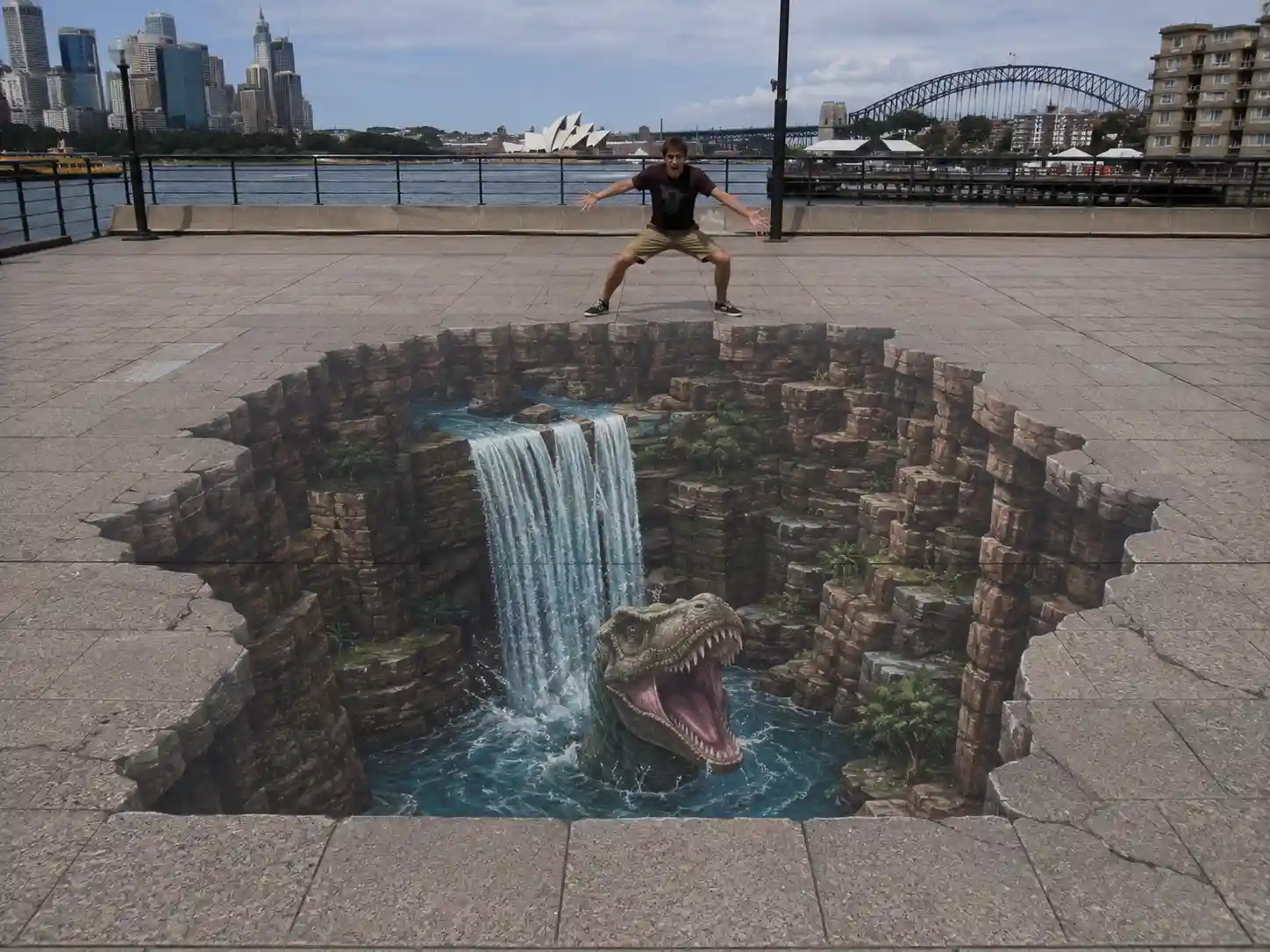
Anamorphic Chalk and Street Art Illusions
Street and chalk paintings drawn as heavily stretched, warped shapes that only resolve into a convincing 3D scene when viewed from one specific, carefully calculated angle.
 Depth
Depth
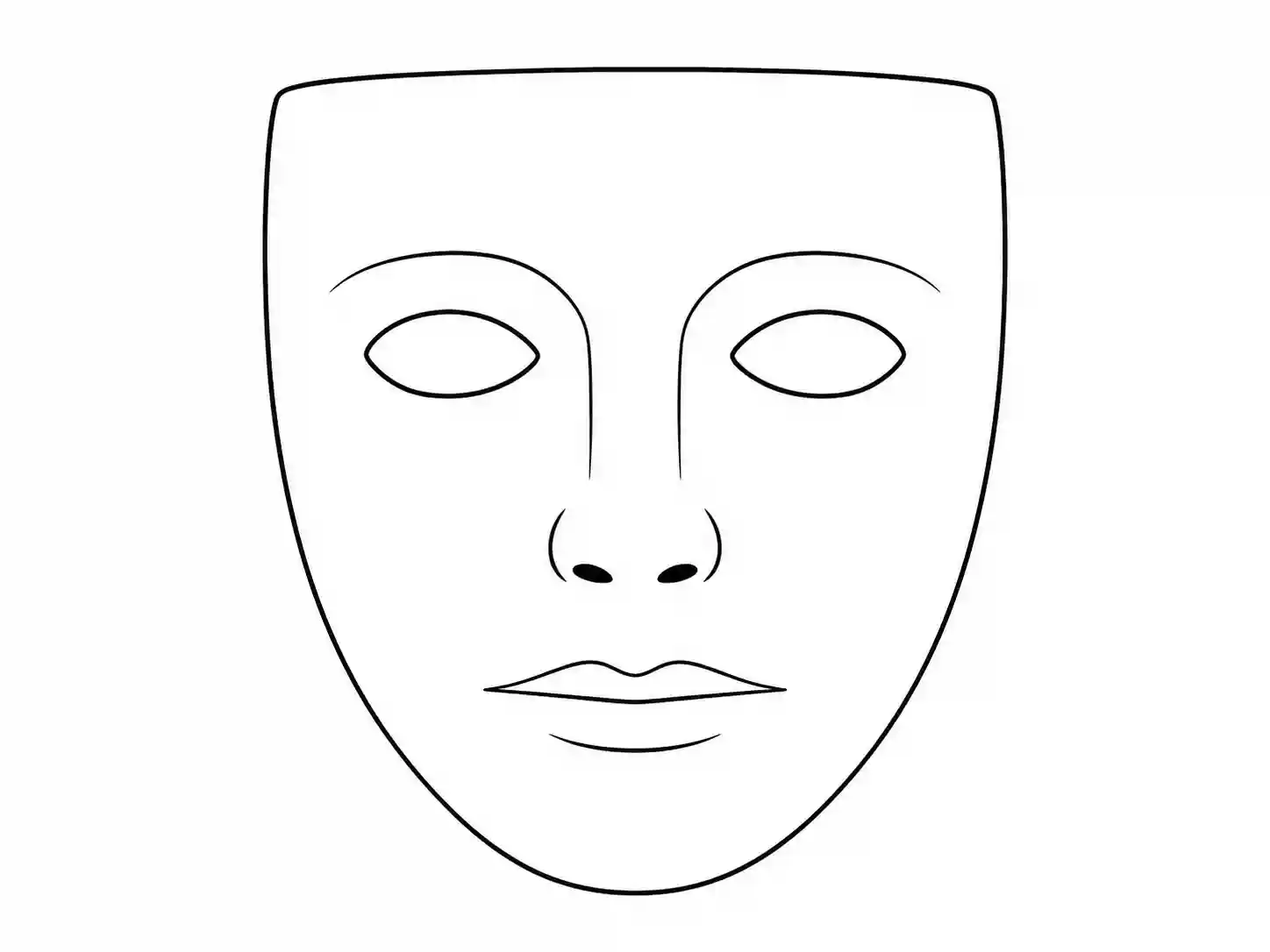
Hollow Face Illusion
A mask or model of a face, viewed from the concave (inside-out) side, still appears to bulge outward as a normal convex face - and even seems to turn and follow you as you move.