 Optical Wonderful
Kanizsa Triangle
Three notched circles, arranged just so, produce a bright white triangle with crisp edges - even though no triangle is actually drawn anywhere in the image.
What you're seeing
Three black circles, each with a wedge cut out of it like a Pac-Man mouth, are arranged with their missing wedges all pointing roughly toward a shared central point. No triangle is drawn anywhere in the figure - there are only three notched circles and, usually, three thin corner brackets sitting behind them. And yet what you perceive is an equilateral triangle sitting on top of the circles: a shape with straight, sharp edges and a surface that looks noticeably brighter than the page around it, as if it were a solid object lit from the front, floating above the three circles and partially covering them.
Look closely at the "edges" of that triangle and there's nothing there. No line, no change in pixel value, no gradient. Zoom in on a screenshot and the boundary you were certain you saw simply isn't in the file. This is one of the few illusions where the missing content - a shape and a brightness difference that exist nowhere in the physical image - is the entire point.
Why it happens
Psychologists call the triangle's edges illusory contours (or subjective contours): boundaries that your visual system constructs and then treats exactly like real, physically present edges, down to the fact that the "triangle" region typically looks brighter, not just outlined. The effect comes from a Gestalt process called modal completion - a close cousin of amodal completion, the mechanism that lets you correctly perceive a cat as a single continuous animal even when a fence post partially blocks your view of its middle. Both rely on the same occlusion logic: your visual system routinely infers that one object is occluding part of another and fills in the hidden portion, because objects in the real world don't have holes that exactly match the silhouette of whatever's in front of them. But where amodal completion fills in a portion you never actually see, modal completion - the process at work here - manufactures a portion you do see: real, visible contours and a real, visible brightness boost, floating in front of the circles rather than hidden behind them.
The Kanizsa figure sets up exactly the conditions that trigger that inference: each notch in each circle looks, locally, like it could be a circle that's being partially covered by something else - and if that "something else" is the same shape and orientation in all three places, the simplest explanation covering all three notches at once is a single triangular object sitting on top of all three circles. Your brain doesn't just infer the triangle's presence abstractly; it actively constructs the missing edges and boosts the perceived brightness of the enclosed region, because a genuinely opaque object occluding a plain background usually does contrast a bit with what's behind it. None of that inference is optional or something you can switch off by knowing how it works - the illusory contours and brightness boost persist even when you're told, in advance, exactly what's really in the image.
A closer relative: figure and ground
The Kanizsa triangle is often grouped with figure-ground illusions like Rubin's vase, and the connection is real, though the two work a little differently. Rubin's vase asks your brain to decide which of two regions is the object and which is the background, flipping back and forth between two equally valid readings of a boundary that's actually drawn on the page. The Kanizsa triangle skips that negotiation entirely - there's no ambiguity about which region is the "figure," because your brain has already manufactured a figure that isn't in the file to begin with.
A little history
Italian psychologist Gaetano Kanizsa introduced the illusory-triangle figure in 1955, as part of a broader research program into how much of what we see is actively constructed by the visual system rather than passively received from it. The Kanizsa triangle became one of the most-cited stimuli in Gestalt and later cognitive-neuroscience research, and it's proved unusually durable in brain-imaging studies: recordings from the visual cortex show neurons responding to the illusory edges of a Kanizsa figure in ways strikingly similar to how they respond to real, physically drawn edges - direct physiological evidence that the "edge" your brain reports isn't a metaphor, it's a genuine signal being generated where no contrast in the image exists.
Related reading
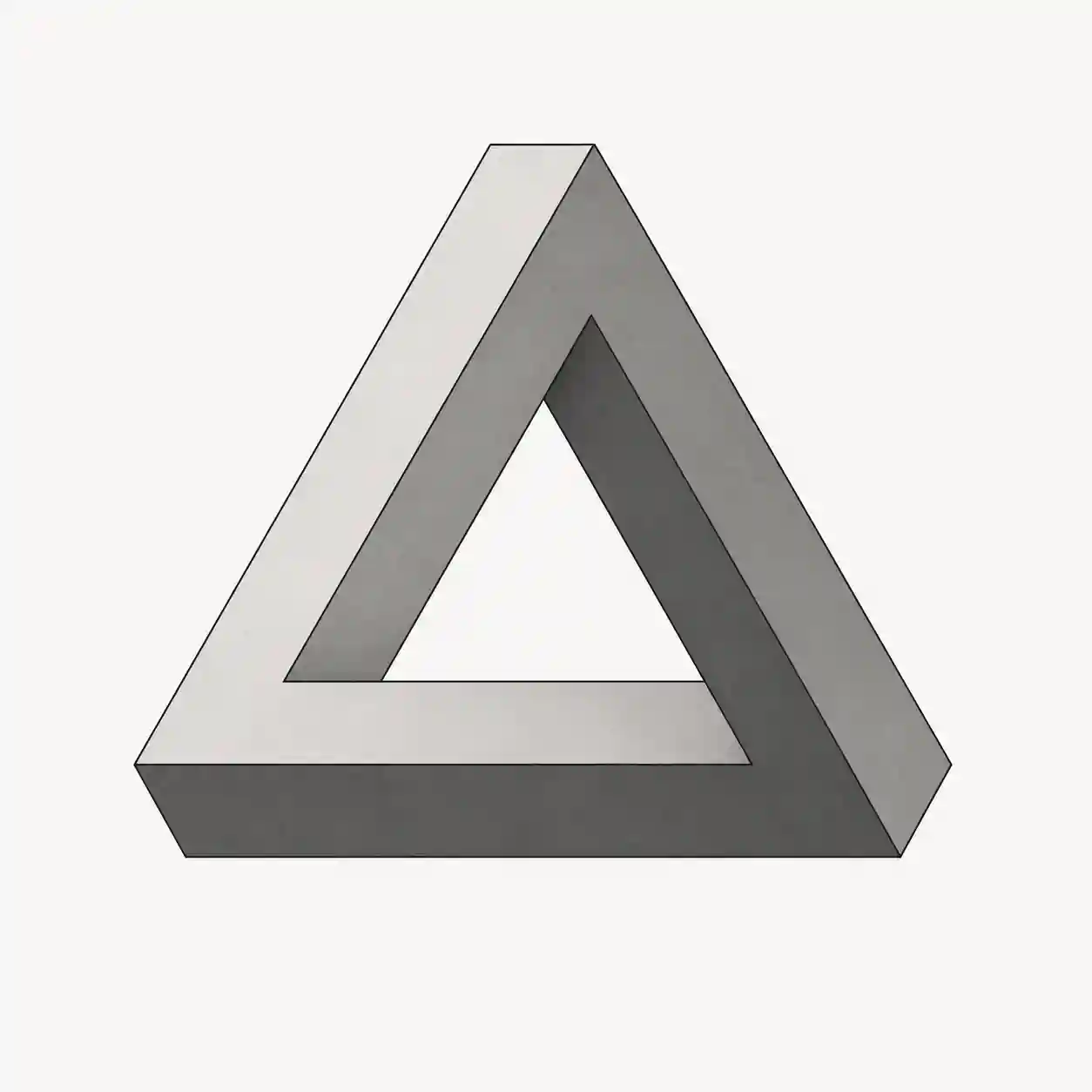
For a different kind of figure-ground negotiation, see Rubin's vase, and for another illusion built from locally valid pieces assembled into a single unified - if here, imaginary - object, see the Penrose triangle. The Necker cube shows the same "brain imposes structure" idea running in a completely different direction.
Read the science behind why this happens →
Related illusions
Rubin's Vase (Face/Vase Illusion)
A single black-and-white silhouette that reads either as a vase or as two faces in profile, depending entirely on which region your brain currently treats as the object.
AmbiguousNecker Cube
A simple wireframe cube with no shading or perspective cues, which your brain reads as three-dimensional in two different - and equally valid - ways.
 Geometric
Penrose Triangle
A closed loop of three beams that each look like an ordinary 3D bar in isolation, yet together describe an object that cannot exist in three dimensions.