 Optical Wonderful
Motion Aftereffect (Waterfall Illusion)
Stare at flowing water or a spinning pattern for half a minute, then look at something still - and the stationary scene will appear to drift in the opposite direction for a few seconds.

What you're seeing
Watch water pour steadily down a waterfall - or, in the modern version, a spiral or set of stripes scrolling in one direction on a screen - for around 30 seconds without letting your eyes wander. Then shift your gaze to a stationary surface: the rocks beside the falls, a plain wall, anything that isn't moving. For a few seconds, that motionless surface will appear to drift upward, or outward, or otherwise slide in the opposite direction from the motion you were just watching, even though you can plainly see it isn't actually going anywhere. The drifting sensation fades on its own, typically within five to twenty seconds, leaving the scene looking normal again.
Why staring at motion warps what comes next
Your visual cortex contains neurons specifically tuned to detect motion in a particular direction - some fire preferentially for "leftward," others for "downward," and so on, across the full range of directions. Normally, competing populations of these directional neurons roughly balance each other out when you look at something stationary, and the net signal reads as "no motion." Watching sustained motion in one direction for an extended period selectively fatigues the neurons tuned to that direction, a process called neural adaptation - essentially the same kind of "getting used to it and firing less" response that lets your nose stop smelling a scent after enough exposure. When you then look at a still scene, the fatigued "downward-motion" neurons (to keep the waterfall example) are firing weaker than usual, while the neurons tuned to the opposite direction are still firing at their normal baseline. That imbalance, rather than reading as "no motion," gets interpreted by the brain as motion in the opposite direction - an illusory drift the visual system essentially invents to correct for its own temporarily lopsided internal signal.
Why it wears off
As soon as you stop viewing the adapting motion, the fatigued neurons begin recovering, and the balance between opposing-direction detectors gradually returns to normal. That recovery is exactly why the illusory drift always fades rather than persisting - it's a temporary imbalance correcting itself, not a lasting change to how you see. Longer or faster adapting motion tends to produce a stronger and longer-lasting aftereffect, up to a point, which is consistent with the neural-fatigue explanation: more sustained firing in one direction means more neurons need to recover.
An illusion that predates modern neuroscience by over a century
What makes the motion aftereffect unusual among illusions on this site is how early it was documented relative to any understanding of neurons at all. Descriptions of motion-adaptation effects go back as far as Aristotle's writings on perception in antiquity, long before anyone had a mechanism to propose. The effect entered the modern scientific record in 1834, when Scottish scientist Robert Addams described it formally after watching the Falls of Foyers in Scotland and then noticing the surrounding rocks appeared to creep upward once he looked away from the falling water. That's why the phenomenon carries "waterfall illusion" as an enduring nickname even though today it's studied almost entirely using rotating spirals, scrolling gratings, and other lab-controlled stimuli rather than actual waterfalls.
Why it matters beyond the party trick
Beyond being a striking personal demonstration, the motion aftereffect has been a genuinely useful research tool. Because the strength and duration of the aftereffect can be measured precisely, it gives vision scientists a behavioral window into how directionally tuned motion neurons adapt, recover, and interact - evidence that has fed directly into broader models of how the visual cortex encodes motion generally, well beyond this one illusion.
Related reading
The waterfall illusion belongs to the same broader family of motion-processing quirks as the rotating snakes illusion and the peripheral drift illusion, though unlike those two, the motion aftereffect requires genuine physical motion to trigger it - it's the comedown, not the trick itself.
Read the science behind why this happens →
Related illusions
 Motion
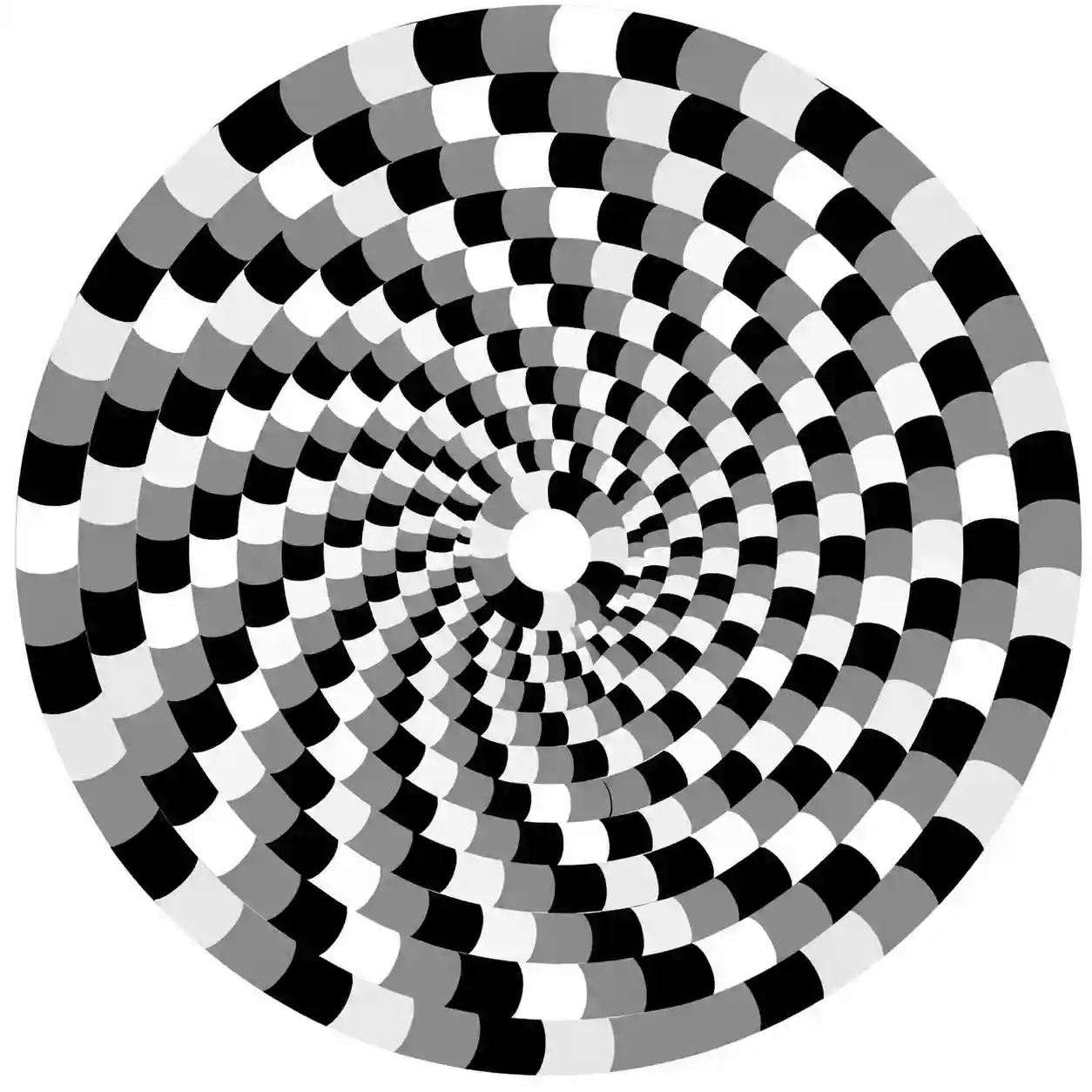
Rotating Snakes Illusion
A completely still image built from repeating rings of asymmetric color gradients that appears to writhe and rotate on its own - one of the strongest static-image motion illusions known.
 Motion
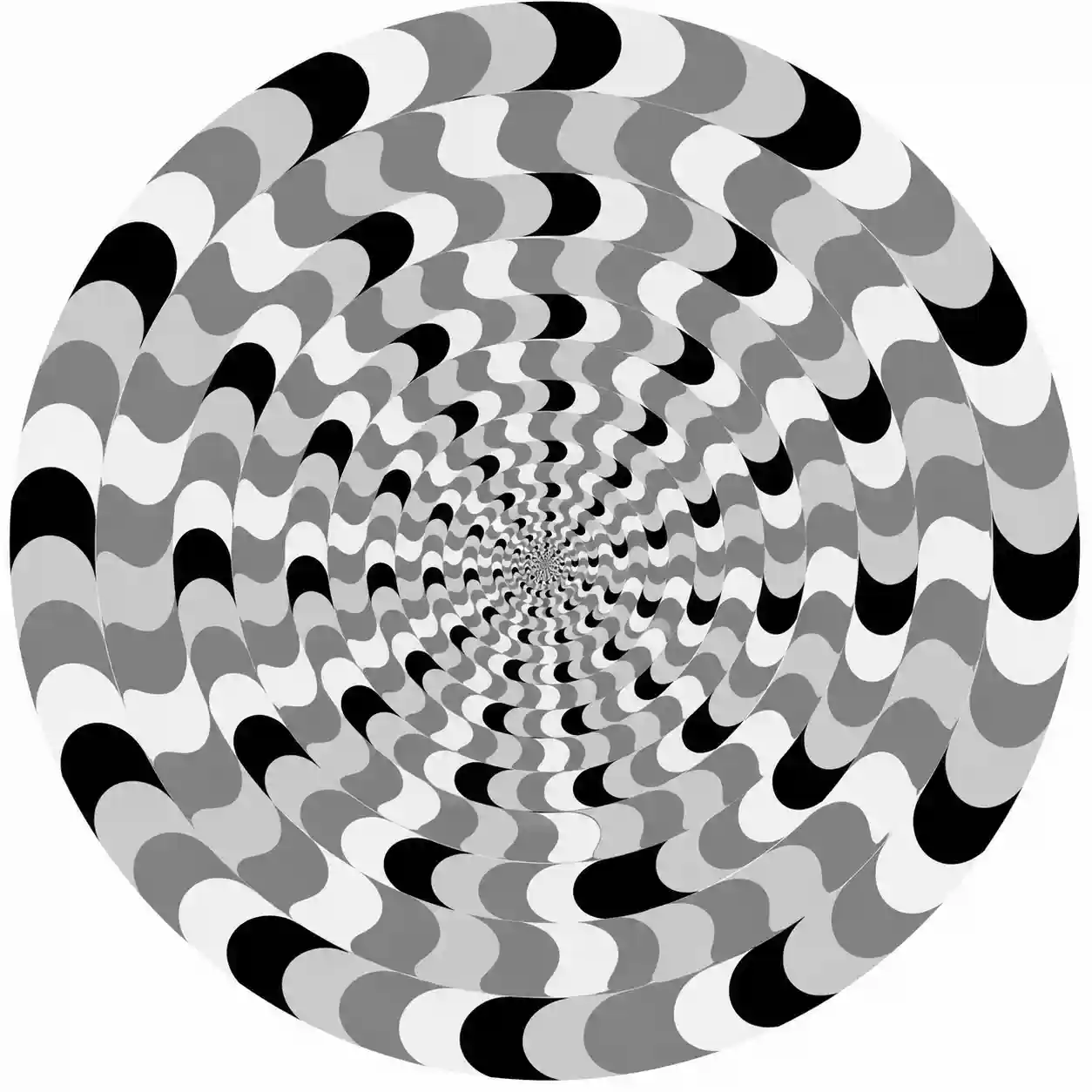
Peripheral Drift Illusion
A broad category of static repeating patterns that appear to drift or shimmer whenever they sit outside the direct focus of your gaze, thanks to asymmetric brightness gradients.
MotionBarber Pole Illusion
The diagonal stripes on a barber's pole appear to travel upward forever, even though they're only ever rotating sideways around a cylinder - a classic case of the visual system solving an ambiguous motion problem badly.