 Optical Wonderful
Roger and Lionel Penrose
The father-and-son pair - a psychiatrist and a mathematical physicist - who formally introduced the impossible triangle and impossible staircase to the scientific literature in 1958.
Two very different careers, one shared paper
Lionel Penrose (1898–1972) was a British psychiatrist and human geneticist, one of the founding figures of modern medical genetics and a longtime professor at University College London, where his research focused on the genetic basis of intellectual disability. His son, Roger Penrose (born 1931), took a very different path, becoming a mathematical physicist whose later career would include foundational work on general relativity and black holes - work for which he was awarded a share of the 2020 Nobel Prize in Physics, alongside Reinhard Genzel and Andrea Ghez.
Despite these very different specialties, father and son shared an interest in geometric puzzles, and in 1958 they co-authored a short paper in the British Journal of Psychology titled "Impossible Objects: A Special Type of Visual Illusion." That paper introduced two figures that have since become the most recognizable "impossible objects" in visual science: the triangle now generally known as the Penrose triangle, and the endless staircase now known as the Penrose stairs.
The triangle and the stairs
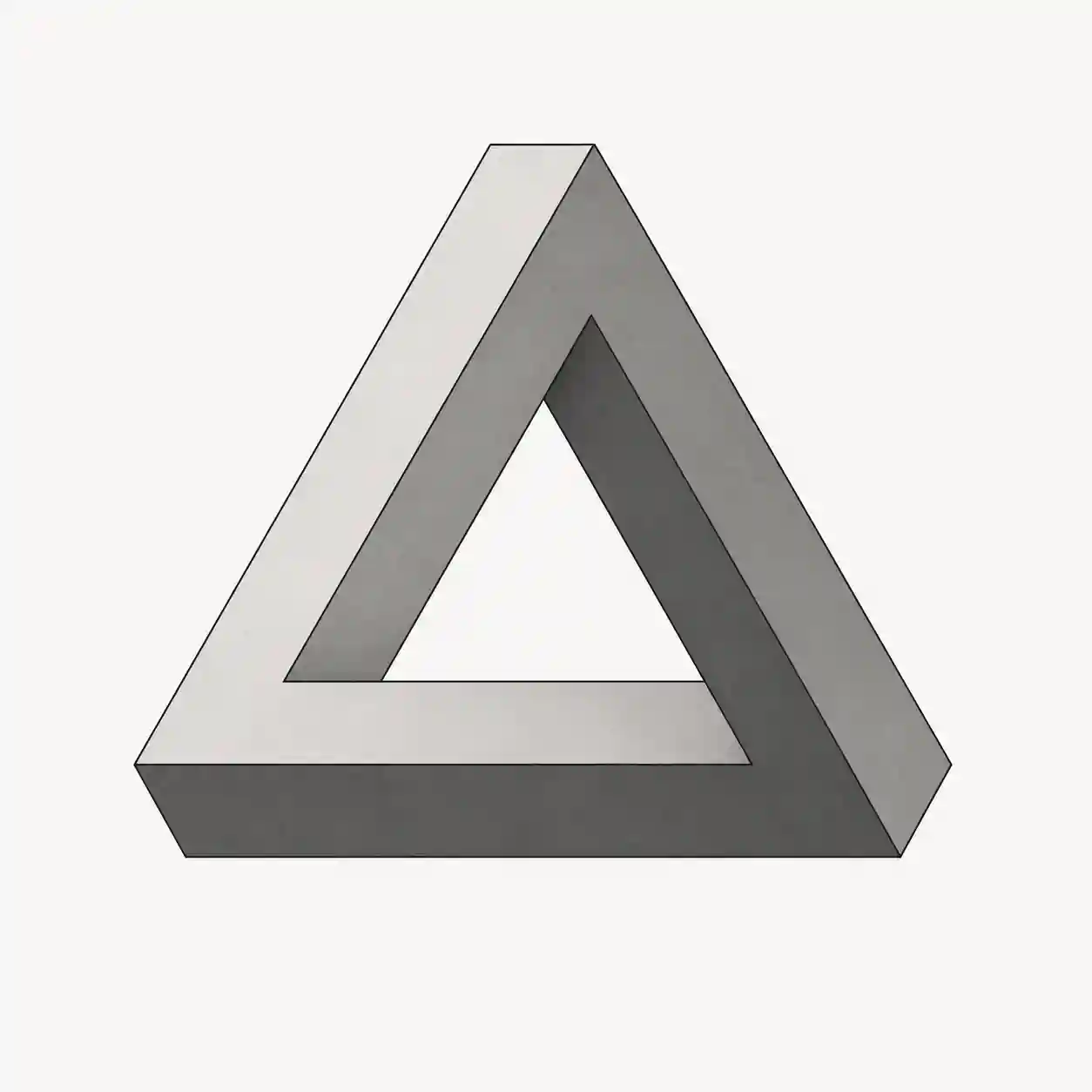
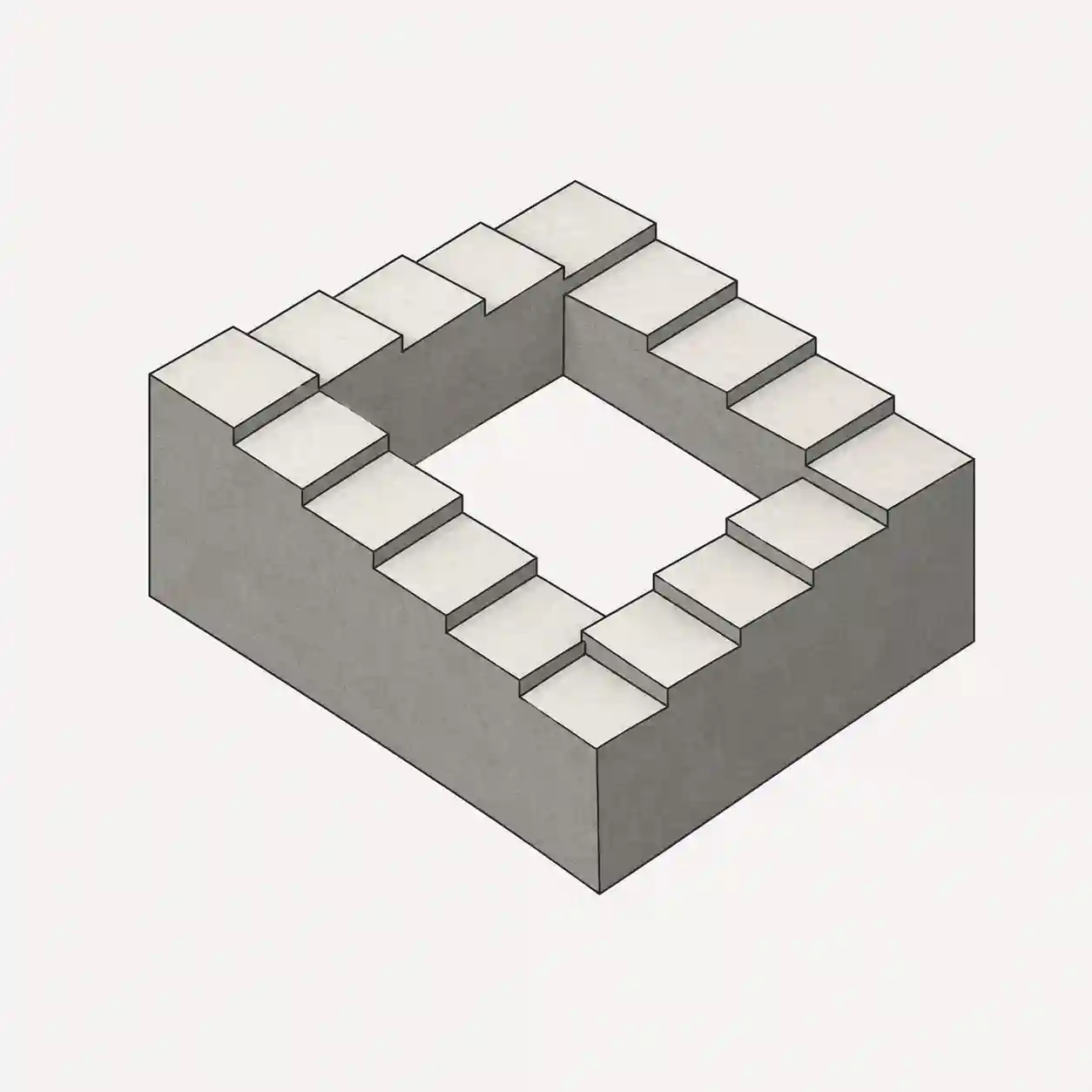
The Penrose triangle is built from three beams, each meeting the next at a locally plausible right angle, arranged so the whole structure appears to form a closed triangular loop - a shape that is fully consistent at every individual joint but cannot exist as a real three-dimensional object, since following the beams around always produces a net change in depth that never returns to zero. The Penrose stairs apply the same principle to a staircase: a closed loop of steps that appears to climb continuously in one direction - clockwise or counterclockwise - while never gaining any actual net height, so that a figure could, in principle, walk "up" the stairs forever and end up back where it started.
Unbeknownst to the Penroses at the time, the essential triangle figure had already been sketched decades earlier by Swedish artist Oscar Reutersvärd in 1934, apparently as an independent discovery in each case. What set the Penroses' contribution apart, and what secured its place in the psychological literature, was less the drawing itself than the analysis around it: their paper treated the figure as a case study in how the visual system infers three-dimensional structure from two-dimensional cues, and it explicitly discussed how such figures could be used to probe the assumptions perception makes when resolving depth from a flat image.
The paper also directly reached the artist M.C. Escher, who read it and corresponded with the Penroses; the impossible triangle and staircase went on to become the geometric skeleton for two of his most famous lithographs, Waterfall (1961) and Ascending and Descending (1960), which brought the Penroses' formal, academic figures to a vastly wider public than a psychology journal ever could have reached on its own.
Why it matters to illusion research
The Penrose paper is a landmark not because it introduced a wholly new visual trick, but because it gave a name, a rigorous description, and a scientific framing to a category of illusion - the impossible object - that has since become a standard tool for studying depth perception, local-versus-global processing in vision, and the assumptions the visual system makes when it reconstructs three-dimensional structure from flat, ambiguous line drawings. The Penrose triangle and stairs remain two of the most reproduced figures in perception textbooks, design, and popular culture, cited as often as the checkerboard illusions and geometric distortions that dominate the rest of the field.
Illusions connected to Roger and Lionel Penrose
 Geometric
Penrose Triangle
A closed loop of three beams that each look like an ordinary 3D bar in isolation, yet together describe an object that cannot exist in three dimensions.
 Geometric
Penrose Stairs (The Impossible Staircase)
A staircase drawn so that each flight climbs upward into the next, all the way around a closed loop, with no floor that is ever the lowest or the highest.